






Definition & Meaning
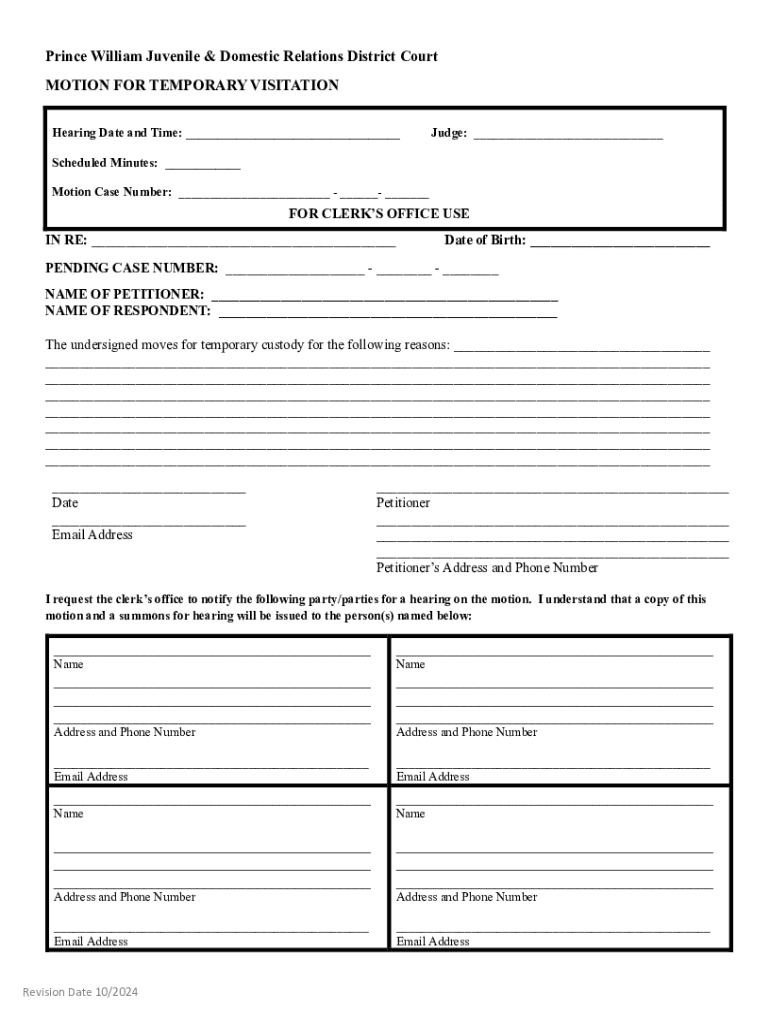
A Motion for Temporary Visitation is a legal request submitted to a court to establish temporary visitation rights for a non-custodial parent or other party. This motion is commonly filed in family law cases to ensure that visitation arrangements are in place while a more permanent custody order is pending. This legal tool is designed to protect the best interests of the child by allowing contact with both parents or guardians during ongoing legal proceedings.
How to Use the Motion for Temporary Visitation
To effectively use a Motion for Temporary Visitation, the petitioner must complete the form with accurate and thorough information. The motion should clearly outline the reasons for requesting temporary visitation, emphasizing how it serves the child's best interest. Providing specific visitation schedules and any conditions for visitation is essential. Additionally, the petitioner must consider consulting with a family attorney to ensure that the motion complies with local court rules and standards.
Steps to Complete the Motion for Temporary Visitation
- Obtain the appropriate motion form, which can be found online or at local court offices.
- Fill in basic information such as the case number, court details, and names of the involved parties.
- Narratively detail the reasons for requesting temporary visitation, focusing on child welfare.
- Specify the desired visitation schedule and any necessary conditions or limitations.
- Attach any required documentation, such as previous court orders or agreements.
- Review the completed form for accuracy and completeness.
- Submit the motion to the appropriate court and serve copies to all involved parties.
Key Elements of the Motion for Temporary Visitation
- Petitioner's Information: Includes name, contact information, and relation to the child.
- Respondent's Information: Details of the other parent or guardian involved in the case.
- Case Information: Includes court name, case number, and judge's name.
- Visitation Schedule: Proposed days, times, and duration of visits.
- Supporting Reasons: Explain why the temporary visitation is in the child's best interests.
- Attachments: Any documentation supporting the motion, such as evidence of relationship with the child or previous agreements.
Legal Use of the Motion for Temporary Visitation
The motion is primarily used when there is an immediate need for a visitation arrangement during divorce or separation proceedings. It helps to establish temporary guidelines that ensure continued contact between the child and the non-custodial parent. Courts assess the motion based on legal standards, including the child's educational, emotional, and physical needs. The motion should not be used frivolously, as it must align with existing laws and the child's welfare.
State-Specific Rules for the Motion for Temporary Visitation
Each U.S. state has specific statutes and rules governing family law cases, including temporary visitation motions. For instance, some states may require mediation or recommend parenting classes as part of the visitation process. Petitioners should research their specific state's legal requirements or consult with a local attorney to ensure full compliance and increase the likelihood of a favorable outcome.
Required Documents
When filing a Motion for Temporary Visitation, certain documents must accompany the motion, including:
- Child's Birth Certificate: Confirms parentage or legal guardianship.
- Existing Custody Orders: Any currently active orders that relate to the child's custody or visitation.
- Evidence of Relationship: Documents supporting the petitioner's relationship with the child, such as photos or communication records.
- Proof of Address: Verifies the petitioner's residence in relation to jurisdiction requirements.
Form Submission Methods (Online / Mail / In-Person)
Submitting a Motion for Temporary Visitation can be done through various methods depending on the court's facilities:
- Online: Some courts offer electronic filing systems where forms can be submitted and served digitally.
- Mail: Forms can be sent to the court through certified mail to ensure receipt.
- In-Person: Direct submission at the courthouse, allowing for immediate processing and feedback on any filing errors.
Understanding the court's preference for submission methods is critical for timely processing of the motion.