
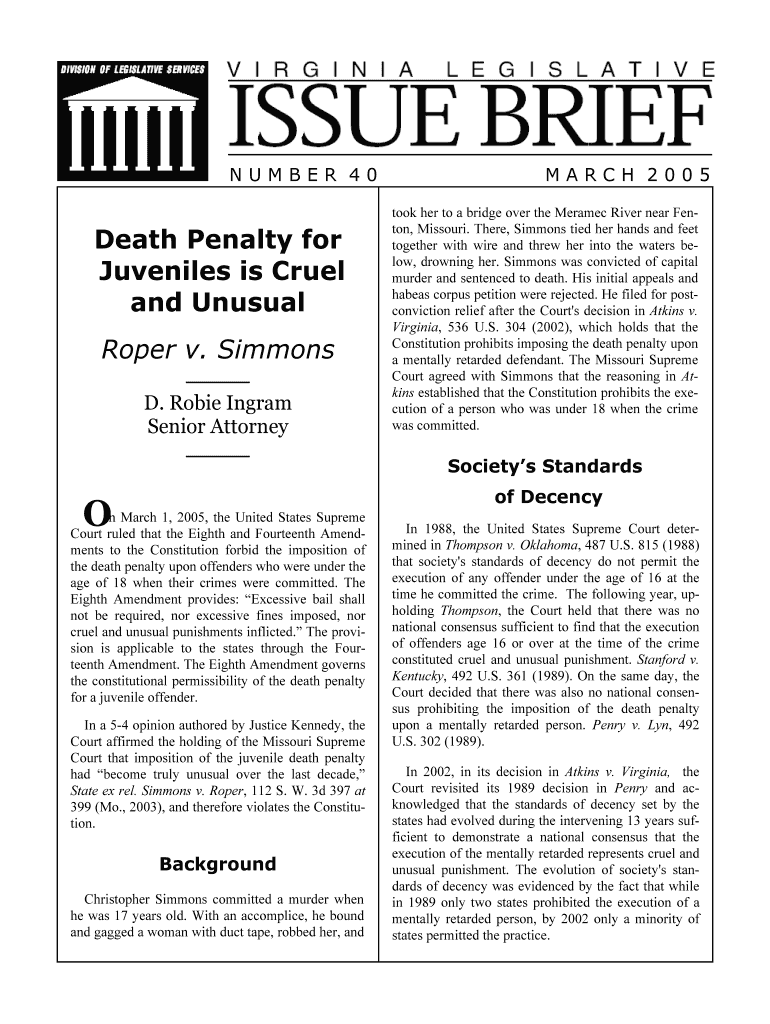







Definition and Meaning
The term "Death Penalty for" is often used in contexts related to the administration of capital punishment for specific offenses. It refers to the legal process where a person is sentenced to death by the state as a punishment for a crime. This concept is deeply rooted in the U.S. legal system, where it is reserved for the most serious offenses, typically capital offenses. It embodies a complex interplay of legal, moral, and social considerations.
Understanding the Context
The death penalty has historically been applied to crimes such as murder, espionage, and treason. Its usage varies significantly across the United States, with some states having abolished it, while others continue to uphold its practice. Over time, legal precedents, such as Roper v. Simmons, have influenced the boundaries of its application, underscoring the evolving nature of legal standards.
Legal Use of the Death Penalty for
In the U.S., the death penalty is a judicial process that follows a legal trial, where the accused is convicted of a capital crime. This punishment is grounded in both state and federal laws, with procedures carefully outlined to ensure fairness and constitutional protections.
Federal and State Laws
The federal government and 24 states currently maintain capital punishment statutes. Legal use is tightly regulated by the Constitution, Supreme Court rulings, and state-specific legislation. The Eighth Amendment prohibits cruel and unusual punishments, setting a legal benchmark for humane application.
Legal Precedents
Significant legal cases, such as Furman v. Georgia and Gregg v. Georgia, have shaped the modern landscape of capital punishment, influencing factors like jury decision-making, appellate processes, and the moral imperative to ensure justice and avoid wrongful convictions.
Key Elements of the Death Penalty for
Several crucial elements are involved in the administration of the death penalty, ranging from legal trials to the appeals process.
Key Procedures
- Trial and Sentencing: Legal proceedings begin with a trial, where evidence is presented, and the guilt of the accused is determined.
- Appeals Process: The convicted individual can appeal their sentence to higher courts, potentially reaching the Supreme Court.
- Execution: If appeals are exhausted, the execution is carried out according to the protocols established by the governing jurisdiction.
Role of Mitigating and Aggravating Factors
During sentencing, juries or judges consider mitigating and aggravating factors, such as the defendant's mental health, age, and the crime's circumstances, to decide on imposing a death sentence.
Important Terms Related to Death Penalty for
Several terms and concepts are intricately linked to the discourse on the death penalty, serving as critical identifiers in legal discussions.
Common Terms
- Capital Offense: A crime that is punishable by death.
- Clemency: A legal reprieve granted to a death row inmate, potentially commuting the sentence to life imprisonment.
- Stay of Execution: A court order that temporarily halts an execution, often pending further review or appeal.
State-Specific Rules for the Death Penalty for
Rules governing the death penalty can vary widely from state to state. Understanding these differences is crucial for grasping the application of capital punishment in the U.S.
State Variations
- Abolishment: Some states, like New York and New Jersey, have abolished the death penalty.
- Execution Methods: Various states permit different methods, such as lethal injection, electric chair, or firing squad.
Regulatory Disparities
These state-specific rules reflect broader societal values and legal frameworks within each jurisdiction, contributing to the fluctuating landscape of capital punishment across the country.
Examples of Using the Death Penalty for
Examples provide insight into how the death penalty is applied in real-world scenarios, often highlighting the complexities involved in legal judgments.
Notable Cases
- Roper v. Simmons: The landmark case that deemed executing juveniles unconstitutional.
- Atkins v. Virginia: Established that executing individuals with intellectual disabilities is prohibited.
Practical Implications
These cases demonstrate the intricate adjudication processes and moral considerations involved, illustrating the overarching influence of legal precedents on current practices.
Steps to Complete the Death Penalty for
Navigating the legal nuances of capital punishment requires a thorough understanding of procedural steps from conviction to execution.
Typical Procedural Steps
- Indictment and Arrest: Begins with formal charges and detainment of the accused.
- Legal Trial: A courtroom process where guilt is determined.
- Sentencing Phase: Considers factors influencing the death penalty decision.
- Appeals and Clemency: Reviews opportunities and extraordinary relief options available post-sentencing.
- Final Review and Execution: Execution occurs if appeals are exhausted, following rigorous procedural standards.
Significance of Due Process
Ensuring due process through each step is fundamental to maintaining legal and ethical integrity, reducing the potential for miscarriages of justice.
Penalties for Non-Compliance
Failing to adhere to legal protocols in administering the death penalty can result in serious legal repercussions.
Legal Consequences
- Appeals: Errors in the handling of death penalty cases can lead to overturned convictions.
- Federal Oversight: Non-compliance can invite federal scrutiny and potential sanctions.
Importance of Compliance
Adhering to established protocols ensures justice and validity in capital punishment proceedings, ultimately upholding the legal system's integrity.
Why Should You Consider Death Penalty for (Debate Perspective)
The discussion around the death penalty is fraught with ethical, legal, and societal debates, each offering compelling arguments for consideration.
Ethical Considerations
- Deterrence: Proponents argue it serves as a deterrent against heinous crimes.
- Retribution: Viewed as a means for justice in extreme cases.
Opposition Arguments
Critics highlight the moral and ethical dilemmas, pointing out the risk of wrongful convictions and the debate over moral authority. The discourse remains a pivotal point of contention in shaping U.S. legal policies.




