
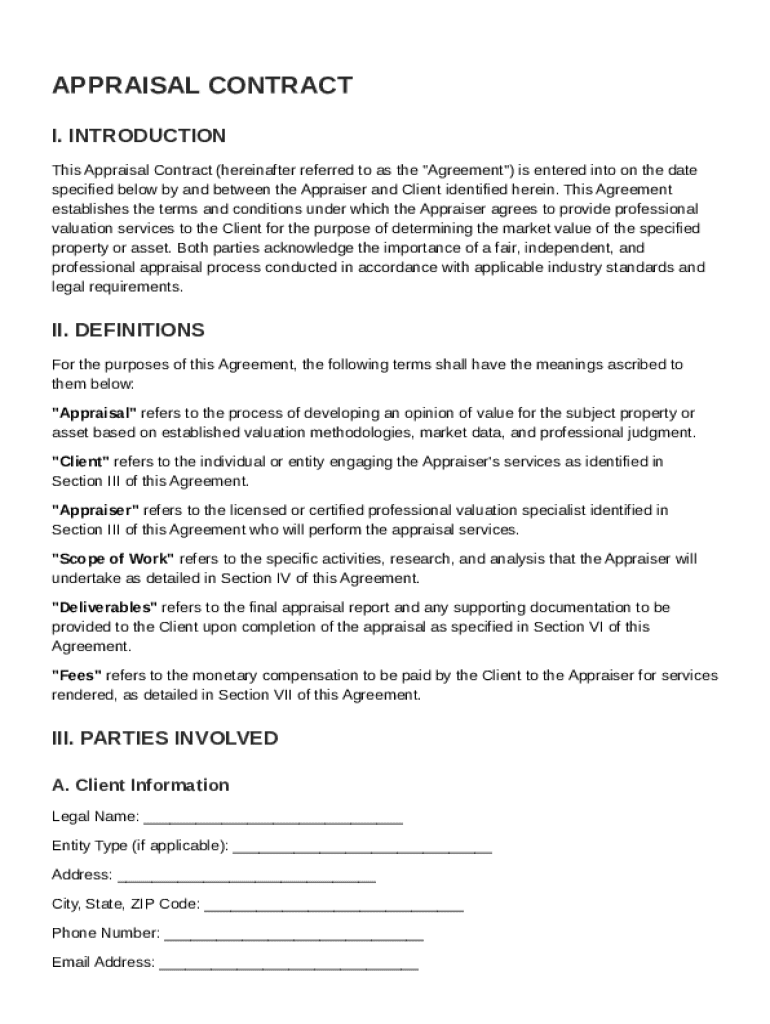







Definition and Purpose of the Appraisal Contract Template
The Appraisal Contract Template serves as a foundational agreement between an appraiser and a client seeking professional valuation services. This document outlines the responsibilities and expectations of both parties to facilitate a transparent appraisal process. At its core, the contract defines essential terms such as the scope of work, appraisal processes employed, expected deliverables, and confidentiality obligations. The template aids in formalizing the business relationship, ensuring all parties comprehend their roles and obligations.
Practical Application
- Scope of Work: Clearly details the specific property or asset to be appraised, including methodology and standards for appraisal.
- Parties Involved: Identifies and provides contact information for both the appraiser and the client.
- Industry Standards: Ensures evaluations comply with relevant governing laws and industry benchmarks.
Key Elements of the Appraisal Contract Template
This template consists of several crucial elements that contribute to a comprehensive appraisal agreement. Understanding these elements enables users to customize the document effectively according to specific needs and requirements.
Components Breakdown
- Appraisal Process: Describes the methods and procedures the appraiser will follow to determine the asset's market value.
- Deliverables: Specifies the format and nature of the reported findings.
- Fees and Payment Terms: Provides a detailed breakdown of costs associated with the service, including expense reimbursements.
- Liability Limitations: Outlines the appraiser’s limited liability in cases where valuation outcomes deviate due to unforeseen market changes.
Steps to Complete the Appraisal Contract Template
Filling out the template involves several structured steps to ensure accuracy and compliance with legal standards. Each step fortifies the document's effectiveness and legality.
Checklist for Completion
- Identify Parties: Include full names, addresses, and contact details for both the client and the appraiser.
- Define Scope: Clearly articulate the property details and the specific appraisal services to be delivered.
- Outline Timelines: Set deadlines for appraisal delivery and specify the duration of the contract's validity.
- Establish Fees: Confirm the agreed-upon payment structure, including any potential additional costs.
- Review Legal Obligations: Ensure all legal and industry standard references align with the state-specific requirements.
Legal Use of the Appraisal Contract Template
The legal implications of using an appraisal contract require diligent consideration to ensure compliance with federal and state regulations. The contract functions as a legal safeguard for both parties involved in the appraisal transaction.
Compliance Factors
- Governing Law: Inclusion of clauses to dictate which state’s laws govern the agreement.
- Dispute Resolution: Describes preferred methods for resolving potential conflicts, such as arbitration.
- Confidentiality Agreements: Protects sensitive information obtained during the appraisal process.
Important Terms Related to the Appraisal Contract Template
Several technical terms are integral to comprehending and utilizing this document. These terms help clarify expectations and contractual obligations.
Glossary
- Market Value: The estimated financial worth of the property, as determined through professional appraisal techniques.
- Appraisal Methods: Refers to the different techniques utilized by appraisers, such as the sales comparison approach or the income approach.
- Confidentiality: A commitment to safeguarding all proprietary information exchanged in the contract.
State-Specific Rules for the Appraisal Contract Template
The application and enforceability of appraisal contracts can vary significantly across different states. Adaptation to state-specific guidelines ensures the legality and effectiveness of the contract.
State Variations
- Licensure Requirements: Some states may mandate appraisers hold specific licenses or certifications.
- Disclosure Norms: Varying state laws may require certain disclosures about potential conflicts of interest.
- Consumer Protection Laws: Regulations that ensure clients have recourse in cases of subpar appraisal services.
Business Types That Benefit Most From the Appraisal Contract Template
Different business entities may find the appraisal contract particularly beneficial in safeguarding their interests during asset evaluations.
Beneficiary Businesses
- Real Estate Firms: Frequently require precise property valuations.
- Financial Institutions: Use appraisals for loan assessments.
- Insurance Companies: Rely on accurate appraisals to adjust premiums and coverage limits.
Examples of Using the Appraisal Contract Template
Practical examples help illustrate the application of the appraisal contract in real-world scenarios. These examples provide context and demonstrate how the contract can be tailored to meet specific circumstances.
Scenario Applications
- Home Buyers and Sellers: Utilize the contract for unbiased property valuation in real estate transactions.
- Corporate Asset Evaluation: Companies engage appraisers to determine the value of tangible and intangible assets.
- Estate Planning: Executors require detailed appraisals to properly manage and distribute estate assets among heirs.
Each section of the Appraisal Contract Template, when utilized effectively, enhances the clarity, legality, and efficiency of the valuation process, benefiting all involved parties.




