
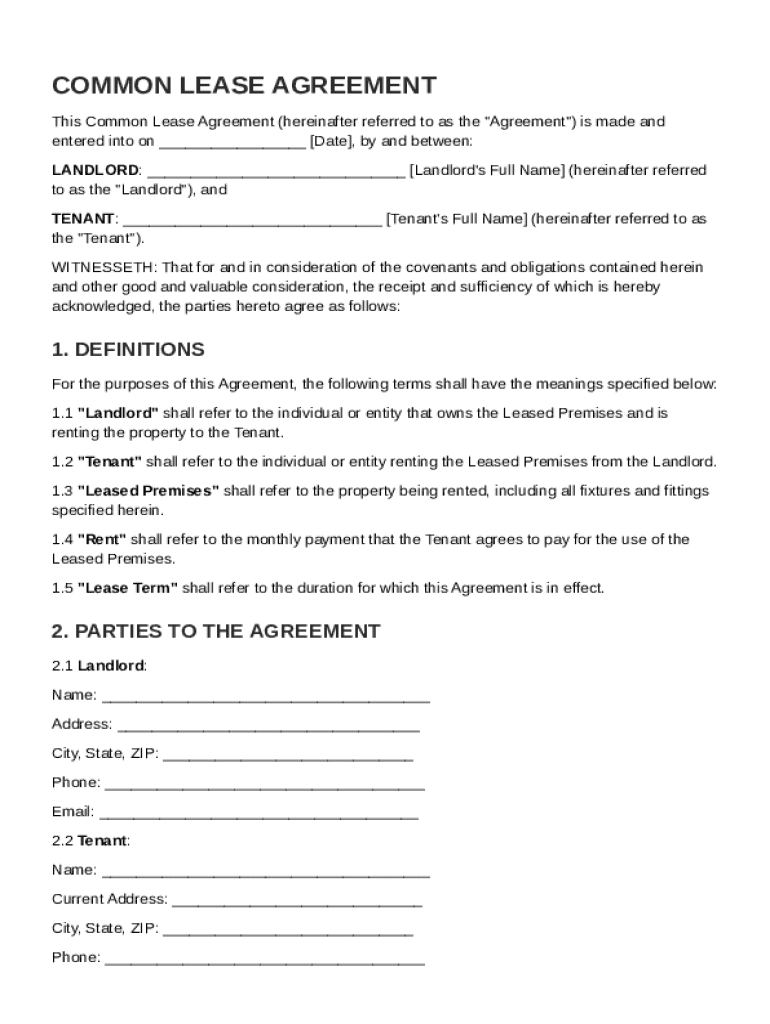







Definition & Meaning
The Common Lease Agreement Template is a standardized document used to outline the terms and conditions between a landlord and tenant for renting a residential property. This form serves as a legal contract that ensures both parties understand their rights and obligations. It typically includes detailed sections on rent payment terms, security deposit requirements, maintenance responsibilities, utilities and services included, and permitted uses of the premises. By clearly delineating these elements, the template minimizes potential disputes and provides a framework for resolving any issues that may arise.
Key Elements of the Common Lease Agreement Template
Property and Parties Involved
The cornerstone of the Common Lease Agreement Template is the identification of the property and the parties involved. This section typically includes:
- Property Description: Address and specific details of the rental unit, such as square footage, unit number, and any amenities included in the rental.
- Parties Information: Full legal names, contact details, and signatures of both the landlord and tenant. Identifying the property and parties accurately ensures clarity and legal enforceability.
Lease Term and Rent Details
A critical component is the specification of the lease term and the financial obligations:
- Lease Term: Defines the duration of the lease, noting start and end dates. It can be fixed-term, such as one year, or month-to-month.
- Rent Amount and Payment Schedule: Includes the monthly rent amount, due date, acceptable payment methods, and late fee policies. This section helps to avoid future disputes over payment terms.
Security Deposit and Maintenance
The agreement should clearly outline policies regarding security deposits and maintenance responsibilities:
- Security Deposit: Amount required, conditions for refund, and how it will be held. It ensures the tenant adheres to their responsibilities and covers potential damages.
- Maintenance Responsibilities: Divides responsibility between landlord and tenant for property upkeep, including who handles repairs and routine maintenance.
Legal Use of the Common Lease Agreement Template
Adhering to State-Specific Laws
Lease agreements must comply with specific state laws, which can significantly vary:
- Governing Law: The agreement should state the jurisdiction whose laws will govern the contract, ensuring both parties are aware of applicable legal standards.
- Termination Procedures: Specifies notice requirements and conditions under which either party can terminate the lease, aligned with state regulations.
Use as a Binding Contract
The agreement is legally binding and enforceable in court if litigation arises. Using it ensures:
- Rights Preservation: Protects the interests of both parties, providing legal recourse if necessary.
- Dispute Resolution: Offers a predefined method for resolving disputes, facilitating mediation or arbitration if specified.
Steps to Complete the Common Lease Agreement Template
Collection of Necessary Information
Prior to filling out the template, gather all pertinent details, including:
- Verification of Identification: Ensure valid IDs for both parties to confirm identity.
- Proof of Income or Employment: To verify tenant's ability to meet rent obligations, such as recent pay stubs or employment letters.
Filling Out the Document
Sequentially address each section of the template, ensuring accuracy:
- Property and Parties Details: Clearly state the landlord and tenant information and property address.
- Lease Terms: Specify lease duration and payment schedules.
- Security Deposit: Record the deposit amount and conditions for return.
- Signatures: Both landlord and tenant must sign the document, preferably in the presence of a witness or notary for added legal validity.
Review and Finalization
Once completed, review the entire document:
- Cross-Verification: Both parties should verify all entered information for accuracy.
- Final Adjustments: Make any necessary corrections to reflect the intentions of both parties before signing.
State-Specific Rules for the Common Lease Agreement Template
Variations in Legal Requirements
Different states may impose unique requirements:
- Tenant Rights: States like California and New York have stringent protections for tenant rights; ensure your lease complies with these provisions.
- Rent Control and Increases: Some states have laws governing rent control and permissible rent increases, which must be reflected in the lease agreement.
Required Disclosures
Some states require certain disclosures:
- Lead-Based Paint Disclosure: For properties built before 1978, federal law mandates landlords disclose known information about lead-based paint hazards.
Examples of Using the Common Lease Agreement Template
Case Studies
- Long-Term Rentals: A family renting a residential home for several years utilizes the template to establish a clear, long-term relationship with the landlord, avoiding month-to-month confusion.
- Roommate Situations: College students renting an apartment can use the lease to designate shared responsibilities, like splitting utility fees, reducing potential roommate disputes.
Real-World Scenarios
- Subletting Arrangements: When a tenant wishes to sublease their apartment, the original lease’s terms will guide what is permissible.
- Property Management Firms: Companies managing multiple properties standardize their leasing agreements across properties to streamline operations and ensure consistency.
By tailoring the Common Lease Agreement Template to specific needs while maintaining legal compliance, both landlords and tenants can benefit from a clear, mutually understood rental arrangement.




