




01. Edit your section 889 certification form online
Type text, add images, blackout confidential details, add comments, highlights and more.

Type text, add images, blackout confidential details, add comments, highlights and more.

Draw your signature, type it, upload its image, or use your mobile device as a signature pad.

Send 889 form fillable via email, link, or fax. You can also download it, export it or print it out.
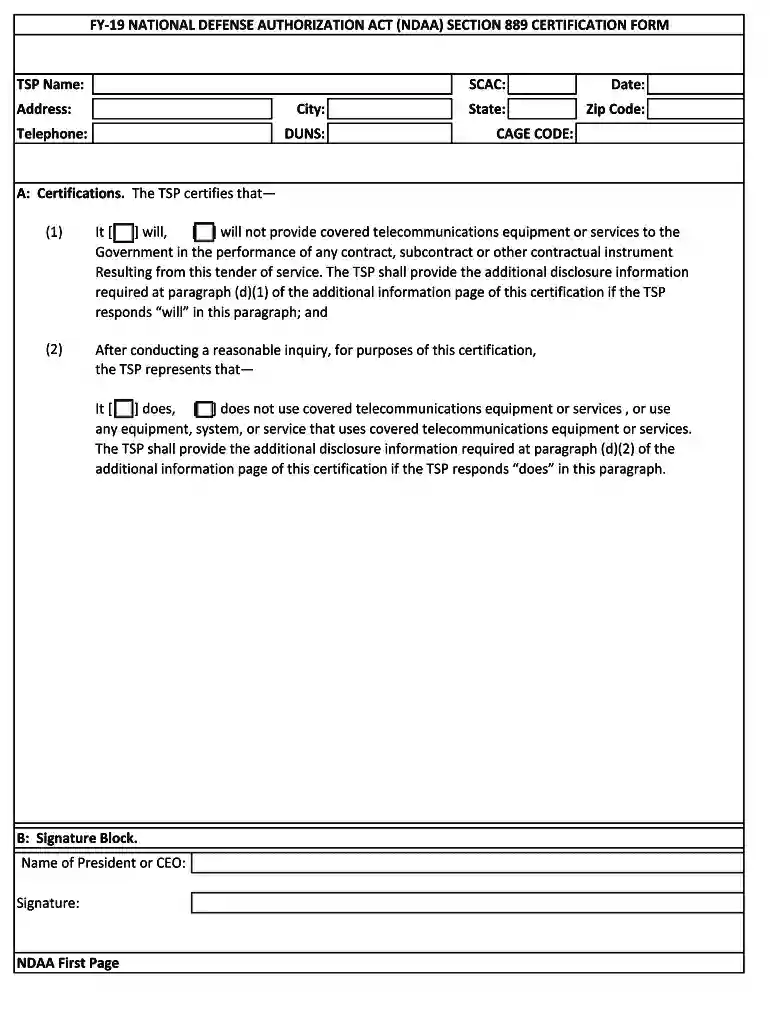
The NDAA Certification Form, specifically from the FY-19 National Defense Authorization Act Section 889, is a critical document within the U.S. legal framework that mandates compliance with specific telecommunications equipment restrictions. Its primary purpose is to ensure Transportation Service Providers (TSPs) certify whether they will or will not supply covered telecommunications equipment or services to the government. This requirement aligns with national security measures that prohibit the use of certain foreign telecommunications technologies. The form outlines necessary definitions, the nature of restricted equipment, disclosure processes, and the legal obligations for providers.
Completing the NDAA Certification Form requires meticulous attention to detail to ensure legal compliance and accuracy. Here is a step-by-step guide:
Gather Relevant Information: Collect details on any telecommunications equipment and services provided by your organization.
Evaluate Equipment and Services: Determine if any of your equipment falls under the NDAA's restricted list. Consult legal or compliance experts if necessary.
Document Preparation: Fill out the form with precise information. Include the company's name, representative details, and specific certifications regarding equipment and services.
Disclosure of Use: If applicable, provide detailed disclosures of any covered equipment or services used, including the nature and purpose of usage.
Review and Sign: Have the certifying official review the entire form for accuracy before signing. The individual must have the authority to bind the organization legally.
Submission: Submit the form according to the specified method—typically electronically via designated government submission portals or by mail.
Transportation Service Providers (TSPs) are the primary users of the NDAA Certification Form. These entities include a wide range of logistics and transport companies that provide services to U.S. government agencies. Key users encompass:


The NDAA Certification Form holds significant importance for organizations engaging in federal contracts with the U.S. government. Compliance with this form ensures:
Failing to comply with the NDAA certification requirements can lead to severe consequences. The legal obligations involved necessitate a thorough understanding of the penalties:
Different methods are available for submitting the NDAA Certification Form to cater to various preferences and circumstances:
Online Submission: Preferred method due to efficiency and speed. Most forms are submitted through secure government portals.
Mail Submission: Paper forms are still accepted in certain cases where online submission isn't feasible.
By thoroughly understanding and following these sections regarding the NDAA Certification Form, organizations can ensure compliance and manage their federal contract obligations effectively.
We've got more versions of the section 889 certification form form. Select the right section 889 certification form version from the list and start editing it straight away!
| Versions | Form popularity | Fillable & printable |
|---|---|---|
| 2020 | 4.2 Satisfied (24 Votes) |
At DocHub, your data security is our priority. We follow HIPAA, SOC2, GDPR, and other standards, so you can work on your documents with confidence.


