




Definition & Meaning
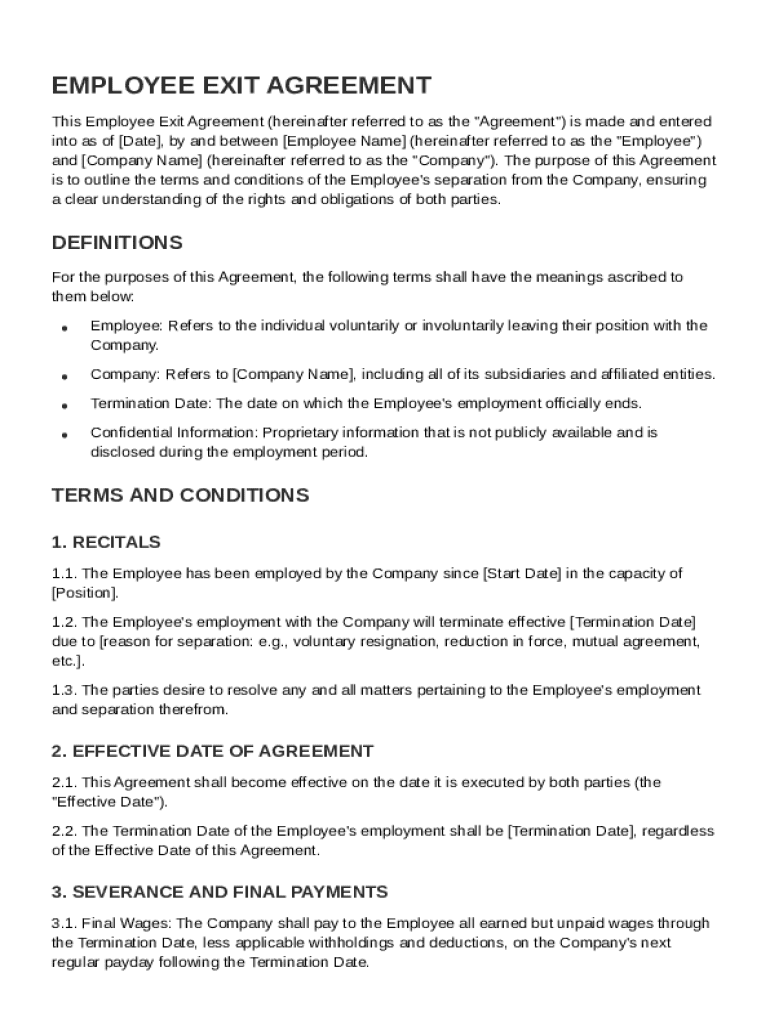
The Employee Exit Agreement Template is a structured document that outlines the terms and conditions governing an employee's departure from a company. It specifies the rights and responsibilities of both the employer and the employee, ensuring a clear and mutual understanding of the separation process. This template generally includes elements like severance pay, confidentiality obligations, the return of company property, and legal release provisions. The emphasis is on setting expectations and safeguarding interests, as well as providing clarity regarding ongoing obligations post-employment.
Key Elements of the Employee Exit Agreement Template
The Employee Exit Agreement Template includes several critical components that must be addressed to achieve a comprehensive agreement:
- Severance and Final Payments: Details regarding any severance pay, accrued vacation, or unpaid salary the employee is entitled to receive upon exit.
- Confidentiality Clauses: Provisions ensuring that the departing employee keeps sensitive company information confidential, both during and after employment.
- Non-Compete and Non-Solicitation Clauses: Restrictions placed on the departing employee to prevent competition with the employer or solicitation of the company's clients and employees post-departure.
- Release of Claims: A section where the employee agrees not to pursue legal claims against the employer, covering issues that arose during their employment.
- Return of Company Property: Requirements for returning any company-owned equipment, documents, or other property in the employee's possession.
Steps to Complete the Employee Exit Agreement Template
Completing the Employee Exit Agreement Template involves a series of precise steps:
- Gather Necessary Information: Ensure all relevant details such as employment dates, role and responsibilities, and outstanding compensation are available.
- Customizing the Template: Modify the template to fit the specific circumstances of the employee's exit, including personalized terms around severance and confidentiality.
- Review Legal Provisions: Check state-specific legal requirements ensuring that all terms, especially those concerning non-compete clauses, comply with applicable laws.
- Incorporate Company Policies: Align the agreement with existing company policies to maintain consistency across employee separations.
- Seek Legal Counsel: Consider consulting with a legal expert to verify all provisions are legally sound and enforceable.
- Finalize and Sign: Both the employer and employee must review the completed document for accuracy before signing to formalize the agreement.
Legal Use of the Employee Exit Agreement Template
The legal use of the Employee Exit Agreement Template centers around ensuring enforceability and compliance with U.S. employment laws. The document serves as a legal contract specifying agreed-upon terms for employment termination. It is crucial to include a governing law clause that specifies which state's laws will be applied in case of disputes. Legal validity requires clarity in language and mutual consent from both parties without any form of coercion or misleading terms. Moreover, it's often advisable to provide the employee with a reasonable period to review the agreement before signing.
Important Terms Related to Employee Exit Agreement Template
Understanding key terms related to the Employee Exit Agreement Template can facilitate a clearer interpretation of the document:
- Effective Date: The date on which the terms of the agreement come into force.
- Severability Clause: A provision ensuring if any part of the agreement is found to be unenforceable, the rest remains effective.
- Governing Law: Identifies the jurisdiction whose laws govern the agreement.
- Consideration: The compensation or promise the employee receives in exchange for signing the agreement.
- Waiver of Rights: An acknowledgment by the employee waiving the right to pursue further claims against the employer.
State-Specific Rules for the Employee Exit Agreement Template
State laws can significantly influence the stipulations within an Employee Exit Agreement Template. For example:
- California: Has strict rules on non-compete clauses making them largely unenforceable except in certain circumstances.
- Texas: Allows non-compete agreements but requires that they be reasonable in geographic scope and duration.
- New York: Non-compete clauses should be necessary to protect legitimate business interests and should not be unduly burdensome on the employee.
Understanding these state-specific differences is important for crafting an enforceable agreement.
Who Typically Uses the Employee Exit Agreement Template
Various stakeholders within a company can be involved in the use of the Employee Exit Agreement Template, including:
- Human Resources (HR) Professionals: Responsible for drafting, customizing, and administering exit agreements.
- Legal Counsel: Assists in ensuring compliance with current employment laws and provides guidance on the enforceability of clauses.
- Company Executives and Managers: Provide input on terms specific to the strategic interests of the company, ensuring the agreement aligns with business goals.
- Employees: The primary party to sign the agreement, acknowledging the terms of their exit.


Who Issues the Form
The Employee Exit Agreement Template is typically issued by the employer, often by the HR department or the company's legal team. The development and issuance of the form are guided by existing company policies and aligned with legal norms to ensure an amicable separation. HR may coordinate with legal counsel to tailor the agreement to specific circumstances, maintaining fairness and protecting the company’s interests.
Why Should You Use the Employee Exit Agreement Template
Utilizing an Employee Exit Agreement Template provides several benefits:
- Clarity and Consistency: Standardizes the exit process ensuring all employees are treated uniformly upon termination.
- Legal Protection: Minimizes risk of post-employment disputes by having clear, documented agreements.
- Smooth Transition: Facilitates a hassle-free transition for the leaving employee by setting clear terms, thereby maintaining positive relationships.
- Safeguarding Interests: Protects confidential information and business interests through enforceable clauses like non-compete and confidentiality agreements.
- Mutual Understanding: Eliminates ambiguities and misconceptions about the terms of employee separation, fostering mutual understanding between parties.