







Definition & Meaning
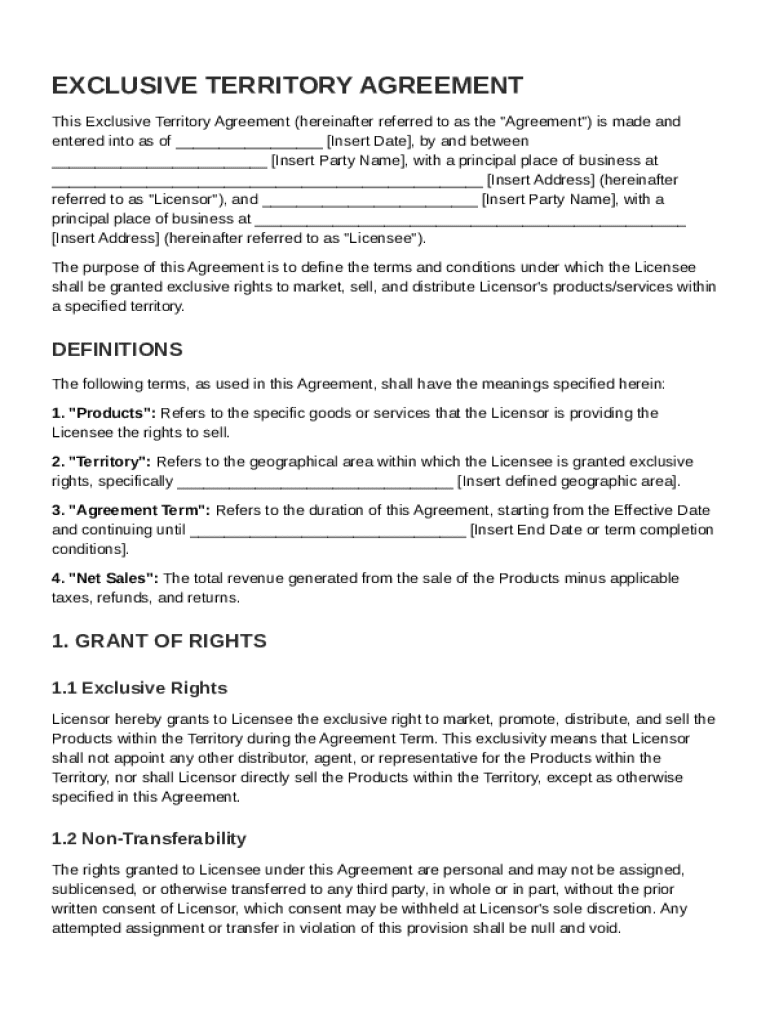
An Exclusive Territory Agreement Template is a legal document that lays out terms allowing a licensee specific rights to market, sell, and distribute a company's products within a designated area. It aims to detail the mutual obligations of both the licensor and licensee. This arrangement is pivotal in protecting territorial rights, managing disputes, and maintaining pricing and payment terms in the transaction of goods or services, offering parties involved a clear framework to operate within a defined locality.
Key Components
- Licensee and Licensor Information: Identifies the parties involved, including business names and contact information.
- Granted Rights: Details the rights being extended to the licensee, including products or services covered.
- Territory Definition: Provides precise geographic boundaries where the licensee can sell or distribute the products.
- Agreement Term: Specifies the duration of the agreement and any conditions that may lead to automatic renewal or termination.
- Sales & Target Obligations: Outlines any sales targets the licensee is expected to meet within the territory, ensuring alignment with business objectives.
Key Elements of the Exclusive Territory Agreement Template
Understanding the essential elements of the Exclusive Territory Agreement Template ensures that both parties comprehend their roles, obligations, and expectations, safeguarding the relationship against potential conflicts.
Main Clauses
- Product Supply Obligations: Detailed expectations on how the licensor must supply products, including timelines and quantities.
- Compliance with Laws: Requirement for both parties to adhere to local, state, and federal regulations applicable to their activities.
- Pricing & Payment Terms: Clear terms on pricing structures, discounts, payment schedules, and late fee policies.
- Confidentiality Requirements: Obligates both parties to maintain the confidentiality of proprietary information exchanged during the term of the agreement.
- Dispute Resolution: Mechanisms for resolving disagreements, potentially through mediation or arbitration, minimizing costly legal proceedings.
Steps to Complete the Exclusive Territory Agreement Template
Filling out an Exclusive Territory Agreement Template can be complex and requires careful attention to detail. Here’s a step-by-step guide to completing this document accurately.
- Enter Basic Information: Start by completing the names and addresses of the parties involved.
- Define Territory: Clearly map out the geographic area where the licensee will have exclusive rights.
- Specify Products: List all products and services included in the agreement.
- Draft Term and Renewal Clauses: Determine how long the agreement will last and conditions for renewal.
- Set Sales Targets: Agree on realistic sales targets that align with the business's strategic goals.
- Outline Payment Details: Include clear terms on payment processes, due dates, and accepted methods.
- Customization Options: Amend sections to fit specific business needs, bearing in mind local legislation.
Examples of Using the Exclusive Territory Agreement Template
Several scenarios highlight how an Exclusive Territory Agreement Template is crucial for businesses looking to expand their market reach or manage cross-border transactions.
- International Expansion: A U.S.-based tech company could use an exclusive territory agreement to license a European distributor, ensuring compliance with local regulations while expanding their market footprint abroad.
- Franchise Operations: Food chains often enter these agreements with local operators, granting exclusive rights within a city or state to protect their brand and standardize operations.
- Retail Partnerships: An apparel brand might license exclusive retail rights for a key region, ensuring store presentations align with brand aesthetics and customer engagement strategies.
Important Terms Related to Exclusive Territory Agreement Template
Advanced understanding of specific terms is essential for precise execution and compliance.
Terminology
- Licensee: The party receiving exclusive rights to sell or distribute products within a defined area.
- Licensor: The party granting exclusive rights over its products or services to the licensee.
- Territory: The specific geographic area defined in the agreement where the licensee's rights are exclusive.
- Sales Quota: The specific sales targets set within the agreement period which the licensee is expected to achieve.
Legal Use of the Exclusive Territory Agreement Template
Legal implications and compliance are critical when crafting an Exclusive Territory Agreement Template. Ensuring adherence to relevant legislation maximizes protection against disputes.
Compliance Considerations
- ESIGN Act Compliance: Electronic signatures on agreements like DocHub are valid under the ESIGN Act, ensuring that signed documents are legally binding in the U.S.
- Gaft and Anti-Trust Laws: Both parties must ensure that the agreement complies with anti-trust laws to prevent unfair competition or market monopolization.
- Regulatory Adherence: Observance of federal commerce regulations and local state laws regarding licensing and distribution practices.
State-Specific Rules for the Exclusive Territory Agreement Template
An Exclusive Territory Agreement Template must accommodate variations in state laws, offering customized terms based on local legal standards.
Examples of State Variations
- California: Businesses must consider the implications of stricter state laws regarding non-compete clauses when crafting exclusive territory terms.
- Texas: Favorable legislation governing business operations could allow broader freedom in defining territory and terms.
- New York: Specific clauses on dispute resolution might require adaptation to comply with state-mandated arbitration processes.
Business Types That Benefit Most from Exclusive Territory Agreement Template
Many industries leverage exclusive territory agreements to strengthen market presence and optimize distribution channels.
Primary Beneficiaries
- Manufacturer and Distributor Partnerships: Ensures streamlined operations while penetrating new markets with limited competition.
- Franchisers and Franchisees: Aligns business protocols and enhances brand recognition through consistent delivery of product standards.
- Corporations with Wide Product Ranges: Supports large product lines by designating distinct territories, maintaining supply chain efficiency and enforcing regional sales strategies.




