






Definition and Purpose of a Notarized Child Support Agreement Template
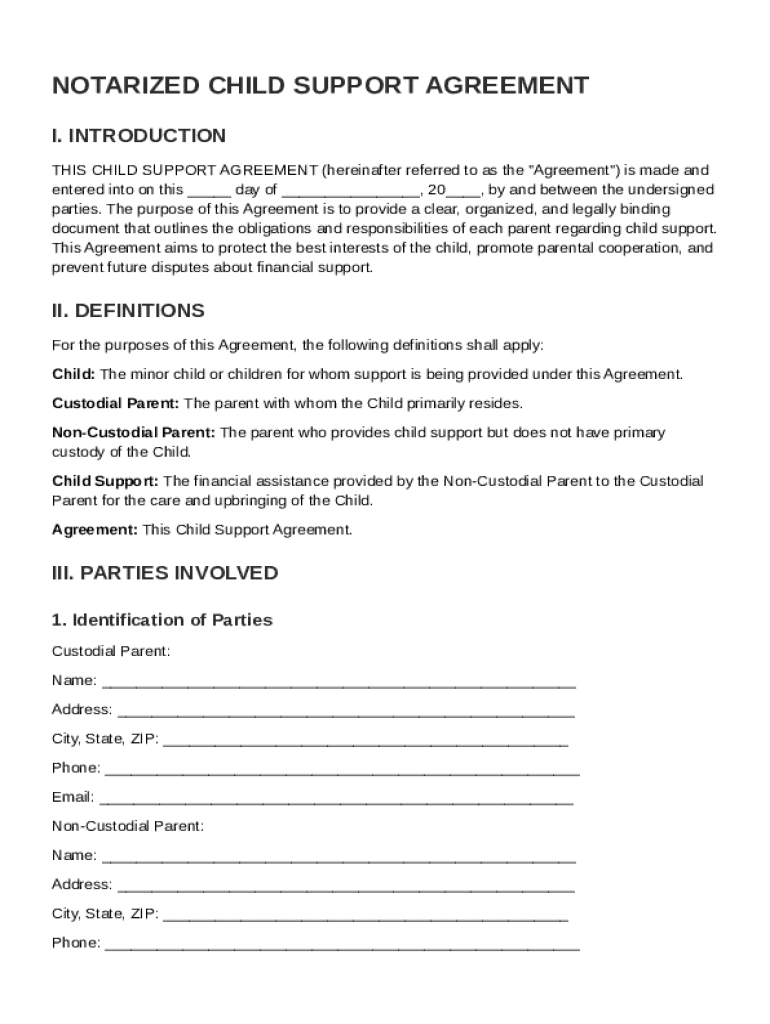
A Notarized Child Support Agreement Template serves as a formal document to outline the financial obligations of both parents regarding the support of their child or children. Generally, it specifies key terms such as the identities of the parties involved, the amount and payment schedule of child support, and any additional financial responsibilities such as healthcare costs or educational expenses. The notarization process provides an added layer of legal authenticity, confirming that the agreement has been voluntarily signed and verified in the presence of a notary public. This type of document is typically used to ensure all parties are clear on their obligations and to mitigate disputes that may arise in the future.
Key Elements of a Notarized Child Support Agreement Template
When crafting a Notarized Child Support Agreement Template, certain elements need to be included to ensure clarity and enforceability:
-
Identifying Information: Full names, addresses, and contact details of both parents, and any pertinent information about the child or children involved.
-
Payment Details: Specific amounts of support, payment frequency (e.g., monthly), and preferred payment methods. This section can also include provisions for payment adjustments tied to cost-of-living changes.
-
Additional Expenses: Details surrounding shared costs, such as medical expenses, child care, education fees, and extracurricular activities.
-
Duration of Support: The period or condition under which child support will continue, often until the child reaches a specific age or educational milestone.
-
Modification Conditions: Criteria that must be met for altering the agreement in the future, such as a change in one parent’s financial situation.
-
Enforcement Mechanisms: Steps that will be taken in the event of a default or dispute, including potential legal actions.
Error or missing these key elements can cause complications, undermining the agreement's validity.
Steps to Complete the Notarized Child Support Agreement Template
Completing a Notarized Child Support Agreement Template involves several careful steps to ensure that the document is accurate, comprehensive, and legally binding:
-
Collecting Necessary Information: Start by gathering all relevant information about both parents and the child or children. This includes basic personal information, financial details, and current child care arrangements.
-
Drafting the Agreement: Using the template, draft the agreement by filling in each section with specific details that reflect the unique circumstances of the involved parties.
-
Review and Discuss: Both parties should review the document thoroughly, discussing any points of disagreement or ambiguity. Amend the draft as needed to ensure mutual understanding and consent.
-
Legal Consultation: Although optional, seeking legal advice can be beneficial to validate that all legal requirements are met and that the agreement serves the best interests of the child.
-
Notarization: Arrange for both parents to sign the agreement in the presence of a notary public, who verifies the identities of the signatories and witnesses the signing process.
-
Distribute Copies: Once notarization is completed, distribute copies of the final document to all relevant parties for their records, including any legal advisors involved in the process.
Who Typically Uses the Notarized Child Support Agreement Template
A Notarized Child Support Agreement Template is typically used by:
-
Separated or Divorced Parents: Most commonly employed by parents who are no longer together to formalize child support arrangements.
-
Unmarried Parents: To establish financial responsibilities even when a formal custody agreement is not in place.
-
Legal Guardians: In situations where guardians or relatives are involved, they might use this agreement to delineate financial responsibilities.
-
Legal Professionals: Lawyers and family law specialists might use these templates to draft documents for their clients, ensuring that all legal and financial aspects are covered comprehensively.
Understanding who utilizes these templates highlights their importance in ensuring fair and legally binding agreements that prioritize the child's welfare.


Why the Notarization of the Child Support Agreement Template is Important
Notarizing a Child Support Agreement is crucial for several reasons:
-
Legal Enforceability: Notarization gives the agreement legal standing in courts, making it easier to enforce should disputes arise.
-
Authenticity Verification: It serves as proof that the agreement was signed voluntarily, without duress or fraudulent circumstances by the involved parties.
-
Protection Against Alterations: A notarized document is more difficult to alter or falsify, providing peace of mind to both parties regarding its authenticity.
-
Support of Legal Decisions: Courts often require notarized documents to support claims, making them necessary for future legal reference or proceedings.
Each of these reasons underscores the importance of notarization as part of the agreement process.
Legal Use and State-Specific Rules for Notarized Child Support Agreements
In the United States, child support agreements must comply with state laws, which may vary. General legal uses and considerations include:
-
State Compliance: Each state has its own laws governing child support; thus, ensuring the agreement aligns with the laws of the governing state is critical.
-
Court Approval: Often, before an agreement becomes enforceable, it might require judicial approval, especially if modifications to state-guided support calculations are included.
-
Public Policy: Agreements must be fair and in the child's best interest, adhering to the public policy of avoiding undue hardship on either parent.
-
State-Specific Provisions: Certain states may have unique provisions or defaults regarding child healthcare responsibilities, education costs, or inheritance that must be considered.
Legal practitioners often advise consulting state-specific legal ordinances or a local attorney to ensure the agreement's viability.
State-by-State Differences in Child Support Agreement Templates
State differences can influence several aspects of child support agreements:
-
Calculation Formulas: States use varied formulas to compute child support amounts, typically considering income proportions and custodial arrangements.
-
Minimum Support Requirements: Some states mandate a minimum level of support irrespective of income levels.
-
Provision of Healthcare: Requirements might differ regarding who is primarily responsible for providing health insurance to the child.
-
Continued Education Support: Unique to certain states, there might be provisions regarding support continuation beyond the age of eighteen if the child pursues post-secondary education.
Understanding these differences is crucial when drafting a Notarized Child Support Agreement Template to ensure it is compliant with specific state requirements.
Important Terms Related to Notarized Child Support Agreement Template
Understanding specific terms is integral to the effectiveness of a Notarized Child Support Agreement:
-
Obligor/Obligee: The obligor is the parent who pays support, while the obligee receives support on behalf of the child.
-
Arrearage: Any overdue support amounts that have not been paid by the obligor.
-
Custodial Parent: The parent with whom the child resides most of the time.
-
Income Withholding: A method for automatically deducting child support payments from the obligor's income to ensure consistent support.
-
Joint Custody: A situation where both parents share decision-making responsibilities about the child's welfare, which may impact support obligations.
Knowing these terms helps clarify the obligations and procedures within the agreement, making it easier for both parties and legal professionals involved.