
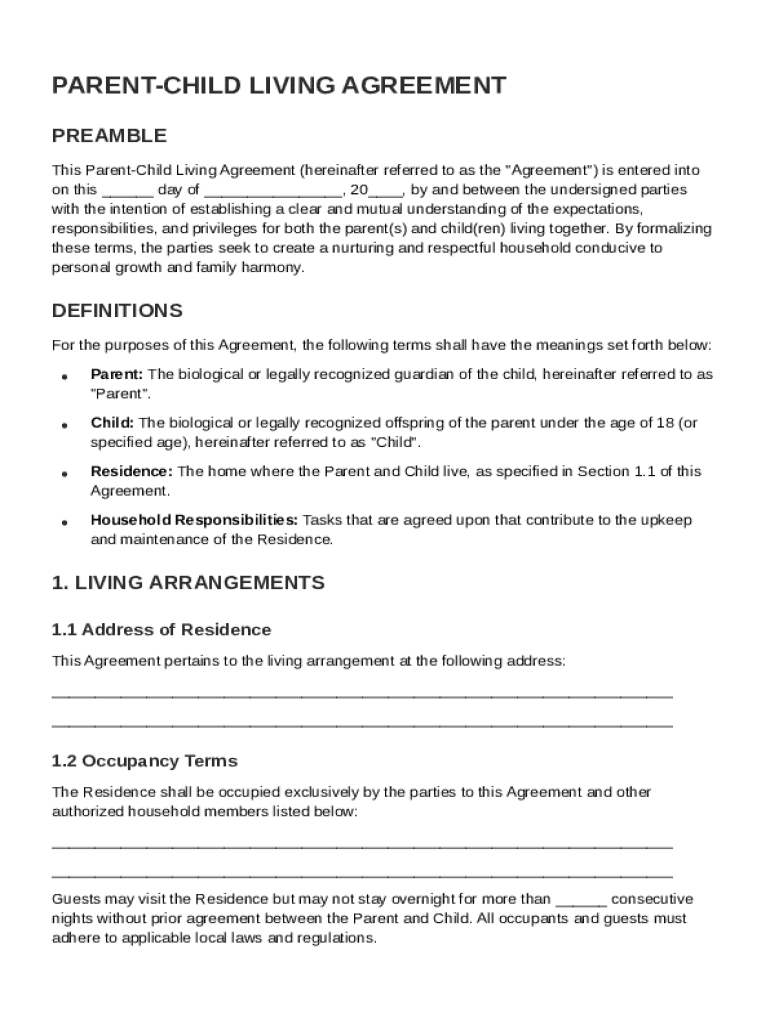







Definition & Meaning
A Parent-Child Living Agreement Template serves as a structured document designed to define and clarify the living arrangement between parents and children residing in the same household. It is a tool that outlines expectations, responsibilities, and roles for all parties involved, ensuring a harmonious living environment. The agreement typically includes sections such as living arrangements, house rules, responsibilities, privacy guidelines, and communication protocols. These templates are crucial for fostering mutual respect, nurturing personal growth, and maintaining family harmony.
Examples in Practice
- Family N1: A family with teenagers may use this agreement to set curfews, outline chores, and establish communication rules.
- Family N2: Parents with adult children returning home after college may leverage this document to manage household contributions and privacy.
Key Elements of the Parent-Child Living Agreement Template
The Parent-Child Living Agreement Template is comprised of several critical sections, each serving a specific purpose in clarifying the living arrangement:
Living Arrangements
- Specifications: Details the physical living setup, including room assignments and shared space usage.
- Privacy: Addresses privacy expectations for all family members.
Household Responsibilities
- Chores: Lists daily, weekly, and monthly tasks and assigns them among family members.
- Shared Duties: Outlines expectations for maintaining shared living areas like the kitchen and bathroom.
Communication Protocols
- Methods: Lists preferred communication methods, whether face-to-face, text, or family meetings.
- Frequency: Establishes how often family meetings will occur and necessary topics for discussion.
Steps to Complete the Parent-Child Living Agreement Template
Completing the Parent-Child Living Agreement Template involves several steps to ensure clarity and mutual consent:
- Initial Discussion: Gather all family members to discuss the goals of the agreement.
- Download Template: Retrieve a template from a reliable source, such as DocHub.
- Review Sections: Go through each section, allowing everyone to express their opinions.
- Draft Agreement: Fill out the template with agreed-upon terms.
- Review and Revise: Revisit each section for any necessary adjustments.
- Finalize and Sign: All parties sign the document to signify agreement and understanding.
Legal Use of the Parent-Child Living Agreement Template
Binding Nature
- Agreements vs. Contracts: While not legally binding like a contract, the document serves as a mutual understanding to guide household interaction.
Benefits
- Conflict Resolution: Provides a reference point for resolving disputes amicably.
Limitations
- Not a Substitute: Cannot replace legal frameworks in matters of custody or legal responsibilities.
Software Compatibility
DocHub offers excellent compatibility with various software platforms, simplifying the usage of the Parent-Child Living Agreement Template:
- File Formats: Supports PDF, DOC, and XLS among others.
- Integration: Compatible with Google Workspace, allowing documents to be accessed via Google Drive and Gmail.
State-Specific Rules for the Parent-Child Living Agreement Template
While the Parent-Child Living Agreement Template is generally uniform, it's important to consider state-specific guidelines that may influence its implementation:
Variations by State
- Cultural Conventions: Some states may have different cultural practices affecting household dynamics.
- Legal Frameworks: Consult local guidelines to ensure compatibility with state-specific family laws.
Who Typically Uses the Parent-Child Living Agreement Template
The template serves a broad array of family configurations:

Common Users
- Traditional Families: Parents looking to establish clear rules with teenage children.
- Blended Families: Families combining children from previous relationships to set household standards.
- Returnees: Families welcoming back adult children need to redefine roles and responsibilities.

Examples of Using the Parent-Child Living Agreement Template
Case Studies
- Scenario 1: A family with differing views on technology use creates a section dedicated to screen time rules.
- Scenario 2: A household with varying dietary preferences uses the agreement to list kitchen usage rules and meal planning responsibilities.
By leveraging the Parent-Child Living Agreement Template, families can create a living arrangement that balances individual needs with collective expectations, fostering healthy communication and respectful boundaries within the household.




