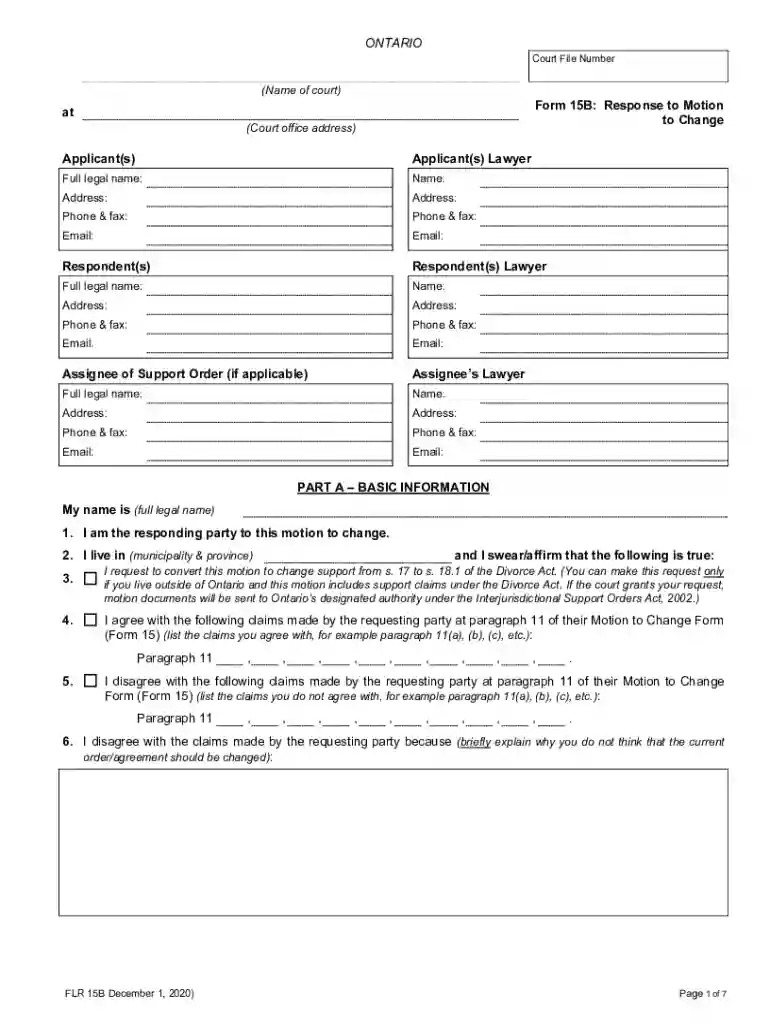
Court File Number - Form 15B: Response to Motion to Change 2026

Get Form
response to motion to change form 15b Preview on Page 1

Here's how it works

01. Edit your response to motion to change form 15b online
Type text, add images, blackout confidential details, add comments, highlights and more.

02. Sign it in a few clicks
Draw your signature, type it, upload its image, or use your mobile device as a signature pad.

03. Share your form with others
Send form 15b response to motion to change via email, link, or fax. You can also download it, export it or print it out.

Definition and Meaning of Court File Number - Form 15B: Response to Motion to Change

Form 15B is a legal document used in Ontario, Canada, primarily in family law proceedings. It is employed when a party is required to respond to a motion to change an existing court order under the Divorce Act. This form is crucial for the responding party to outline their positions, such as agreement or disagreement with the motions presented, and to propose changes or maintain certain agreements related to support orders. The form incorporates various sections to capture financial details and any additional relevant information related to support cases, ensuring that both parties present their arguments and evidence for consideration by the court.

Key Elements of the Court File Number - Form 15B

Form 15B is composed of several critical components that must be completed accurately to ensure the court fully understands the responding party's position:

  • Agreement or Disagreement Sections: Allows the respondent to specify their stance on each assertion made by the applicant.
  • Requests for Changes: Provides the opportunity to request amendments to the current order, with detailed explanations needed to justify these requests.
  • Financial Disclosure: Requires comprehensive financial information, supporting claims related to child or spousal support.
  • Comebacks and Additional Information: Enables the respondent to add supplementary facts and context that may influence the court's decision.
  • Legal Counseling and Filing Instructions: Advises the parties on seeking legal advice for the completion of the form and provides instructions for form submission.

How to Use the Court File Number - Form 15B: Response to Motion to Change

Using Form 15B entails a thorough understanding of the respondent's legal standing and obligations. Here's a step-by-step guide on how to utilize this form effectively:

  1. Review the Motion: Carefully go through the motion to change filed by the applicant to understand the claims and changes requested.
  2. Complete the Form: Fill out each section of Form 15B accurately, providing all required information and ticking off sections that reflect your position.
  3. Gather Financial Documents: Compile necessary financial documents, such as income statements and expense reports, to substantiate claims made within the form.
  4. Consult Legal Assistance: Engage with a legal advisor to review the completed form and ensure all legal implications are thoroughly covered.
  5. Submit the Form: File the completed Form 15B with the appropriate court office, adhering to filing procedures and deadlines set by the court.

Steps to Complete the Court File Number - Form 15B: Response to Motion to Change

Successfully completing Form 15B involves meticulous attention to each step:

  1. Identification Section: Enter the court file number, names, and contact details of both parties.
  2. Agreement with Changes Section: Indicate whether you agree, partially agree, or disagree with the proposed motions.
  3. Detail Any Requested Amendments: List and explain any proposed changes you are suggesting to the current orders.
  4. Financial Information Documentation: Complete the financial statement annexed with the form, ensuring all figures are accurate and up-to-date.
  5. Additional Information: Provide any supplementary evidence or details that support your case.
  6. Final Review and Signing: Confirm all details are correct, then sign and date the form before submission.

Legal Use of the Court File Number - Form 15B: Response to Motion to Change

Form 15B is a binding legal document that plays a central role in family law proceedings in Ontario. Its primary legal uses include:

  • Modification of Existing Orders: Allows for the adjustment of child or spousal support orders when circumstances have changed.
  • Formal Document in Court Proceedings: Provides the court with essential information to decide support-related matters.
  • Record Keeping: Ensures a formal record of the respondent's position and requested changes within the legal system.

Who Typically Uses the Court File Number - Form 15B: Response to Motion to Change

Form 15B is generally used by:

  • Divorced or Separated Individuals: Primarily those with existing support orders who seek to change the terms.
  • Legal Counsels: Attorneys representing clients in family law cases use this form to formalize their clients' responses to motions.
  • Courthouses: Administrators who manage the filing and processing of family law documents.
decoration image ratings of Dochub

Examples of Using the Court File Number - Form 15B: Response to Motion to Change

Consider these scenarios to understand how Form 15B is employed:

  • In a situation where an individual's income has significantly decreased, they may use the form to request a reduction in spousal support payments.
  • If a child reaches adulthood and begins to work full-time, a respondent might file Form 15B to terminate child support obligations.

Important Terms Related to Court File Number - Form 15B

Understanding the terminology associated with Form 15B is vital:

  • Motion to Change: A formal request to modify an existing court order.
  • Respondent: The party replying to the motion to change.
  • Support Order: A legal directive regarding financial support, typically involving spousal or child support.

State-Specific Rules for the Court File Number - Form 15B

As laws and regulations vary by region, understanding Ontario-specific requirements is essential:

  • Jurisdictional Compliance: Ensure the form is used within the appropriate legal framework set out by Ontario's family law system.
  • Procedural Guidelines: Adhere strictly to deadlines and filing procedures as outlined by provincial law.

By diligently following these guidelines and leveraging all the components of Form 15B, individuals can effectively manage the complexities of responding to a motion to change, ensuring that their position is clearly communicated and legally protected.

See more Court File Number - Form 15B: Response to Motion to Change versions

We've got more versions of the Court File Number - Form 15B: Response to Motion to Change form. Select the right Court File Number - Form 15B: Response to Motion to Change version from the list and start editing it straight away!
Versions Form popularity Fillable & printable
2020 4.6 Satisfied (33 Votes)
2020 4.8 Satisfied (160 Votes)
2008 4.2 Satisfied (69 Votes)
be ready to get more

Complete this form in 5 minutes or less

Get form

Got questions?

We have answers to the most popular questions from our customers. If you can't find an answer to your question, please contact us.
Contact us

Microsoft Word doesn’t have signing tools to create legitimate electronic signatures and enforceable paperwork. Fortunately, DocHub is an online eSignature-compliant editor that works with different file formats, such as .doc files. Log in to your account and upload the Word version of your 15b response to motion to change from your device and cloud, or URL - our editor will automatically transform it into an editable PDF. Make all required alterations in your document and click Sign to create your own legally-binding electronic signature. You will find four signing methods from which to choose.

In addition to an extensive toolset for editing PDFs on mobile devices, DocHub allows you to sign your form 15b family law along the way. Open our editor in your web browser, make changes using DocHub’s toolset, and complete your editing by eSigning the completed form.

STEP 1: DETERMINE IF THERE IS AN ASSIGNEE. STEP 2: DECIDE WHERE TO MAKE THE MOTION. STEP 3: COMPLETE THE PROPER FORMS. STEP 4: FILE YOUR DOCUMENTS AT THE FAMILY COURT OFFICE. STEP 5: SERVE A COPY OF THE DOCUMENTS. STEP 6: FILE AFFIDAVIT(S) OF SERVICE. STEP 7: WHAT TO DO AFTER SERVICE.
Rule 15 of the Family Law Rules sets out the procedure to change a final order or support agreement. The Family Law Rules guide each step of your family court case and tell you the forms each person must complete.
If you cannot file your response to motion to change within 30 days, you can file Form 14B: Motion Form with the court asking to extend the time for you to file. On the form, explain why you need more time. You must serve the moving party or their lawyer, and an assignee, if any, with Form 14B.

Security and compliance

At DocHub, your data security is our priority. We follow HIPAA, SOC2, GDPR, and other standards, so you can work on your documents with confidence.

Learn more
ccpa2
pci-dss
gdpr-compliance
hipaa
soc-compliance
be ready to get more

Complete this form in 5 minutes or less

Get form

People also ask

The change in circumstances must be something that could not have been reasonably foreseen by the judge who issued the original order. For instance, a docHub change in income, an unanticipated relocation, or a sudden health concern would meet this requirement.
Form 15D: Consent Motion to Change Child Support. In this form, you and the other party give the court information about your current child support arrangement and the changes you have agreed on. This form must be signed and dated by you, the other party, and any assignee in front of witnesses.
You will need to go to the Crowns office and get permission to reschedule the court date. Once the Crown signs the form, it needs to be filed at the clerks counter. This must be arranged well before your scheduled court date. You can only reschedule for an earlier date.

form 15b small claims court