Out of Court Settlement Agreement Template 2026

Get Form
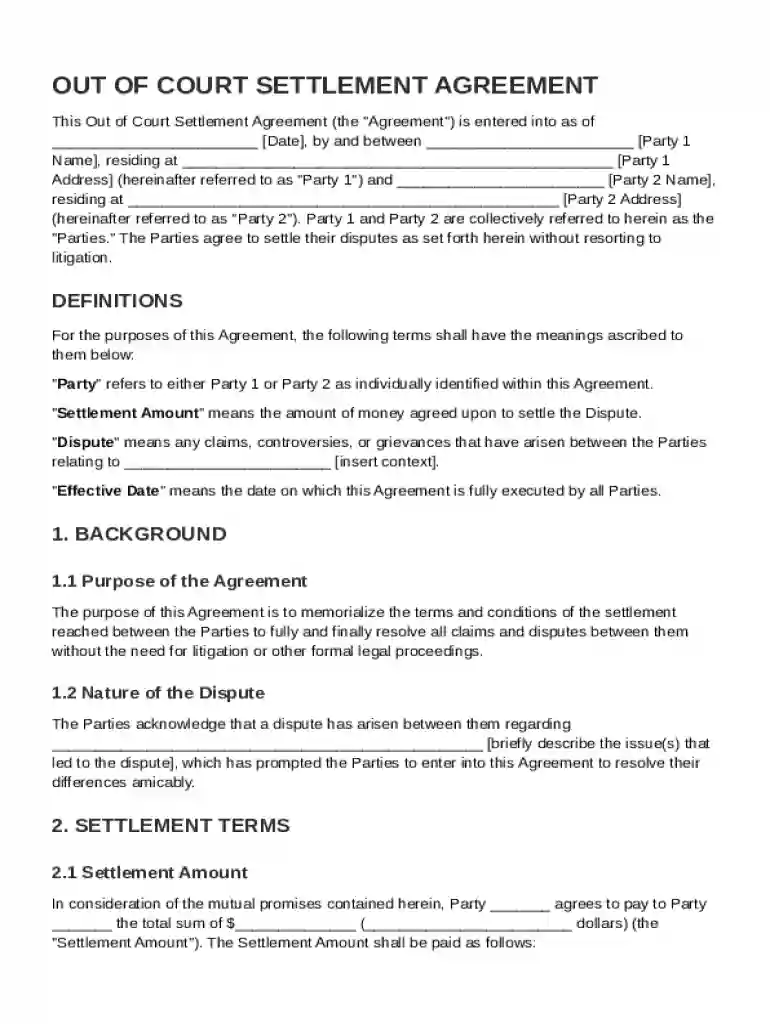
Out of Court Settlement Agreement Template Preview on Page 1

Here's how it works

01. Edit your form online
Type text, add images, blackout confidential details, add comments, highlights and more.

02. Sign it in a few clicks
Draw your signature, type it, upload its image, or use your mobile device as a signature pad.

03. Share your form with others
Send it via email, link, or fax. You can also download it, export it or print it out.

Definition and Meaning

An Out of Court Settlement Agreement Template is a significant legal document designed to resolve disputes between parties without the need for litigation. This agreement serves as a formalized contract where the involved parties—the claimant and the respondent—agree on terms that address their needs and interests but also eliminate the requirement for court proceedings. The template typically includes essential features such as the defined scope of the dispute, agreed-upon settlement terms, and specific clauses related to confidentiality and liability disclaimer. The fundamental purpose is to provide a mutually agreed resolution that both parties accept, ensuring compliance while avoiding the adversarial and often costly nature of litigation.

Key Elements of the Out of Court Settlement Agreement Template

Constructing an effective Out of Court Settlement Agreement requires the inclusion of several key elements to ensure clarity and enforceability:

  • Agreement Details: Clearly specify the date of the agreement along with the names and contact information of all parties involved.
  • Background Information: Provide a concise summary of the dispute, detailing the events leading up to the agreement and the context of the settlement.
  • Terms of Settlement: Outline the agreed terms, including any financial compensation, required actions, and timelines for completing these obligations.
  • Confidentiality Clause: Include provisions that restrict the parties from disclosing settlement details to third parties, ensuring privacy.
  • Liability Waiver: Clarify that the settlement does not constitute an admission of liability, protecting the parties from potential future claims linked to the resolved matter.
  • Governing Law: Identify the jurisdictional legal framework that will oversee the agreement, often dependent on the parties' location or the nature of the dispute.

Steps to Complete the Out of Court Settlement Agreement Template

When filling out the Out of Court Settlement Agreement Template, it is crucial to follow a systematic process to ensure accuracy and comprehensiveness:

  1. Review the Template: Begin by thoroughly reading the entire template to understand all sections and requirements.
  2. Input Party Information: Enter the full names and addresses of both parties involved in the settlement.
  3. Articulate the Dispute: Summarize the background of the dispute, ensuring both parties are in agreement on the narrative described.
  4. Define Settlement Terms: Clearly state the settlement terms, specifying financial amounts, deadlines, and any specific obligations both parties must fulfill.
  5. Draft Restrictions: Add any confidentiality agreements or restrictions that both parties must adhere to during and after the settlement.
  6. Include a Legal Disclaimer: Note explicitly within the template that entering into this agreement does not imply admission of fault or liability by any party.
  7. Review and Finalize: Both parties should review the document carefully, often in consultation with legal advisors, prior to signing.
  8. Sign and Execute: Have each party sign the prepared documents before a notary public, where necessary, to ensure legal validity.

Important Terms Related to the Out of Court Settlement Agreement Template

Understanding the terminology often used in settlement agreements is crucial, as it guides both the interpretation and execution of the document:

  • Claimant: The party initiating the claim or dispute.
  • Respondent: The party against whom the claim is made.
  • Settlement Amount: The monetary compensation agreed upon by the parties to resolve the dispute.
  • Mutual Release: This term signifies that both parties release each other from future claims related to the present matter.
  • Dispute Resolution Clause: An agreement on how future disputes, if any, will be handled, often through arbitration or mediation.
  • Effective Date: The date upon which the agreement becomes binding and enforceable.

Legal Use of the Out of Court Settlement Agreement Template

In the United States, the Out of Court Settlement Agreement Template is widely recognized and used as a tool for resolving disputes:

  • Litigation Avoidance: Enables parties to reach a compromise without going through expensive and time-consuming court proceedings.
  • Confidentiality Assurance: Keeps sensitive information out of the public domain as court cases often do.
  • Finality and Enforceability: Once signed, the agreement is legally binding and enforceable, offering a conclusive end to the issue.
  • Customizable Solutions: Allows parties to tailor the terms specifically to their circumstances, which is often not possible in a court-ordered judgment.

State-Specific Rules for the Out of Court Settlement Agreement Template

Each state within the U.S. may have unique statutes and interpretations influencing how settlement agreements are drafted and enforced. While the basic structure remains consistent, parties must consider:

  • Jurisdictional Laws: State laws that might affect the enforceability of certain clauses.
  • Statute of Limitations: Specific time frames within which disputes must be resolved or rights exercised, varying by state.
  • Notarization and Witnesses: Some states may require agreements to be notarized or witnessed to be valid.

Examples of Using the Out of Court Settlement Agreement Template

Utilizing the Out of Court Settlement Agreement Template is common across a variety of situations:

  • Business Disputes: Companies may settle intellectual property disagreements or breach of contract claims without tarnishing business reputations.
  • Employment Conflicts: Employers and employees might resolve issues related to wrongful termination through this template to maintain privacy.
  • Personal Injury Cases: Injured parties and defendants often agree to settlements outside court to receive fair compensation while avoiding prolonged litigation.
  • Civil Cases: Neighbors might use such agreements to resolve boundary disputes amicably without involving local courts.

Versions or Alternatives to the Out of Court Settlement Agreement Template

While the Out of Court Settlement Agreement Template is standard in many cases, alternatives might be better suited to specific needs:

  • Mediation Agreements: For cases with potential ongoing relationships or where a mediator's involvement is necessary.
  • Arbitration Agreements: When parties prefer binding resolution solutions outside traditional courts.
  • Confidentiality Agreements: Focuses solely on preventing disclosure rather than resolving the entire dispute.

Business Types that Benefit Most from Out of Court Settlement Agreements

Certain businesses find particular utility in utilizing these templates due to the nature of their operations:

  • Service Providers: Often face disputes regarding payment terms or service levels and find settlements a quick resolution method.
  • Small to Medium Enterprises (SMEs): Aim to avoid the costs associated with lengthy litigation processes which can strain limited resources.
  • Corporate Sectors: Frequently use settlements to manage public relations, keeping disputes discreet and controlled.
  • Real Estate Firms: Encounter disputes over property transactions or contractual terms that settlements can swiftly resolve.
be ready to get more

Complete this form in 5 minutes or less

Get form

Got questions?

We have answers to the most popular questions from our customers. If you can't find an answer to your question, please contact us.
Contact us
Ways to achieve an out of court settlement Without prejudice negotiations - off the record discussions are conducted without prejudice. Mediation - becoming an increasingly common method of dispute resolution.
The most common types of dispute resolution that may be used to settle a case out of court are negotiation, facilitation, mediation, and conciliation. Arbitration may also be used, but it is not used as commonly in disputes that are started in courts.
An out of court settlement is always preferable to a trial. A settlement provides certainty, and is the most economical way to end a case. It costs a lot to take a case to trial, and, even if you have strong evidence, the result cannot be guaranteed.
Settlement agreements commonly include terms about: The amount of compensation youll receive. The date your employment will end. The notice period youre entitled to and if you have to work your notice (or if a payment will be made to you instead)
Resolve your claim through mediation. Mediation is when an impartial professional (the mediator) helps both sides work out an agreement. Its confidential and usually quicker and cheaper than going to court.

Security and compliance

At DocHub, your data security is our priority. We follow HIPAA, SOC2, GDPR, and other standards, so you can work on your documents with confidence.
Learn more
ccpa2
pci-dss
gdpr-compliance
hipaa
soc-compliance

People also ask

Disadvantages of Settling Out of Court Defendants may offer lower settlement amounts to avoid the uncertainty and expense of a trial. Limited Legal Recourse: Once a settlement is docHubed, parties generally forfeit their right to pursue further legal action related to the same dispute.
Negotiation, mediation and arbitration, often called ADR or alternative dispute resolution, are the most well known.
An out-of-court settlement happens when the parties to a case resolve the legal issues without going to trial.

Related links