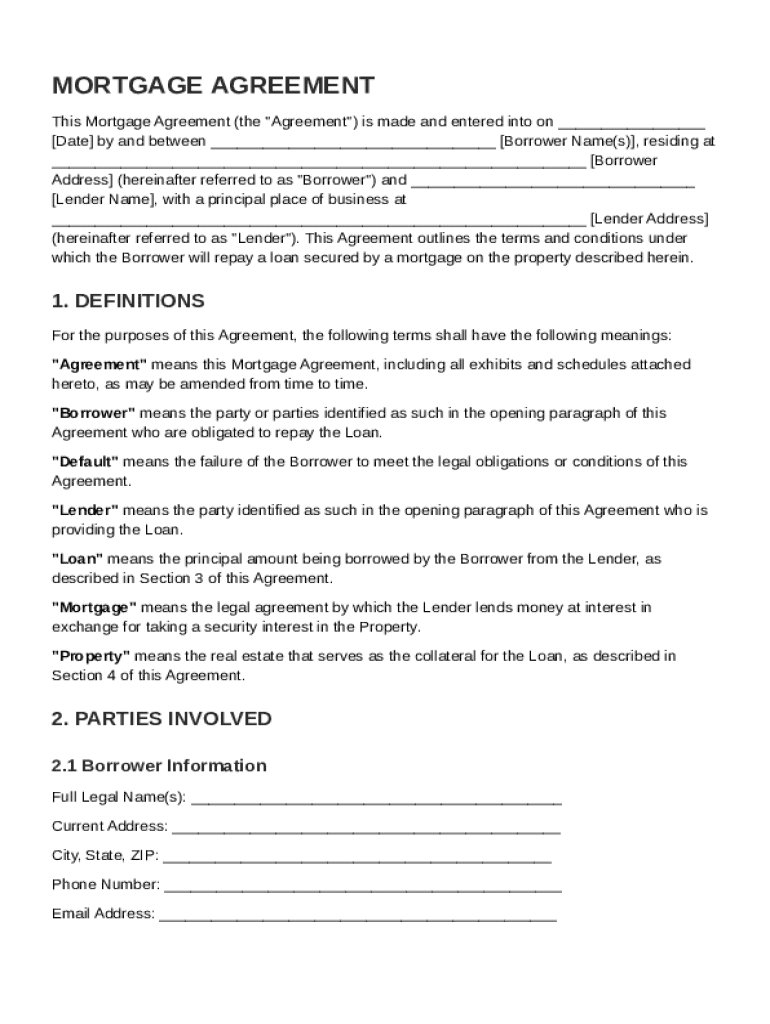







Definition and Meaning of a Mortgage Agreement Template
A Mortgage Agreement Template is a structured and standardized document that outlines the terms and conditions under which a loan, secured by a mortgage on a specified property, is provided by a lender to a borrower. This form captures essential elements such as the loan amount, interest rates, payment schedule, and the rights and obligations of each party. This template serves as a foundational tool for ensuring that all vital details are included, thus providing clarity and legal protection for both parties involved.
Key Elements Included in the Template
- Loan Amount: Specifies the total amount borrowed, which is secured by the mortgage.
- Interest Rates and Payment Schedule: Outlines the interest rates applied and details the amortization schedule including payment intervals and amounts.
- Parties Involved: Clearly identifies the borrower and lender, along with their respective roles and responsibilities.
- Collateral Description: Precises the property used as security for the loan, including its legal description.
- Default and Remedies: Details the conditions under which the borrower is considered in default and the lender’s legal recourse in such a scenario.
How to Use the Mortgage Agreement Template
The Mortgage Agreement Template is designed for easy adaptation, allowing users to customize it according to the specific terms agreed upon between the borrower and lender. Users should carefully review the template and fill in the personalized sections such as party names, loan amounts, and specific terms.
- Customize the Template: Adjust the sections that require personalized information such as names, dates, and specific terms of the agreement.
- Verify Legal Terms: Ensure that all legal terms align with the jurisdictional requirements and are understandable to both parties.
- Review and Edit: Collaborate with legal advisors, if necessary, to confirm accuracy and completeness.
- Finalize with Signatures: Once both parties agree to the terms, finalize the document with signatures from the borrower, lender, and notary if required.
Important Considerations
- Legal Advice: Consulting with a legal professional can be beneficial to adapt the template accurately to specific needs.
- Review State Laws: Ensure adherence to state-specific requirements as mortgage laws may vary.
Steps to Complete the Mortgage Agreement Template
Executing a mortgage agreement involves several critical steps to ensure it serves the intended legal purpose and protects both parties’ interests.
- Gather Necessary Information: Collect details regarding the borrower, lender, loan amount, and property details.
- Fill Out the Template: Accurately enter the information into the designated sections of the template.
- Include Specific Terms: Incorporate detailed terms agreed upon for loan repayment, interest rate, and conditions in the event of a default.
- Review and Amend: Conduct a thorough review for any errors or omissions and make necessary amendments.
- Finalize the Agreement: Both parties and, if applicable, a notary should sign the document to validate it legally.
Example Steps in Depth
- Detailed Information Collection: Ensure every aspect, from legal descriptions to personal identification, is precise and accounted for.
- State Specific Fields: Incorporate fields for specific requirements such as disclosure mandates, which may be state-dependent.
Who Typically Uses the Mortgage Agreement Template
Mortgage Agreement Templates are widely used across various sectors and individual circumstances. Below are examples of entities that commonly utilize this form:
- Lending Institutions: Banks, credit unions, and financial services that issue mortgage loans.
- Real Estate Investors: Individuals or companies securing properties for investment purposes.
- Private Lenders: Individuals who provide loans to friends, family, or acquaintances secured by real estate.
- Homebuyers: Individuals purchasing a property with financing from a mortgage lender.


Practical Scenarios
- First-time Homebuyers: Typically use this template during the purchasing process.
- Real Estate Developers: Utilize for securing development financing on large projects.
Important Terms Related to Mortgage Agreement Templates
The template incorporates several crucial terms essential for understanding and correctly drafting the document:
- Amortization: The process of spreading out a loan into a series of fixed payments over time.
- Principal: The original sum of money borrowed in the loan.
- Foreclosure: Legal process by which the lender can collect amounts owed on a defaulted loan through selling the collateralized property.
- Lien: A legal right granted to the lender over the property as collateral to carry an obligation, such as repaying the loan.
Use Cases for Terms
- Foreclosure: Understanding foreclosure is vital for borrowers to comprehend the risks of default.
- Amortization Schedules: Essential for borrowers to forecast payment obligations and manage finances.
Legal Use of the Mortgage Agreement Template
Utilizing the Mortgage Agreement Template ensures compliance with legal standards and safeguards the transaction between borrower and lender.
Aspects of Legal Validity
- Adherence to the ESIGN Act: Ensures that electronic signatures in the template are recognized as valid.
- Notary Acknowledgment: Required in some jurisdictions for the document to meet the legal standards for recording.
- Record of Agreement: Serves as a legal record that can be referenced in court if disputes arise.
Examples of Legal Compliance
- Electronic vs. Wet Signatures: Understanding when electronic signatures are sufficient under state law.
- Recording Requirements: Ensuring compliance with local laws regarding public recording of mortgage agreements.
Version and Alternatives to the Mortgage Agreement Template
Various versions and alternatives to the standard Mortgage Agreement Template exist to cater to special circumstances or unique borrower-lender agreements.
Types of Alternatives
- Adjustable-Rate Mortgage (ARM) Agreements: Specific for loans with interest rates that can vary over time.
- Interest-Only Loans: Templates for loans where the borrower only pays the interest for a specified period.
- Government-Backed Mortgages: FHA, VA, or USDA-specific agreements with particular provisions.
Practical Considerations for Alternatives
- Financial Suitability: Evaluate the financial implications of each mortgage type.
- Risk Assessment: Consider long-term risks associated with adjustable-rate terms.
State-by-State Differences in Mortgage Agreement Templates
Mortgage agreements may vary significantly across different states, primarily due to varying real estate laws and regulations.
Key State-Specific Variations
- Foreclosure Laws: Differences in how foreclosures are processed and timelines involved.
- Recording Fees: Variability in fees associated with recording the mortgage agreement with local authorities.
- Lien Prioritization: Different rules on how liens are prioritized in case of bankruptcy or property sale.
State-Specific Examples
- Judicial vs. Non-Judicial Foreclosures: States like Florida use judicial procedures while California may utilize non-judicial processes.
- Specific Fees and Costs: Different base costs for filing and registering mortgage paperwork to local municipalities.
Through careful consideration of the Mortgage Agreement Template and its components, parties can ensure a comprehensive and legally binding document that facilitates smooth home purchasing or lending experiences.