
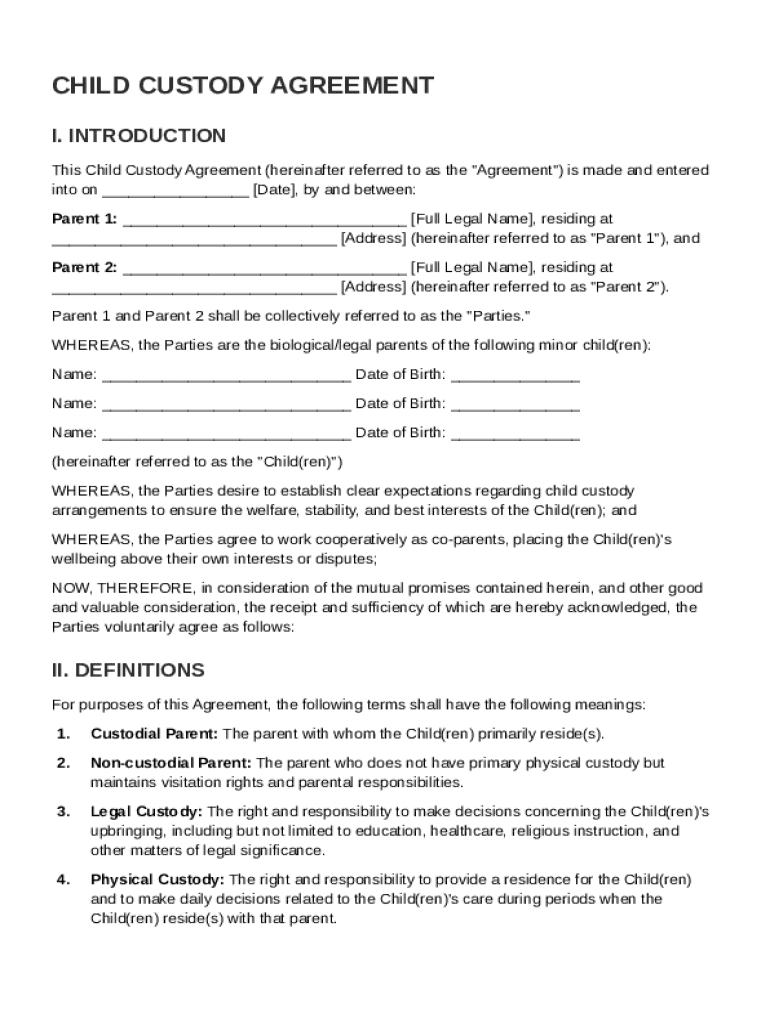







Definition and Purpose of the Child Custody Custody Agreement Template
The Child Custody Custody Agreement Template is a structured document that outlines the terms and regulations regarding the custody and care of minor children. This legal form is typically used by parents, referred to in the document as Parent 1 and Parent 2, to establish clear guidelines for various aspects of parenting and custody. The template covers several crucial areas, including definitions related to custody, visitation schedules, decision-making authority, child support obligations, and procedures for resolving disputes. Its primary goal is to promote cooperation between parents, ensuring the welfare of the children remains the top priority. The document may also include provisions for future modifications, communication protocols, and expected parental conduct.
Key Elements of the Child Custody Custody Agreement Template
A comprehensive Child Custody Agreement Template is composed of several key elements that address the various aspects of joint and individual parenting. Each section can be customized to meet the specific needs of the family involved.
- Custody Definitions: This part delineates legal and physical custody, providing clarity on where the child will live and who will make significant decisions in their life.
- Visitation Schedules: Establishes when and how the non-custodial parent will spend time with the child, detailing regular visits, holidays, and vacation times.
- Decision-Making Authority: Specifies which parent has the authority to make decisions regarding the child’s education, healthcare, and religion.
- Child Support Obligations: Outlines the financial responsibilities of each parent, including the amount, frequency, and method of payment.
- Dispute Resolution Procedures: Provides methods for resolving disputes, such as mediation or arbitration, to help avoid prolonged legal battles.
Steps to Complete the Child Custody Custody Agreement Template
Successfully completing a Child Custody Agreement Template requires careful attention to detail and thorough consideration of the needs of the family unit.
- Gather Necessary Information: Ensure that all relevant details about the child's needs, parental circumstances, and legal requirements are available.
- Fill in the Basic Details: Include names of both parents and the children involved, along with current addresses and contact information.
- Define Custody Terms and Schedules: Clearly specify arrangements for custody, visitation, and parental responsibilities.
- Outline Financial Agreements: Record agreements on child support, detailing amounts and payment schedules.
- Set Guidelines for Dispute Resolution: Choose and document preferred methods for handling disagreements, such as through mediation.
- Review and Revise: Both parties should review the completed template to ensure all provisions are clear and fair.
- Sign and Notarize: Once finalized, both parents should sign the document in the presence of a notary or legal authority to validate the agreement.
Legal Use of the Child Custody Custody Agreement Template
While the Child Custody Custody Agreement Template serves as a helpful guide, it is essential to understand its legal standing. Generally, such agreements can become legally binding once they are signed and approved by a court. However, regulations can vary by state, and incorporating the agreement into a court order may enhance its enforceability.
- Court Review: Submitting the agreement to a family court ensures that it adheres to state laws and adequately protects the child's interests.
- Modification and Enforcement: Changes to the agreement usually require court approval. Courts can also enforce agreements through legal mandates if a party fails to comply.
Important Terms Related to the Template
Understanding the terminology associated with the Child Custody Custody Agreement Template is crucial for ensuring clarity and legal compliance.
- Legal Custody: Refers to the right to make long-term decisions about the upbringing of a child.
- Physical Custody: Pertains to where and with whom the child will live on a day-to-day basis.
- Joint Custody: An arrangement where both parents share responsibilities for the child equally or nearly equally.
- Sole Custody: One parent has full responsibility for the child, with the non-custodial parent having potentially limited visitation rights.
- Visitation Rights: The schedule and conditions under which the non-custodial parent can visit the child.
Who Typically Uses the Child Custody Custody Agreement Template
This template is predominantly used by parents who are going through a divorce or legal separation, seeking to delineate clear terms for the custody of their children. It can also be used by unmarried parents who wish to formalize parenting arrangements outside of court proceedings.
- Divorced Parents: To set clear expectations and minimize conflicts.
- Unmarried Parents: To ensure that both parents have legally recognized rights and responsibilities.
- Family Lawyers: Professionals may use these templates as a starting point for drafting customized agreements tailored to client needs.


State-Specific Rules for the Template
Each state in the U.S. has its own legal framework regarding child custody agreements, which can impact the applicability and enforceability of the template.
- Varied State Laws: Statutes may differ regarding factors like age considerations, parent obligations, and custody types.
- Court Approval Requirements: Some states require formal court review and approval of custody agreements to make them legally binding.
- Regional Preferences: States may have specific preferences or statutory guidelines favoring certain custody arrangements, such as joint custody.
Digital Versus Paper Version of the Template
Choosing between a digital or paper version of the Child Custody Custody Agreement Template can affect the ease of use and legal processing.
- Digital Version: Offers the convenience of easy editing, sharing, and electronic signing. Supports PDF and word processing formats.
- Paper Version: Might be preferred for those who are more comfortable with physical documents or in jurisdictions where digital formats are less recognized.
- Hybrid Approach: Utilizing both digital and paper formats allows parties to harness the benefits of technology while maintaining a physical record.




