
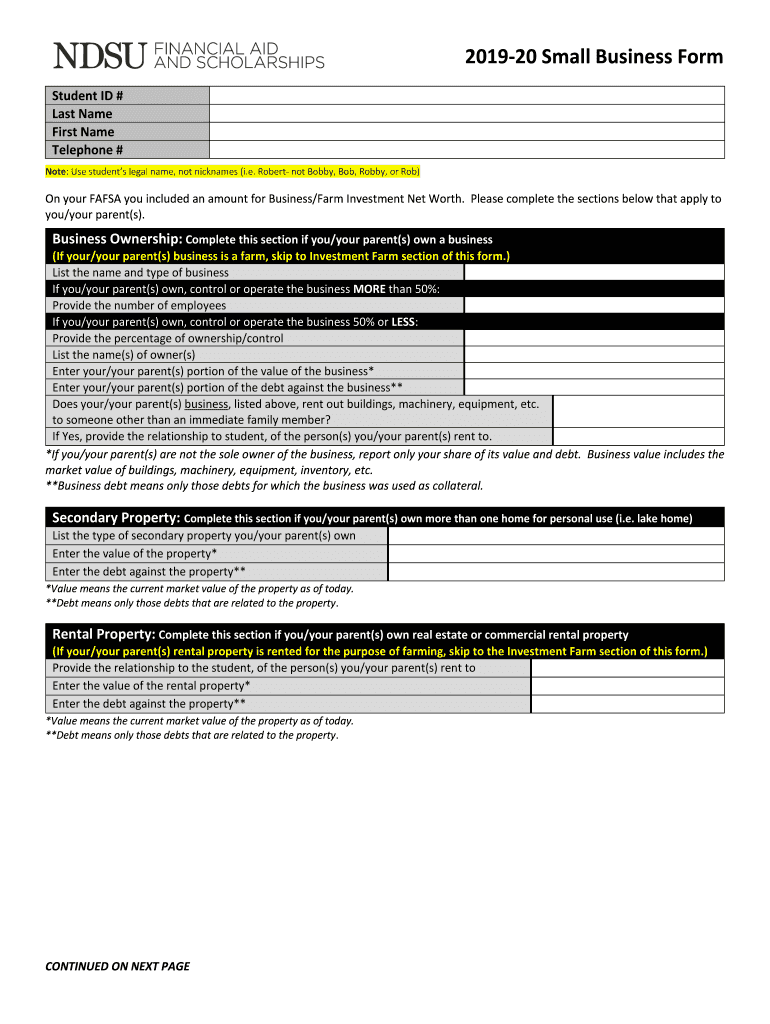







Definition and Purpose
The "2019-20 Small Business Form" is essential for students reporting business and farm investments as part of their FAFSA submission. It provides a structured way to disclose ownership of businesses, secondary and rental properties, and investment farms. This form is crucial for accurately reflecting the financial status of a business, as it ensures the inclusion of all pertinent details within a FAFSA application.
How to Use the 2019-20 Small Business Form
Using this form involves detailed reporting of various business investments. Specific sections need to be completed depending on ownership interests. Instructions guide the user in providing required information, such as total income, expenses, and assets related to business or farm operations. Careful attention is required to ensure accurate and complete data entry, which impacts overall financial aid eligibility.
Steps to Complete the 2019-20 Small Business Form
- Gather Financial Records: Collect all necessary documentation related to business or farm operations, including tax returns and profit/loss statements.
- Identify Ownership Information: Clearly outline the ownership structure of each business or farm.
- Enter Financial Data: Input data related to income, expenses, assets, and liabilities as instructed.
- Review for Accuracy: Double-check entries for correctness to avoid errors that may affect financial aid calculations.
- Submit Completed Form: Ensure submission through the designated FAFSA method—whether online, via mail, or in person.
Key Elements of the 2019-20 Small Business Form
- Business Ownership Details: Information such as name, address, and ownership percentage.
- Financial Reporting Sections: Detailed sections for recording income and expenditure.
- Asset Disclosure: Fields for listing all significant assets tied to the business or farm.
- Verification Needs: Aspects of the form that may require proof or documentation for verification purposes.
Who Typically Uses the 2019-20 Small Business Form
This form is predominantly used by students who have direct involvement in family-owned or personally operated small businesses or farms. Adult students, dependent students, and their families who maintain additional property or business interests often require this form for accurate financial reflection in their FAFSA application.


Form Submission Methods
Submissions can occur online, by mail, or in person, depending on the user’s preference and available infrastructure. It's critical to ensure timely submission to align with FAFSA deadlines to avoid penalties or delays in financial aid processing.
Important Terms Related to the 2019-20 Small Business Form
- Net Worth: The total assets minus liabilities of the business.
- Depreciation: Accounting for wear and tear on capital assets over time.
- Gross Income: Total income before deducting any expenses or taxes.
- Operating Expenses: Costs necessary for running the business that are deducted from income.
Required Documents for Completion
To fill out the form, various documents are essential:
- Previous year tax returns
- Business profit and loss statements
- Valuation of business assets
- Recent property appraisals for real estate associated with businesses and farms
Penalties for Non-Compliance
Failure to accurately complete and submit the 2019-20 Small Business Form can lead to sanctions, including reduced financial aid eligibility or penalties for misreporting. Non-compliance can also lead to auditing by educational financial authorities, potentially resulting in repayment requirements or fines.




