




01. Edit your form online
Type text, add images, blackout confidential details, add comments, highlights and more.

Type text, add images, blackout confidential details, add comments, highlights and more.

Draw your signature, type it, upload its image, or use your mobile device as a signature pad.

Send it via email, link, or fax. You can also download it, export it or print it out.
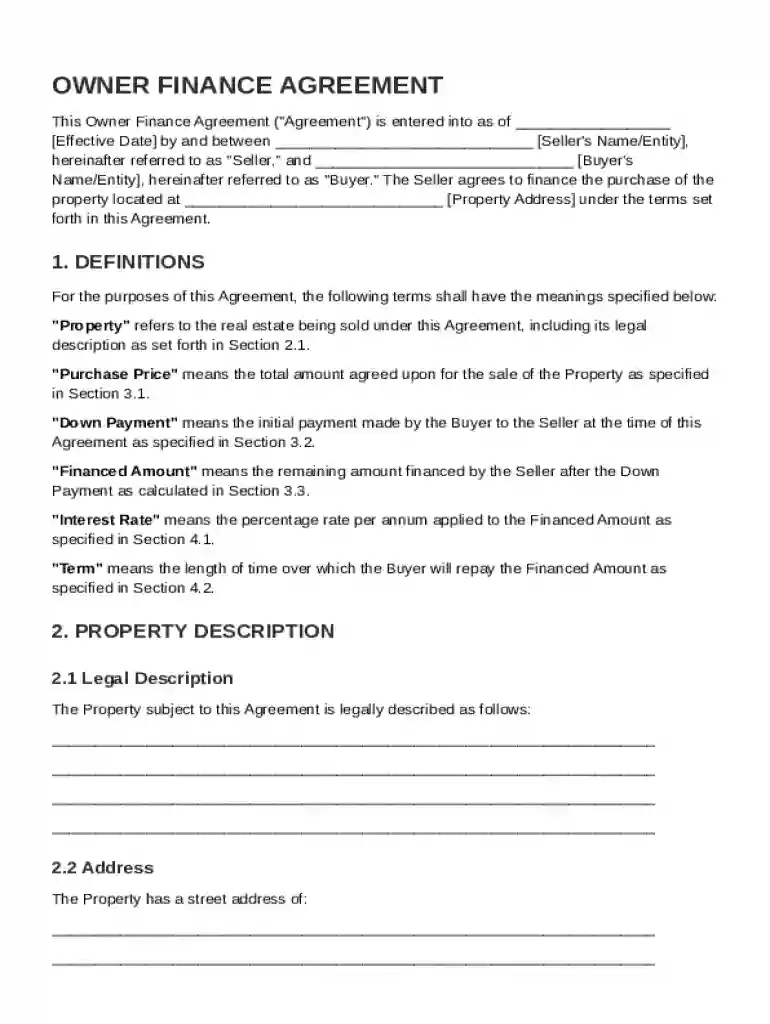
An Owner Finance Contract Template, also known as an Owner Finance Agreement, is a legally binding document that outlines the terms and conditions under which a seller agrees to finance the purchase of a property for a buyer. This type of agreement is often used in real estate transactions where the buyer does not use traditional bank financing. Instead, the seller acts as the lender, providing the buyer with a loan to complete the purchase. The contract covers essential aspects such as the property details, purchase price, down payment, interest rate, and repayment schedule. It ensures that both parties understand their obligations and the process involved in the owner-financed sale.
To effectively use the Owner Finance Contract Template, it is crucial to follow a structured approach. Start by reviewing the template provisions to ensure they meet your specific transaction needs. Customize the template by filling in key information such as parties involved, property details, and financial terms. It is important to consult with legal counsel to adapt template clauses to comply with state-specific regulations and legal requirements. Once customized, both parties must thoroughly review the document before signing. Each party should retain an executed copy for their records. It's advisable to keep a timeline or checklist to track payments and any stipulated obligations.
Completing the Owner Finance Contract Template involves several steps:
Identify the Parties: Clearly list the full names and contact details of the seller (financer) and the buyer.
Describe the Property: Provide a detailed description of the property being sold, including the address, size, and any pertinent identifiers like parcel numbers.
Set Financial Terms: Outline the purchase price, down payment, interest rate, repayment schedule, and payment method. Clearly specify any applicable late fees or penalties.
Define Responsibilities: Detail the obligations of both the buyer and seller concerning property maintenance, insurance, and taxes.
Include Legal Provisions: Incorporate representation and warranties, amendment terms, dispute resolution procedures, and legal notices.
Draft and Review: Compile all information, draft the contract, and have it reviewed by legal professionals.
Execution: Both parties need to sign and date the contract, confirming their agreement to the stated terms.
File and Store: Ensure the signed contract is appropriately filed and accessible for future reference.
The Owner Finance Contract Template is composed of several critical elements:
Property Description: A comprehensive overview of the property features and legal description.
Purchase Price and Down Payment: Specifies the total sale price and initial payment required.
Loan Terms: Covers the interest rate, duration of the loan, and specific payment deadlines.
Seller’s Financing Conditions: Details under which the seller is extending credit to the buyer.
Default Clauses: Outlines the consequences if either party fails to adhere to the terms.
Verification of Ownership: Requires the seller to prove ownership and the right to sell.
Amendment and Termination: Procedures for modifying or ending the agreement.
The legal use of an Owner Finance Contract Template is grounded in ensuring compliance with relevant property and financing laws. It is paramount for the contract to adhere to federal and state laws, especially those pertaining to property transactions and lending practices. Legal provisions should include necessary disclosures and rights, ensuring the template covers aspects like foreclosure rights and the retention of the title until full payment. Engaging with a qualified real estate attorney can help confirm that the contract conforms to legal standards and identifies potential legal liabilities.
Since real estate laws and regulations can vary significantly across states, the Owner Finance Contract Template must be adapted to comply with specific state requirements. Some states have unique rules about allowable interest rates, disclosure requirements, and the foreclosure process. For instance, while some states follow strict judicial foreclosure processes, others may facilitate non-judicial foreclosures. Understanding these distinctions is crucial, as they impact how you draft and execute the agreement. Legal counsel with expertise in the specific state's real estate law can provide invaluable guidance to ensure compliance.
Real-world scenarios illustrate the versatility of the Owner Finance Contract Template. For instance, a seller in a rural area may use this contract to sell a property to a local buyer who cannot secure a traditional loan. Another example could be an investor wanting to rapidly divest a property while generating recurring income through interest payments. These examples demonstrate the contract's ability to facilitate sales in markets where conventional financing is challenging or for transactions aimed at generating seller income over time.
Choosing between a digital and paper version of the Owner Finance Contract Template depends on the transaction's convenience and legal considerations. Digital versions are advantageous for ease of access, sharing, and securing electronic signatures. However, in scenarios where parties prefer physical documentation or where local legislation necessitates, a paper version might retain importance. Both formats require careful management to ensure all parties duly sign and confirm the contract's validity. For digital contracts, platforms like DocHub provide robust security features and compliance with electronic signature laws, such as the ESIGN Act.
At DocHub, your data security is our priority. We follow HIPAA, SOC2, GDPR, and other standards, so you can work on your documents with confidence.



(a) Title. Within () days of the Effective Date, Buyer shall obtain, at s expense, a commitment for an owners policy of title insurance
2.1 PARTY RELATIONSHIP AND ETHICS The Parties each agree to proceed with the. Project on the basis of trust, good faith, and fair dealing, and shall take
Page 8 of 12. Australia and New Zealand Banking Group Limited (ANZ) ABN 11 005 357 522. ASSET FINANCE INDIVIDUAL/SOLE TRADER. APPLICATION FORM. REFERENCES. Bank


