






Definition & Meaning
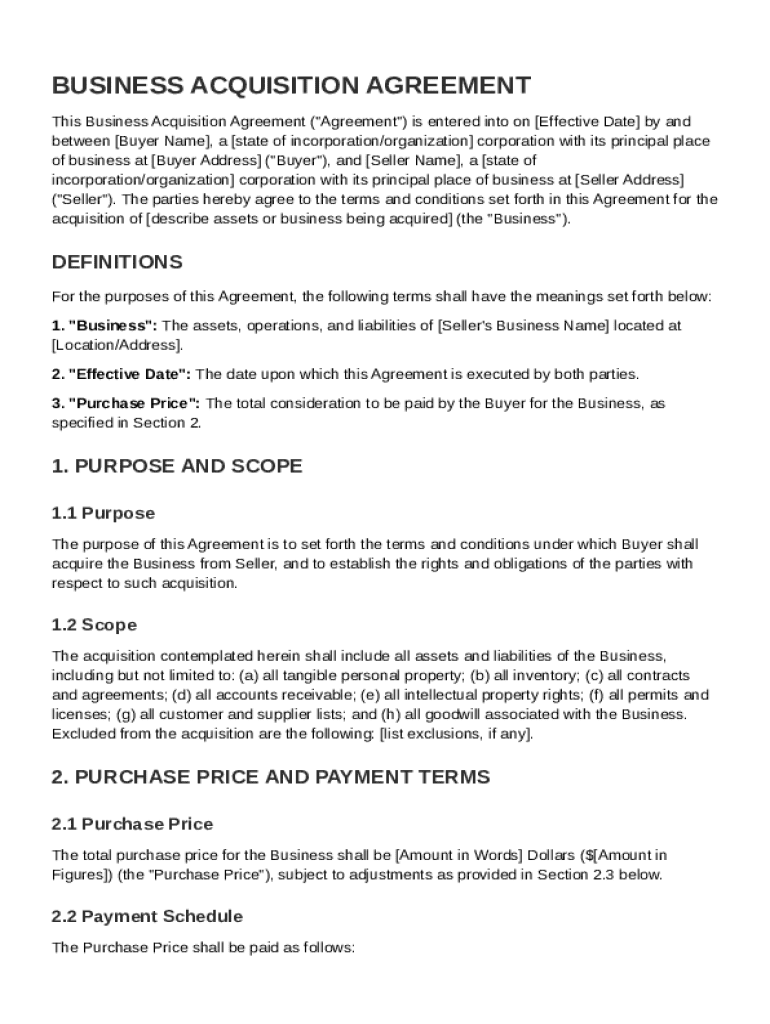
The Business Acquisition Agreement Template serves as a foundational legal document outlining the terms and conditions under which one business acquires another. This template is designed to clearly define the rights and responsibilities of both the buyer and the seller. It typically covers critical aspects such as the purchase price, payment terms, and any representations and warranties offered by both parties. The agreement ensures that parties have a mutual understanding and a formalized commitment to the terms of the business transaction.
Components of the Agreement
- Purchase Price: Details how much the buyer will pay and the breakdown of payment methods.
- Representations and Warranties: Ensures both parties have stated all relevant information truthfully.
- Conditions Precedent: Lists what needs to occur before the acquisition is finalized.
- Post-Closing Covenants: Includes any commitments like non-compete clauses or support in transitioning management.
- Dispute Resolution: Outlines how disputes will be handled if conflicts arise.
How to Use the Business Acquisition Agreement Template
Using the Business Acquisition Agreement Template involves understanding its structure and customizing it to fit your specific transaction. Each clause in the template is a placeholder requiring review and adjustment to incorporate the details that reflect the transaction's context.
Customization Steps
- Identify Parties: Clearly specify the buyer and seller, including their legal names and contact information.
- Payment Terms: Adjust the sections related to the payment terms to align with the agreed financial arrangements.
- Representation Adjustments: Modify any warranties to ensure they are accurate and reflect truthful representations.
- Legal Counsel: Engage with a legal professional to ensure that the modifications are valid and conform to applicable laws.
Practical Tips
- Clause Examination: Evaluate if each standard clause relates to your transaction.
- Special Provisions: Add any necessary clauses unique to your transaction, such as industry-specific regulations.
Key Elements of the Business Acquisition Agreement Template
Each Business Acquisition Agreement Template will typically include several key elements that ensure comprehensive coverage of a business transfer. Understanding these elements helps users effectively utilize the template and tailor it to their needs.
Main Elements
- Confidentiality Obligations: Protects sensitive information exchanged between parties.
- Governing Law: Determines which state or jurisdiction’s laws will apply to the agreement.
- Amendment Procedures: Specifies how changes to the agreement will be made and documented.
- Closing Date: States when ownership of the business officially transfers.
In-Depth Details
- Non-Compete Clauses: Restricts sellers from starting a similar business within a designated area and time frame.
- Transition Assistance: Offers sellers the chance to support buyers in transitional phases post-acquisition.
Steps to Complete the Business Acquisition Agreement Template
Completing the template involves a methodical approach to ensure all necessary information is accurately captured and legally binding. Below is a breakdown of the steps needed to finalize the template.
- Gather Information: Collect relevant details about both businesses involved, including financial documents and business licenses.
- Fill Out Buyer and Seller Details: Input accurate information for each party.
- Detail Transaction Terms: Specify the purchase price, payment schedule, and any contingencies.
- Review Representations and Warranties: Ensure these are accurate and agreed upon by all parties.
- Legal Review: Consult a legal expert to review the completed agreement to verify compliance with legal standards.
- Signatures: Once reviewed and agreed upon, both parties should sign the document in the presence of a notary if required.
Legal Use of the Business Acquisition Agreement Template
This template ensures that all aspects of business transactions are appropriately documented and legally compliant. Adhering to legal standards is crucial to avoid potential disputes that might arise from the acquisition process.
Compliance Aspects
- Legal Jurisdiction: Make sure the document adheres to the legal requirements in the state where the business operates.
- Tax Obligations: Consider tax liabilities and obligations that may arise from the acquisition.
- ESIGN Act Compliance: Ensure that electronic signatures used on the document are valid and legally binding.
Documentation Necessities
- Supporting Documents: Ensure all certificates of incorporation, financial statements, and licenses support the agreement.
- Audit Trail: Maintain records of the document revisions and approvals, which can serve as the legal audit trail.
Important Terms Related to the Business Acquisition Agreement Template
Understanding key contractual terms ensures clarity and prevents misunderstandings between the involved parties. Here are some pivotal terms commonly used in the context of business acquisition agreements:
Key Terms
- Indemnification: This term deals with compensations for losses incurred.
- Closing Conditions: Details what must happen before the acquisition is completed.
- Material Adverse Change: A disclosure requirement for any events that might impact the business significantly post-agreement.
Contextual Understanding
- Asset vs. Stock Purchase: Distinguishes whether the acquisition involves buying the assets of a company or purchase of its stock.
- Earnout: A provision allowing sellers to get additional compensation based on the future performance of the business.
Who Typically Uses the Business Acquisition Agreement Template
This legal template is utilized predominantly by individuals or entities engaged in the buying or selling of businesses. It facilitates clarity and professionalism in structuring the transaction.


Typical Users
- Entrepreneurs: Individuals seeking to expand their portfolio through acquisitions.
- Small Businesses: Companies involved in organic growth strategies by acquiring competitors or complementary businesses.
- Mergers and Acquisitions Professionals: Legal and financial advisors who assist clients in structuring their business deals using standard legal frameworks.
Use Case Scenarios
- Startup Acquisitions: For quick expansion into new markets by acquiring promising startups.
- Family Business Transfers: Familiy-owned business transitions to new family members or third-party buyers.
State-Specific Rules for the Business Acquisition Agreement Template
Each state in the U.S. may have different legal requirements and regulations involving business acquisitions. Recognizing these differences is critical to ensure compliance and validity of the acquisition agreement.
State Variations
- Regulatory Requirements: Some states may have distinct registration requirements or tax obligations.
- Jurisdiction-Specific Clauses: It might be necessary to insert clauses that pertain only to specific state-based legal precedents.
Examples
- California: Could require additional environmental compliance certifications.
- Delaware: Known for its business-friendly laws, with more flexible corporate regulations that might alter the standard agreement format.
Examples of Using the Business Acquisition Agreement Template
Real-world examples illustrate how the Business Acquisition Agreement Template is applied in different scenarios to successfully negotiate and document a business purchase.
Case Studies
- Local Franchise Purchases: A company using the template to ensure the smooth transfer of franchise rights and responsibilities.
- Technology Firms Mergers: Two tech firms utilizing the template to merge their operations and achieve a collective operational strength.
- Retail Chain Expansions: A national retailer employing the template in the acquisition of regional stores to strengthen its market reach.
Practical Scenarios
- Joint Ventures: Documenting agreement terms for newly formed entities composed of existing businesses.
- Asset Relocation: Using the template to clarify asset purchase terms when a business moves its operations to another state.
These sections offer comprehensive insights into the Business Acquisition Agreement Template, ensuring that users can accurately complete and utilize the document effectively in business transactions.