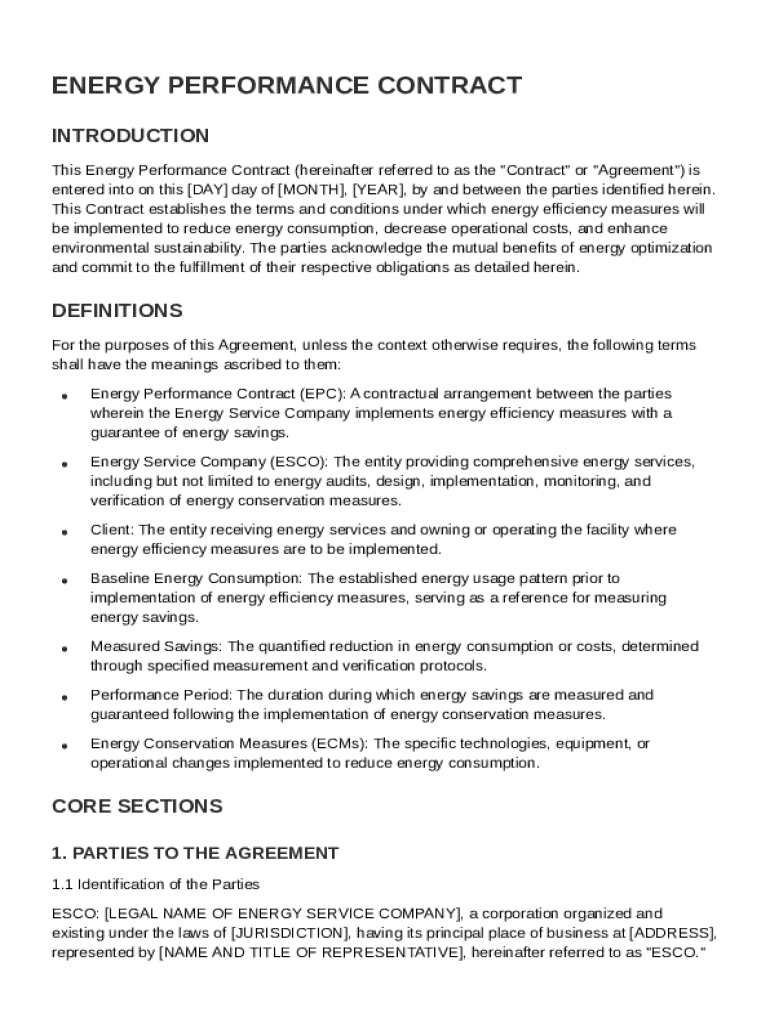







Definition & Meaning
An Energy Performance Contract (EPC) serves as a formal agreement between an Energy Service Company (ESCO) and a client, aimed at implementing energy efficiency measures to reduce energy consumption and operational costs while enhancing sustainability. This contract outlines each party's roles and responsibilities, detailing the scope of work, financial provisions, measurement and verification protocols, and performance guarantees. The document additionally addresses terms for termination and dispute resolution, serving as a comprehensive framework for energy optimization and monitoring energy savings.
- ESCO Role: The ESCO is tasked with identifying potential energy savings, implementing the necessary improvements, and guaranteeing the project’s performance.
- Client Role: The client provides access to facilities and agrees to financial arrangements as outlined in the agreement.
Key elements include establishing measurable savings, defining project scopes, and ensuring both parties understand their commitments. The overarching goal is for both participants to benefit from energy savings and improved efficiencies.
Key Elements of the Energy Performance Contract Template
A well-drafted Energy Performance Contract Template encompasses several critical components that contribute to its effectiveness:
- Scope of Work: Clearly identifies the buildings or systems where energy efficiency measures will be applied, along with the specific improvements to be undertaken.
- Financial Provisions: Provides a detailed breakdown of initial costs, financing options, payment schedules, and savings projections.
- Performance Guarantees: Specifies the expected energy savings and requires the ESCO to cover any shortfalls, ensuring a return on investment for the client.
- Measurement and Verification Protocols: Outlines the methodologies used to assess actual energy savings against projected outcomes, often utilizing standard protocols like the International Performance Measurement and Verification Protocol (IPMVP).
- Termination and Dispute Resolution: Details the conditions under which the contract can be prematurely terminated and the mechanisms for resolving contractual disputes, such as mediation or arbitration.
Comprehensive inclusion and detailed drafting of these elements are essential for ensuring clarity and achieving the intended benefits of the contract.
How to Use the Energy Performance Contract Template
Utilizing the Energy Performance Contract Template requires a step-by-step approach to customize the framework to meet specific needs:
- Identify Objectives: Determine the primary goals for energy savings and sustainability improvements.
- Select a Qualified ESCO: Choose an energy service company with a proven track record and the appropriate technical capabilities.
- Customize the Template: Use the template as a foundation, modifying specific sections like scope, financial terms, and performance metrics to accurately reflect the agreement's intentions.
- Legal Review: Consult with legal counsel to review the customized contract for compliance with relevant regulations and standards.
- Sign and Implement: Once both parties agree to the terms, execute the contract and initiate the agreed-upon energy efficiency measures.
This process ensures that the contract template is effectively tailored to the specific project requirements and legal standards.
Steps to Complete the Energy Performance Contract Template
Completing the Energy Performance Contract Template requires diligence to ensure all pertinent information is included:
- Gather Information: Collect necessary data regarding energy use, potential savings, and technical information for improvements.
- Draft Specific Terms: Modify the template to include project-specific details such as site locations, scope, timelines, and roles.
- Negotiate Terms: Collaborate with the ESCO to negotiate financial terms, performance guarantees, and implementation schedules.
- Review and Finalize: Conduct a thorough review to ensure all necessary clauses are clearly defined and legally sound.
- Signatures: Have both parties sign the finalized document to signify agreement and contractual obligation.
In-depth attention to each step assures that the contract aligns with the shared objectives of all stakeholders involved.
State-Specific Rules for the Energy Performance Contract Template
The energy services landscape varies across different states, influencing how Energy Performance Contracts are implemented:
- Regulatory Compliance: Some states have more stringent regulations regarding energy savings measures and reporting requirements.
- Incentive Programs: Available incentives such as rebates, tax credits, and grants can vary, potentially impacting financial arrangements.
- Public Sector Requirements: Specific rules may exist for public entities concerning bidding processes and financial approval.
- Environmental Standards: Local environmental standards can dictate technology and methods eligible for use in an EPC.
Understanding these differences is crucial to ensure the contract is valid and takes full advantage of state-specific advantages.
Important Terms Related to Energy Performance Contract Template
Understanding terminology is essential to successfully navigate an Energy Performance Contract:
- Baseline: Pre-project energy consumption levels against which savings are measured.
- Retrofit: Upgrading existing building systems to improve energy efficiency.
- Performance Period: The phase during which savings measurements take place.
- Energy Audit: An assessment conducted to identify opportunities for energy savings.
- Lifecycle Cost Analysis: Evaluation of all costs associated with an energy project over its lifetime.
Familiarity with these terms ensures all parties have a shared understanding of the contract's provisions.
Examples of Using the Energy Performance Contract Template
Various sectors have successfully employed Energy Performance Contracts to achieve substantial energy savings:
Commercial Sector
- Case Study - Office Complex: A commercial office complex employed an EPC to retrofit lighting and HVAC systems, resulting in a 20% reduction in annual energy expenses.
- Retail Chains: Large retail chains have used EPCs to standardize energy-saving measures across locations, improving overall sustainability.
Government Buildings
- Municipal Buildings: Local governments have applied EPCs to reduce energy usage in public buildings, achieving compliance with environmental mandates.
- School Districts: School systems have utilized EPCs for heating and ventilation upgrades, cutting costs while maintaining a comfortable learning environment.
These examples illustrate the adaptability and effectiveness of EPCs in diverse applications, highlighting their potential for cost savings and enhanced sustainability.
Legal Use of the Energy Performance Contract Template
Ensuring the legal validity and enforceability of an Energy Performance Contract involves several considerations:
- Regulatory Compliance: The contract must adhere to federal and state-level legal standards, including environmental regulations.
- Contractual Obligations: Clearly outline the obligations of each party and the consequences of non-compliance.
- Binding Nature: Ensure that the contract is signed by authorized representatives, making it binding.
- Legal Recourse: Include provisions for legal recourse in case of disputes, such as mediation or court proceedings.
Legal precision in drafting and compliance ensures the enforceability and sustainability of the agreement, enabling it to hold up under scrutiny if any disputes arise.
Who Typically Uses the Energy Performance Contract Template
The Energy Performance Contract Template is commonly utilized by a range of entities focused on cost reduction and sustainability:
- Corporate Facilities: Large corporations looking to reduce operating costs and increase energy efficiency.
- Government Agencies: Public sector bodies committed to reducing energy usage in municipal buildings.
- Healthcare Institutions: Hospitals and health systems aiming to reduce the environmental impact while lowering utility expenses.
- Educational Institutions: Universities and school systems seeking budget-friendly solutions for campus energy management.
Each user group has unique goals but shares the broader aim of operational cost reduction and improved energy performance.