Unilateral Contract Template 2026

Get Form
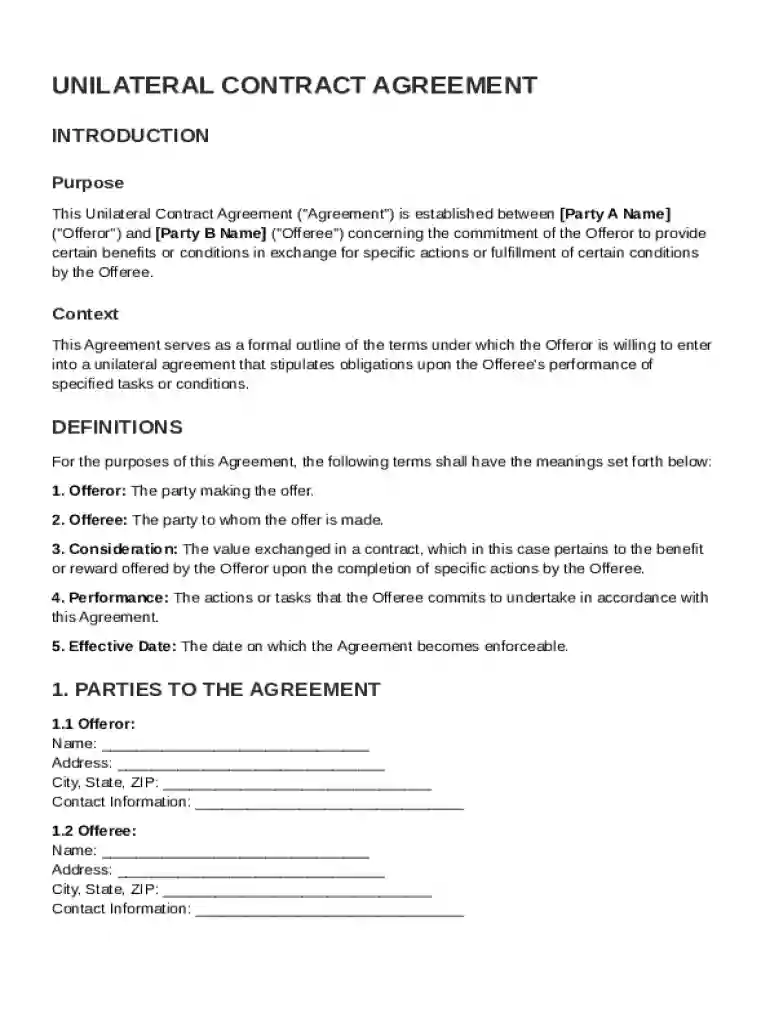
Unilateral Contract Template Preview on Page 1

Here's how it works

01. Edit your form online
Type text, add images, blackout confidential details, add comments, highlights and more.

02. Sign it in a few clicks
Draw your signature, type it, upload its image, or use your mobile device as a signature pad.

03. Share your form with others
Send it via email, link, or fax. You can also download it, export it or print it out.

Definition & Meaning

A Unilateral Contract Agreement is a legal arrangement between an Offeror and an Offeree, where the Offeror promises to provide a benefit contingent upon the Offeree performing a specified act. Common in scenarios like rewards or insurance policies, this agreement binds the Offeror once the Offeree completes the stipulated action, allowing legal enforcement of the promised benefits. By understanding the definition, both parties can navigate their roles more effectively, ensuring clarity in the responsibilities and the rewards involved.

Key Characteristics

  • Single Party Obligation: Only the Offeror is legally bound to fulfill the promise once the Offeree completes the task.
  • Performance-Based Agreement: The contract is enforceable only upon the successful performance of an action by the Offeree.
  • Examples: Common examples include reward advertisements, insurance claims, or acceptance of public offers.

Key Elements of the Unilateral Contract Template

Understanding the critical components of the Unilateral Contract Template is essential for creating a comprehensive and binding agreement. These elements include:

Obligations and Actions

  • Offer Description: Clearly outlines what the Offeror is promising.
  • Action Required: Details the specific action the Offeree must perform.

Consideration

  • Value Exchange: Specifies the benefit or reward the Offeree receives upon completion.

Legal Terms

  • Governing Law and Jurisdiction: Specifies which state's laws will govern the contract.
  • Termination Conditions: Lists the scenarios under which the contract may be terminated prior to completion.

How to Use the Unilateral Contract Template

Using the Unilateral Contract Template properly involves several steps to ensure the agreement is valid and enforceable.

Step-by-Step Process

  1. Identify Offer Details: Specify the offer and conditions that must be fulfilled.
  2. Clarify Expectations: Include precise terms to prevent misunderstandings.
  3. Include Consideration Clauses: Detail what the Offeree will receive for fulfilling their part of the contract.

Best Practices

  • Clear Language: Avoid legal jargon to ensure both parties fully understand the terms.
  • Consult Legal Advice: Consider consulting a lawyer to review the draft for compliance with local laws.

Examples of Using the Unilateral Contract Template

Using practical scenarios can help illustrate how the Unilateral Contract Template is applied in real-world cases.

Common Examples

  • Public Rewards: Offering a financial reward for the return of lost property.
  • Incentive Programs: Companies offering bonuses to customers for referrals or repeat purchases.

Case Studies

  • Insurance Policies: Insurance companies providing coverage benefits once specific conditions are met.
  • Academic Scholarships: Grants where students must attain certain grades to receive funding.

Legal Use of the Unilateral Contract Template

Ensuring legal compliance when using a Unilateral Contract Template is crucial to prevent disputes.

Considerations

  • Legal Clarity: All terms should be clearly defined to ensure enforceability.
  • State Laws: Different states may have specific requirements or interpretations.

Dispute Resolution

  • Mediation and Arbitration: Common methods included in contracts to resolve disputes without court involvement.

Who Typically Uses the Unilateral Contract Template

Understanding who uses the Unilateral Contract Template can offer insight into its versatility and practicality across industries.


decoration image ratings of Dochub

Typical Users

  • Businesses and Corporations: Often use unilateral contracts for promotional activities.
  • Individuals: May use them in private transactions such as hiring services or fulfilling public offers.

Benefits for Businesses

  • Clarity and Efficiency: Helps to streamline agreements where conditional performance is required.
  • Risk Mitigation: Protects the Offeror by setting specific terms for compliance.

State-Specific Rules for the Unilateral Contract Template

State laws can affect how unilateral contracts are interpreted and enforced.

Variations by State

  • Unique Legal Precedents: Each state may have different precedents that affect contract enforcement.
  • Contractual Requirements: Some states might require additional clauses or disclosures.

Compliance Tips

  • Research Local Laws: Ensure the contract meets all state-specific legal requirements.
  • Update Regularly: Keep the template in line with any changes in local jurisdiction rules.

Important Terms Related to Unilateral Contract Template

Understanding the terminology used in a Unilateral Contract Template is essential for its effective use and enforcement.

Core Terms

  • Offeror and Offeree: Differentiates the party making the promise from the one expected to perform the action.
  • Performance: Refers to the action taken by the Offeree to fulfill the contract's terms.

Legal Jargon

  • Consideration: A fundamental concept referring to the value exchanged for the execution of the contract.

By recognizing and understanding these terms, users of the Unilateral Contract Template can navigate its intricacies with better comprehension and precision.

be ready to get more

Complete this form in 5 minutes or less

Get form

Got questions?

We have answers to the most popular questions from our customers. If you can't find an answer to your question, please contact us.
Contact us
A unilateral contract is a one-sided agreement formed when an offer can only be accepted by performing the specified action, meaning payment is made only after the action is completed.
Elements of a unilateral contract For example, if someone makes an offer to reward a person who finds a lost pet, then the person is bound by his offer to pay a reward only when someone actually finds the pet and comes to him to return the pet.
One common example of a unilateral contract is an insurance policy. In this case, the insurance company (the offeror) promises to pay a specified amount to the policyholder (the offeree) in the event of a covered loss.
Unilateral refers to one side. It is a term used to describe movements or structures on one side of the body. For example, when the erector spinae contract unilaterally, they contribute to ipsilateral flexion and ipsilateral rotation.
How to create a unilateral contract step-by-step Step 1: Identify the offer. Step 2: Detail the required performance. Step 3: State the offers timeframe. Step 4: Outline the terms of acceptance. Step 5: Draft the contract clauses. Step 6: Review for legal compliance. Step 7: Finalize and communicate the offer.

Security and compliance

At DocHub, your data security is our priority. We follow HIPAA, SOC2, GDPR, and other standards, so you can work on your documents with confidence.

Learn more
ccpa2
pci-dss
gdpr-compliance
hipaa
soc-compliance

People also ask

In a unilateral contract, there is an express offer that payment is made only by a partys performance. Common examples include reward offers or contests, where one party promises to pay or give a reward if the other party accomplishes a specific task.
Legal Elements Required in Unilateral Contracts Clear Offer: The offeror must make an unambiguous promise. Consideration: There must be something of value offered (e.g., money for returning a lost item). Performance: The contract becomes binding only when the offeree starts or completes the specified action.

Related links