
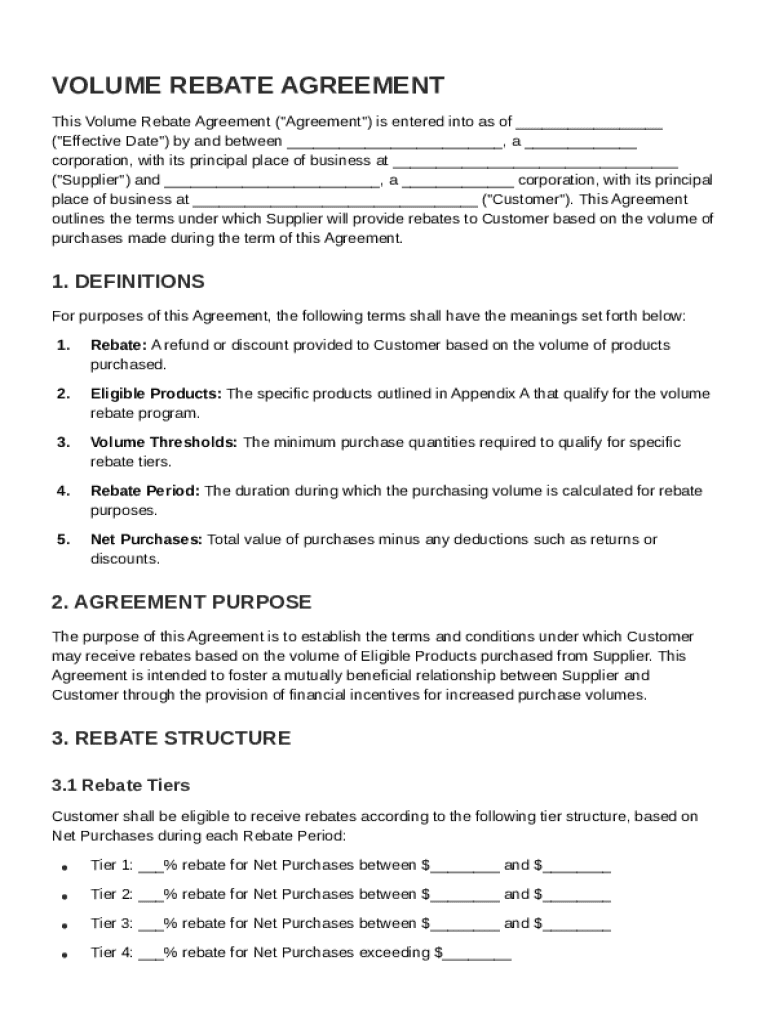







Definition and Meaning
The Volume Rebate Agreement Template is a legal document outlining the conditions under which a supplier provides rebates to customers based on the volume of eligible product purchases. It acts as a framework to incentivize clients to purchase larger quantities by offering financial rewards or rebate payments, contingent upon meeting specific purchasing milestones.
Purpose of Volume Rebate Agreements
- Incentivize Larger Purchases: Encourages customers to increase their order volume to benefit from rebate incentives.
- Strengthen Supplier-Customer Relationships: Fosters long-term partnerships by aligning incentives with customer needs.
- Predictable Revenue Streams: Assists suppliers in forecasting revenue based on expected order volumes.
How to Use the Volume Rebate Agreement Template
Utilizing the Volume Rebate Agreement Template involves several specific steps to ensure accuracy and compliance with the agreed-upon terms.
- Identify Stakeholders: Recognize the parties involved, typically the supplier and the customer.
- Define Rebate Criteria: Clearly outline the conditions under which rebates will be offered, including purchase volume thresholds.
- Set Rebate Tiers: Establish rebate tiers that may encourage progressive purchasing.
- Agree on Payment Terms: Determine the frequency and method of rebate payments.
- Include Confidentiality Clauses: Protect sensitive information, ensuring both parties maintain confidentiality regarding terms and conditions.
- Negotiate Dispute Resolution Mechanisms: Establish processes for resolving potential conflicts or discrepancies.
Important Terms Related to Volume Rebate Agreement Template
Understanding key terms within the Volume Rebate Agreement is crucial for both parties to protect their interests.
- Rebate Threshold: The minimum volume purchase required to qualify for rebates.
- Eligibility Criteria: Conditions products must meet to be eligible for rebate calculations.
- Rebate Tier: Different levels of rebates offered as purchase volumes increase.
- Confidentiality Clause: A section in the agreement ensuring both parties uphold the privacy of shared information.
- Termination Clauses: Stipulations allowing for the agreement to be voided under specific circumstances.
Examples of Key Terms in Action
- Rebate Thresholds: A supplier mandates a minimum purchase of 1,000 units for any rebate to apply, ensuring high-volume commitment from the customer.
- Confidentiality Clauses: Both parties agree not to disclose specific rebate percentages to external entities to retain competitive advantage.
Steps to Complete the Volume Rebate Agreement Template
Completing this template requires precise input from both stakeholders to accurately reflect the agreement's terms.
- Download the Template: Access a standard template that fits your business needs.
- Input Company Information: Enter details for both the supplier and the customer, including legal name and business address.
- Specify Product Details: Enumerate products subject to the rebate, including specific SKUs if applicable.
- Outline Rebate Terms: Clearly define the volume thresholds and corresponding rebate percentages.
- Include Legal Clauses: Insert necessary legal language covering confidentiality, dispute resolution, and termination.
- Review and Adjust: Both parties should scrutinize the draft to ensure mutual agreement.
- Sign the Final Version: Ensure both parties electronically sign or physically autograph the final document version.
Key Elements of the Volume Rebate Agreement Template
A successful agreement contains several foundational elements:
- Identification of Parties: Names and contact information of all involved entities.
- Detailed Rebates Structure: Explicit articulation of volume thresholds and corresponding percentages.
- Payment Processes: Description of how rebates will be paid (e.g., credit, direct payment).
- Legal Safeguards: Provisions for confidentiality and dispute resolution.
- Termination Rights: Clauses that outline exit strategies for either party.
Real-World Scenarios Utilizing Agreement Elements
- Incentive Programs: A supplier offers a 10% rebate for customers purchasing over 5,000 units in a calendar year, driving up bulk orders.
- Dispute Resolution: Should a disagreement arise over rebate calculations, pre-established arbitration ensures impartial settlement.
State-Specific Rules for the Volume Rebate Agreement Template
Regulatory requirements can vary across U.S. states, impacting the structure of rebate agreements.
- California: Strict privacy protection laws may require enhanced confidentiality clauses.
- New York: State-specific electronic signature compliance could affect document execution.
- Texas: Competitive rebate practices may need further detailing to avoid anti-trust issues.
Examples of State-Specific Compliance
- California Compliance: Necessary to incorporate explicit consent for data collection within agreements.
- Texas Anti-trust Concerns: Agreements need additional provisions to ensure rebates are structured to not inhibit fair competition.
Legal Use of the Volume Rebate Agreement Template
The correct application of this agreement requires adherence to legal guidelines, ensuring the document’s enforceability.
- Adherence to Contract Law: Agreements must align with states' contract legality.
- ESIGN Act: Ensures electronic agreements are legally binding, relevant for digital document execution.
- Disclosure of Rebates: Certain jurisdictions might necessitate full disclosure of rebate structures to maintain transparency and equality among comparable transactions.
Practical Examples of Legal Use
- Ensuring Validity: A New York-based company uses the DocHub platform to electronically sign a rebate agreement, utilizing ESIGN compliance for legal recognition.
- Disclosure Requirements: An agreement specifies that rebate conditions will not be shared with competing suppliers to maintain ethical fairness.
Business Types That Benefit Most from Volume Rebate Agreement Template
Several business models benefit significantly from employing volume rebate agreements.
- Wholesale Distributors: Utilizing rebates to encourage bulk ordering, increasing stock turnover.
- Manufacturing Entities: Incentivizing partners to prioritize their products over competitors.
- Retail Chains: Securing better pricing with suppliers based on committed purchase volumes.
Scenario Examples
- Retail Chains: A nationwide retail chain secures lower purchase prices from suppliers by committing to high-volume orders, bolstered by rebate incentives.
- Wholesale Distributors: A distributor of electronics harnesses a rebate structure to spur regional retailers to purchase more stock, streamlining supply chain efficiency.


