Definition and Meaning of Michigan Notary Public
A Michigan Notary Public is an appointed official authorized to perform various administrative tasks, including witnessing signatures on legal documents, administering oaths, and certifying copies in the state of Michigan. The role is critical for ensuring the authenticity of certain transactions and preventing fraudulent activities. To become a notary in Michigan, individuals must meet specific eligibility requirements and follow a structured application process.
How to Use the Michigan Notary Public Status
Once appointed, a Michigan Notary Public can perform several tasks. Common uses include:
- Administering Oaths and Affirmations: Notaries can administer oaths, which are typically required in legal proceedings such as affidavits and depositions.
- Acknowledging Signatures: Notaries verify the identity of signers to ensure the authenticity of their signature on legal documents like deeds and powers of attorney.
- Certifying Copies: Notaries may certify that a copy of a document is true to the original, although this excludes public records.
For a document to be notarized in Michigan, it must contain the signature of the notary, a notary seal, and a statement of certification.
How to Obtain the Michigan Notary Public Appointment
To become a notary public in Michigan, individuals must follow several steps:
- Eligibility Requirements: Applicants must be at least eighteen years old, a resident of Michigan or maintain a principal place of business in the state, and must read and write English.
- Surety Bond: Obtain a surety bond in the amount of $10,000 from an approved insurance provider.
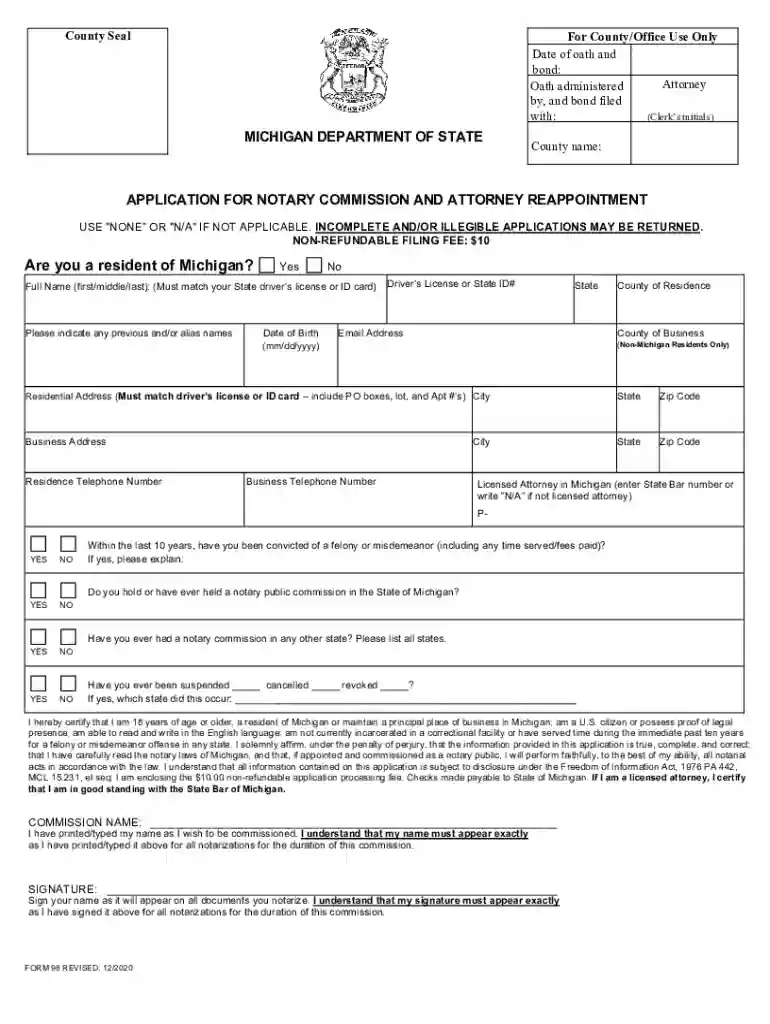
- Application Submission: Complete the application form provided by the Michigan Department of State. An application must include identification details and be notarized.
- File with County Clerk: Submit the application and bond to the County Clerk’s office where the applicant resides or has their principal business.
- Pay Fees: A $10 fee must be included with the application.
Steps to Complete the Michigan Notary Application
Completing the Michigan Notary Public application involves the following detailed steps:
- Prepare Documentation: Acquire a surety bond and have identification ready for verification.
- Fill the Application Form: Provide required personal details and information about your residence or place of business.
- Notarize the Application: The application must be notarized before submission, which can be done by an existing notary.
- Submission and Fees: Submit the notarized form, surety bond, and fee to the County Clerk’s office.
- Await Approval: The application process typically takes several weeks. Once approved, you will receive your notary commission.
Why Should You Pursue Becoming a Michigan Notary Public?
Becoming a Notary Public in Michigan can benefit individuals and businesses alike. Here are some reasons:
- Enhance Professional Credentials: Being a notary can add credibility and authority to your professional profile, especially in fields such as law, real estate, and finance.
- Income Opportunities: Notaries can charge fees for their services, providing additional income streams.
- Community Service: Notaries play an essential role in safeguarding public trust by ensuring that legal processes are carried out with integrity.
Who Typically Becomes a Michigan Notary Public?
Typically, individuals in professions requiring document authentication pursue notary status. These include:
- Legal Professionals: Lawyers and paralegals often become notaries to facilitate legal document processing.
- Real Estate Agents: Notary services are crucial for property transactions and closing processes.
- Bankers and Financial Advisors: These professionals frequently handle documents that require notarization, such as loan agreements.
Legal Use and Considerations for a Michigan Notary Public
A Michigan Notary Public must adhere to specific legal standards and ethical considerations:
- Impartiality: Notaries must be impartial and should not perform notarizations where they have a personal interest.
- Record Keeping: Maintain an accurate logbook of all notarial acts performed, including date, type of transaction, and names of signers. This logbook may be required as evidence in legal proceedings.
- Compliance with State Laws: Familiarity with Michigan's legal requirements for notarizations is essential to avoid penalties or loss of commission.
Key Elements of the Michigan Notary Public Role
Several key elements define the role of a Michigan Notary Public:
- Seal or Stamp: A notary is required to have an official seal that includes their name, the words "Notary Public, State of Michigan," and their commission expiration date.
- Commission Duration: A notary's commission lasts for six years, after which it must be renewed following the same application process.
- Identification Verification: It is obligatory for notaries to verify the identity of individuals before notarizing documents. Acceptable forms include government-issued photo identification.
By understanding these elements, a Michigan Notary Public ensures they fulfill their responsibilities competently, adhering to the standards set by the state.