Parenting Plan Agreement Template 2026

Get Form
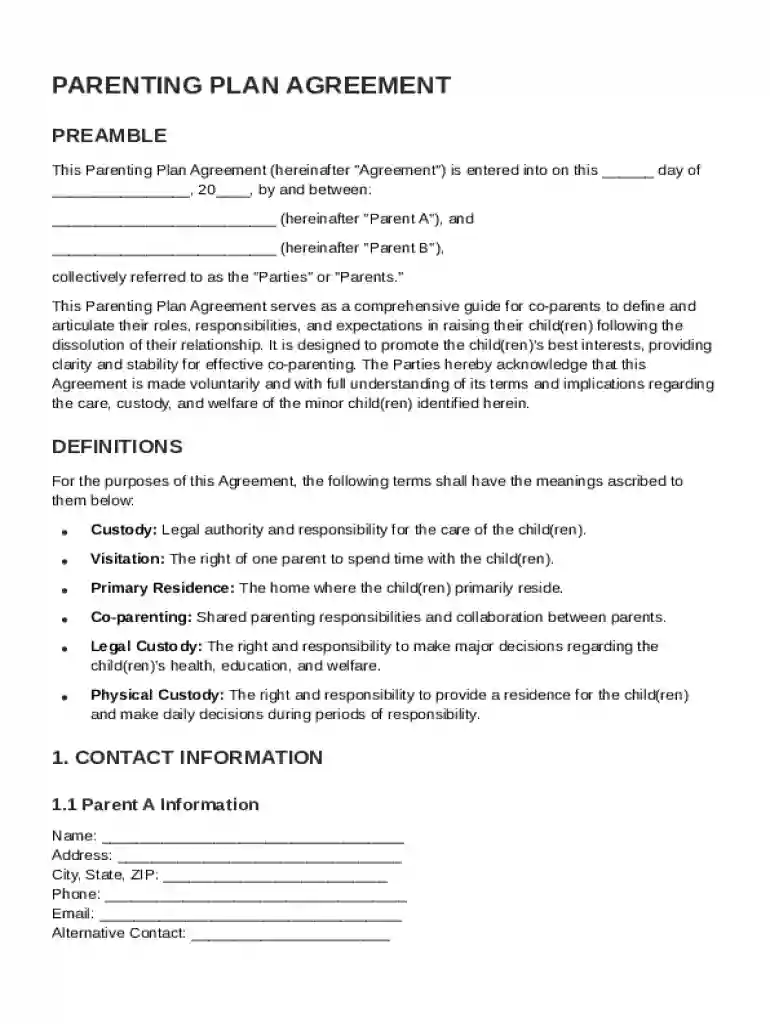
Parenting Plan Agreement Template Preview on Page 1

Here's how it works

01. Edit your form online
Type text, add images, blackout confidential details, add comments, highlights and more.
02. Sign it in a few clicks
Draw your signature, type it, upload its image, or use your mobile device as a signature pad.
03. Share your form with others
Send it via email, link, or fax. You can also download it, export it or print it out.

Definition and Purpose of a Parenting Plan Agreement Template

A Parenting Plan Agreement Template is a vital legal document that codifies the responsibilities and expectations of parents who are co-parenting after separation. It outlines arrangements concerning legal and physical custody, visitation schedules, and the financial obligations of each parent, such as child support and healthcare expenses. This agreement endeavors to maintain stability and clarity for both parents while ensuring the best interests of the child(ren).

Key Features of the Agreement

  • Custody Arrangements: Defines both legal and physical custody, detailing who makes significant decisions regarding the child(ren) and where they will reside.
  • Visitation Schedules: Establishes a schedule for when the child(ren) will spend time with each parent.
  • Financial Responsibilities: Identifies obligations related to child support and shared expenses like medical bills and education.

How to Use the Parenting Plan Agreement Template

The Parenting Plan Agreement Template is a tool designed to assist parents in formalizing their co-parenting strategy. It allows for the inclusion and modification of various elements specific to the family's needs.

Detailed Steps for Effective Use

  1. Familiarize with the Template: Review the template's structure to understand essential sections like custody and financial arrangements.
  2. Personalize Details: Modify the template to reflect the unique dynamics and needs of your family.
  3. Consult Legal Professionals: Consider seeking advice from a family law attorney to ensure all elements comply with relevant laws.

Customization Options

  • Add or adjust terms to address special needs, such as religious upbringing or school choice.
  • Use optional sections in the template to specify emergency protocols or summer vacation schedules.

Steps to Complete the Parenting Plan Agreement Template

Completing the Parenting Plan Agreement Template is a detailed process that requires careful consideration of various factors and clear communication between parents.

Step-by-Step Guide

  1. Gather Required Information: Collect personal details of both parents and the child(ren).
  2. Clarify Custody Details: Establish the type of custody arrangement and outline decision-making responsibilities.
  3. Define Visitation and Holiday Schedules: Specify routines for holidays, school breaks, and regular visits.
  4. Outline Financial Obligations: Detail child support agreements and shared costs like healthcare.
  5. Finalize and Execute: Review the completed document and sign it in the presence of a legal professional, if necessary.

Key Elements of the Parenting Plan Agreement Template

Primary Components

  • Contact Information: Details for both parents and the child(ren).
  • Communication Protocols: Methods and frequency of communication between parents.
  • Dispute Resolution Mechanisms: Procedures for managing disagreements, such as mediation.

Supporting Elements

  • Amendments and modifications clause should unforeseen circumstances arise.
  • Provisions for relocation or change in school districts.

Legal Use of the Parenting Plan Agreement Template

In the U.S., a Parenting Plan Agreement serves as a legal document that can be utilized in court proceedings related to custody and child support cases. It is crucial to ensure the template aligns with state-specific requirements and legal standards.

Legal Compliance Considerations

  • State Laws: Review state guidelines, as some states have specific requirements or suggested formats for parenting plans.
  • Modification Rights: Agreements can often be modified with mutual consent or court approval to accommodate changing needs.

Important Terms Related to the Parenting Plan Agreement Template

Understanding the jargon and key terms within the Parenting Plan Agreement is essential for ensuring all parties comprehend their obligations.

Terminology Explanation

  • Joint Custody: Both parents share decision-making responsibilities.
  • Sole Custody: One parent holds the primary authority for significant decisions.
  • Visitation Rights: The scheduled time allotted for the non-custodial parent to spend with the child(ren).

Examples of Using the Parenting Plan Agreement Template

Practical insights into how families utilize the Parenting Plan Agreement can offer guidance for structuring an effective plan.

Real-World Scenarios

  • A family with joint custody may use the template to detail a weekly alternating schedule and shared financial responsibilities for extracurricular activities.
  • Another scenario involves a situation where one parent is given sole custody with supervised visitation rights for the other parent. The template can specify conditions and schedules for such visits.

State-Specific Rules for the Parenting Plan Agreement Template

While the template provides a framework, customization may be required to ensure it meets specific legal standards in different states.

Adapting to State Requirements

  • Some states mandate that a plan must include detailed visitation schedules, while others may have specific statutes concerning child support.
  • In states like California, the template may need to comply with detailed forms required by the court.

By following these detailed steps and considering the practical implications and legal requirements, parents can use the Parenting Plan Agreement Template as an effective tool to support the well-being of their child(ren) and provide clarity in their co-parenting relationship.

be ready to get more

Complete this form in 5 minutes or less

Get form

Got questions?

We have answers to the most popular questions from our customers. If you can't find an answer to your question, please contact us.
Contact us
The 777 Parenting Rule is straightforward. When you feel overwhelmed or triggered, you pause. You breathe deeply for seven seconds, hold that breath gently for another seven seconds, and then slowly release the breath over the final seven seconds.
What is the 7-7-7 rule? At its core, the 7-7-7 rule is exactly what it sounds like: spend 7 minutes in the morning, 7 minutes after school or work, and 7 minutes before bed in a dedicated, undivided connection with your child.Jan 7, 2026
To create a parenting plan, start by discussing a series of checklist items. Focus on your childs best interest and use a mediator if necessary. Youll address issues like the custody schedule, finances, and much more. Youll submit it to a family court, and its legally binding once approved.Mar 14, 2025
Youre showing up, fully, for your child. Some parents also interpret the 7 7 7 rule of parenting as a breathing technique to calm down during stressful parenting moments, inhale for 7 seconds, hold for 7 seconds, exhale for 7 seconds. That version is powerful too, especially for managing parental stress.Aug 5, 2025
The 7-7-7 rule of parenting has two main interpretations: one focuses on three daily 7-minute connection blocks (morning, after school, bedtime) for undivided attention to build emotional security, while the other suggests a developmental approach (0-7 years: Play; 7-14 years: Teach; 14-21 years: Advise) to guide children as they grow, with a third, less common interpretation being a 7-second breathing technique for stressed parents. Both aim to create quality time and support childrens emotional health at different stages, emphasizing presence over quantity. 1. The Daily Connection Method (21 Minutes Total) 7 Minutes in the Morning: Start the day positively with hugs, breakfast talk, or planning the day. 7 Minutes After School/Work: Reconnect by asking open-ended questions and actively listening without distractions like phones. 7 Minutes Before Bed: Wind down with reading, reflection, or calm conversation to build security. 2. The Developmental Stages Method (Age-Based Roles) Ages 0-7: Focus on Play, building the foundation of their learning and social skills. Ages 7-14: Focus on Teaching, guiding them on right and wrong and life skills. Ages 14-21: Focus on Advising, supporting their growing independence. 3. The Stress-Relief Breathing Technique Inhale deeply for 7 seconds, hold for 7 seconds, and exhale slowly for 7 seconds to calm yourself during stressful moments. All versions emphasize intentional, focused time to strengthen the parent-child bond, with the connection method being a practical tool for busy families, notes this LinkedIn post. The 7 7 7 Rule of Parenting: 21 Minutes That Change EverythingAug 5, 2025 Some parents also interpret the 7 7 7 rule of parenting as a breathing technique to calm down during stressful parentinSakeena AcademyThe 7-7-7 Rules That Change Parenting Forever I Morning BytesOct 30, 2025 when you were truly. there but the truth is that most of the time. we are so caught up with work our screen time and sYouTube Gitas Kitchen

Security and compliance

At DocHub, your data security is our priority. We follow HIPAA, SOC2, GDPR, and other standards, so you can work on your documents with confidence.

Learn more
ccpa2
pci-dss
gdpr-compliance
hipaa
soc-compliance

People also ask

The biggest mistake in a custody battle is losing sight of the childs best interests by letting anger, revenge, or personal conflict drive decisions, as courts prioritize the childs well-being and stability above parental disputes, viewing negative behavior like badmouthing the other parent or obstructing access as harmful to the child and damaging to your case. Common pitfalls include poor communication (especially online/social media), inflexibility, failing to co-parent, disengagement, or putting the child in the middle of adult conflicts. Key Mistakes to Avoid Prioritizing Conflict Over Co-Parenting: Allowing resentment to dictate actions, refusing to communicate, or trying to win rather than cooperate. Badmouthing the Other Parent: Speaking negatively about your ex to the children or in court undermines your ability to foster a healthy co-parenting relationship, which judges value highly. Inappropriate Communication: Sending angry texts, emails, or posting on social media about the case or the other parent can be used as evidence against you. Blocking Access: Unreasonably preventing the other parent from seeing the child, unless there are genuine safety concerns, signals a lack of support for the childs relationship with both parents. Disengagement/Inconsistency: Being an absent or neglectful parent or failing to maintain consistent routines, which signals a lack of commitment and stability. Parentification: Forcing a child to act as an emotional support or caregiver, which is detrimental to their development. Moving Strategically: Moving far away just before filing for custody can be seen negatively. What Courts Look For Childs Best Interests: The primary focus is the childs safety, stability, emotional well-being, and consistent care. Cooperation Communication: The ability to work with the other parent to make decisions for the child. Stability: A predictable, stable environment with established routines. Fostering Healthy Relationships: Supporting the childs relationship with both parents (when safe). What is the biggest mistake in a custody battle?Miles Mason Family Law Group, PLCWhat Is the Biggest Mistake in Custody Battle? - Inman TourgeeJan 1, 2026 The biggest mistake in a custody battle is losing sight of your childs best interests. When parents let anger or hurt Inman Tourgee Attorneys At Law
70/30 parenting refers to a child custody schedule where one parent has the child 70% of the time (e.g., weekdays/school year) and the other has them 30% (e.g., every other weekend/holidays), often creating one primary home base, while a different interpretation is a parenting philosophy for perfectionism: being good enough (70%) is sufficient, allowing for imperfection the other 30%. Both concepts focus on consistency and meeting needs, whether for a childs living situation or emotional development, with the custody model fitting families where one parents schedule or location makes 50/50 difficult. 70/30 Custody Schedule (Logistical) Concept: One parent serves as the primary residential parent (70%), while the other has DocHub visitation (30%), often structured as weekends and some mid-week time. Examples: Week/Weekend: Parent A (Primary) has Monday-Friday; Parent B (30%) has Saturday-Sunday. Every Other Weekend: Parent A has the child during the week, and Parent B has them every other weekend. 2-1 Rotation: Child spends two weeks with Parent A, then one week with Parent B. Why its used: Creates a stable home base for the child, suits geographic distance, or accommodates work schedules. 70/30 Parenting Philosophy (Emotional) Concept: A reminder that parents dont need to be perfect; responding with love and consistency about 70% of the time is enough. The 30%: The remaining time is for imperfection, mistakes, and self-care, which ultimately helps parents be better caregivers. Goal: Reduces parental stress and perfectionism, focusing on connection rather than flawless execution. Aiming for 70/30: When Good Enough Parenting is EnoughMar 24, 2016 They show us what we need to work on within ourselves. They show us our trigger points. They show us how to cope with Sarah Ockwell-Smith70/30 Custody Visitation Schedules: 5 ExamplesCustody X Change
The 3-6-9-12 rule, created by French psychiatrist Serge Tisseron, is a guideline for gradually introducing screens to children: no screens before age 3, no personal game consoles before 6, no internet with adult supervision before 9, and no social media or unsupervised internet before 12, focusing on promoting development and healthy digital habits. It emphasizes shared, educational screen time with parental involvement, transitioning to responsible digital exploration as children grow. The 3-6-9-12 breakdown: Before Age 3: No screens (TV, phones, tablets) to encourage sensory and play-based learning, except perhaps for supervised video calls. Ages 3-6: Introduce short, shared screen time (e.g., educational apps with parents) to foster creativity, but avoid personal game consoles. Ages 6-9: Allow limited, supervised internet access (around 30-60 mins/day), focusing on exploration and learning rules, with no personal consoles. Ages 9-12: Delay social media, teach online safety and critical thinking, and allow more independent, but still monitored, internet use. Key principles: Parental Involvement: The rule stresses active parental participation in shared screen experiences. Gradual Introduction: Its about pacing technology use with a childs developmental stages, not strict bans forever. Focus on Alternatives: Encourages play, reading, and outdoor activities instead of passive screen time. Guide your childrens screen use with the 3-6-9-12 rule - AleteiaFeb 17, 2019 Lent 2026. Your Lenten sacrifice can enlighten millions of readers. Please support Aleteia. Doctors are unanimous in tAleteiaVisualizing the rule of 3-6-9-12 - Eleni TriantopoulouJan 25, 2016LinkedIn Eleni Triantopoulou

Related links