
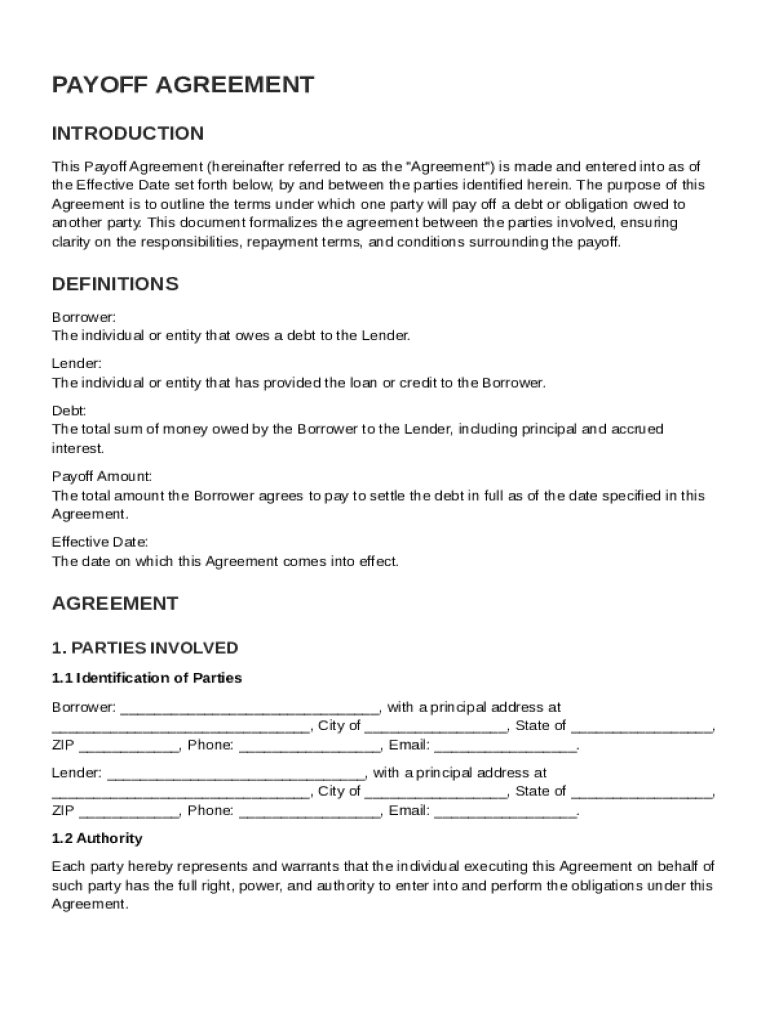







Definition and Meaning of a Payoff Agreement Template
A Payoff Agreement Template is a standardized document that outlines and formalizes the terms and conditions under which a borrower agrees to settle or pay off a debt owed to a lender. This template is essential in providing clarity and transparency to both parties involved in the transaction. It details the obligations, rights, and responsibilities associated with the payoff, ensuring mutual understanding and agreement. Key components typically included in the document are definitions of essential terms, identification of the parties involved, a comprehensive description of the outstanding debt, and the specific terms of payment, such as the amount, timing, and method of payoff.
How to Use the Payoff Agreement Template
To effectively use the Payoff Agreement Template, follow these steps to ensure each critical aspect is addressed:
-
Review Terms and Conditions: Begin by carefully reading and understanding the generic terms outlined in the template. Ensure it aligns with the specific needs and context of your agreement.
-
Customize for Specific Needs: Input borrower and lender details, tailor payment terms, and specify any additional conditions or clauses that may be unique to the situation. Specific attention should be paid to state-specific legal requirements if applicable.
-
Consult with Legal Professionals: Given the legally binding nature of these documents, it is prudent to consult with legal professionals to ensure compliance with relevant laws and regulations.
-
Execute and Secure Signatures: Once the template is customized and reviewed, arrange for both parties to sign the document. Utilizing electronic signature tools can facilitate this process smoothly and securely.
-
Maintain Records: Keep a copy of the completed agreement for future reference and ensure that all parties involved have access to the finalized document.
Steps to Complete the Payoff Agreement Template
Effectively completing a Payoff Agreement Template involves several structured steps:
-
Gather Information: Collect all necessary details regarding the debt, including the original loan agreement, identification of all parties involved, and any previous agreements or amendments.
-
Fill Out General Information: Enter the names and contact information of both the borrower and lender, as well as the date of agreement execution.
-
Specify Payment Details: Clearly outline the total payoff amount, the breakdown of payments if applicable, due dates, and the accepted payment methods.
-
Incorporate Legal Provisions: Ensure inclusion of any applicable representations and warranties, conditions precedent, and release of claims clauses.
-
Finalize the Document: After compiling all the required information and clauses, review the document thoroughly to check for completeness and accuracy before obtaining signatures.
Key Elements of the Payoff Agreement Template
A comprehensive Payoff Agreement Template will consist of several key elements that collectively ensure clarity and enforceability:
- Parties Involved: Fully identifies the borrower and lender, including legal names, addresses, and any relevant identification details.
- Description of Debt: Provides a detailed account of the debt being settled, including principal, interest rates, fees, and any accrued penalties.
- Payment Terms: Includes a detailed plan for payment execution, covering aspects like lump-sum payments, installment schedules, and any interest rate implications.
- Mutual Release of Claims: Outlines the terms under which both parties agree to release each other from future claims related to the debt once it is paid off.
- Legal Compliance: Ensures the agreement adheres to applicable legal standards and jurisdictions.
Examples of Using the Payoff Agreement Template
For a deeper understanding of practical applications, examine scenarios where the Payoff Agreement Template is utilized:
-
Mortgage Payoff: When a homeowner is ready to pay off their mortgage in full, the template is used to ensure all payment terms are clearly outlined and agreed upon.
-
Business Loan Settlement: Companies might use the agreement when settling outstanding business loans, providing clarity in what conditions each party must meet for the loan to be considered repaid in full.
-
Auto Loan Finishing: Individuals concluding an auto loan might use the template to clarify the final payment terms and release the lien on the vehicle.
Who Typically Uses the Payoff Agreement Template
The Payoff Agreement Template is predominantly used by individuals and entities involved in lending and borrowing agreements. Typical users include:
- Mortgage Lenders and Borrowers: Engaging in housing or property loan payoffs.
- Business Lenders and Corporate Borrowers: Utilizing the template to document the payoff of commercial loans.
- Financial Advisors and Legal Professionals: Assisting clients in concluding debt responsibilities with structured agreements.


State-Specific Rules for the Payoff Agreement Template
Certain states may have specific legal requirements or additional stipulations regarding payoffs:
-
Statutory Notice Periods: Some states require specific notice periods before a payoff can be finalized, ensuring that both parties have adequate time to review conditions.
-
Recording Requirements: In some jurisdictions, payoff agreements must be recorded with a public authority, especially in case of real estate transactions, to update ownership or encumbrance records.
-
Mandatory Disclosures: Certain states mandate additional disclosures concerning interest calculations or methods used by lenders.
Digital vs. Paper Version of the Payoff Agreement
An evolving trend in the completion of Payoff Agreements is the preference for digital over paper versions. Key advantages of digital versions include:
-
Ease of Distribution and Accessibility: Digital templates can be easily shared and accessed by all parties, facilitating quicker review and modifications.
-
Security: With secure platforms offering encryption and authentication, digital agreements can provide higher security than physical documents.
-
Legally Binding Electronic Signatures: The incorporation of digital signature technologies allows for straightforward execution, maintaining legality and efficiency.




