
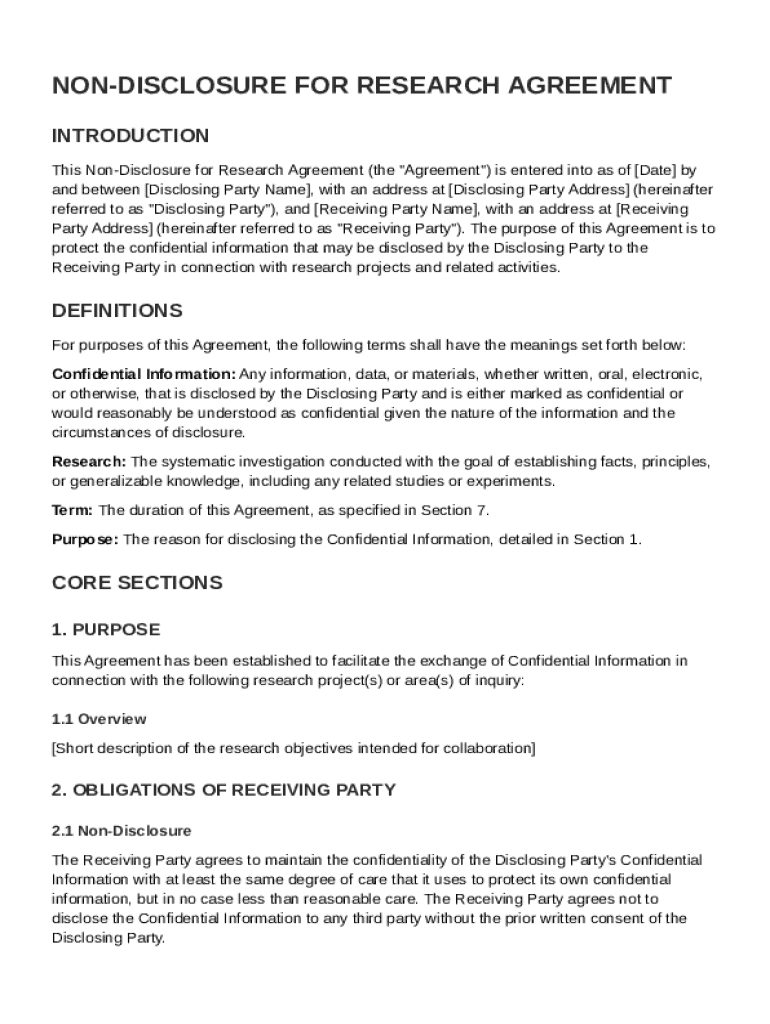







Understanding the Non-Disclosure for Research Agreement
The Non-Disclosure for Research Agreement (NDRA) is a vital legal document designed to safeguard sensitive information exchanged between two parties during a research collaboration. It outlines specific obligations for the Receiving Party to protect confidential data, establishes exclusions to confidentiality, and sets the duration of confidentiality obligations. This agreement highlights the mechanisms for enforcing confidentiality, emphasizing its importance in maintaining trust and integrity during research activities.
Key Elements of the Agreement
Definitions and Obligations
- Disclosing Party: The entity providing confidential information.
- Receiving Party: The entity receiving and obliged to protect the confidential information.
- Confidentiality Obligations: The Receiving Party must not disclose or use the confidential information beyond agreed purposes.
Exclusions and Duration
- Exclusions: Information that was public prior to disclosure or becomes public through no fault of the Receiving Party.
- Duration: Typically, obligations last for a specified period, often ranging from two to five years, after which the information may no longer be considered confidential.
How to Use the NDRA Template
Utilizing the NDRA template involves several systematic steps:
- Download the Template: Obtain the template from a reliable source, ensuring it is the latest version.
- Fill Out Basic Information: Enter the names of the Disclosing and Receiving Parties, the scope of the agreement, and the definition of confidential information.
- Review Terms: Carefully go through the obligations, exclusions, and terms of confidentiality to ensure mutual understanding.
- Sign and Date: Ensure both parties sign and date the document, making it a legally binding commitment.
Who Typically Uses the NDRA
The Non-Disclosure for Research Agreement is commonly used by:
- Academic Institutions: When collaborating with other universities or private sectors.
- Research Companies: Seeking to protect proprietary methods.
- Government Entities: Engaging in joint research projects with third parties.
- Nonprofits and NGOs: In collaborations involving sensitive data.


Legal Use and Compliance
Enforceability
- The NDRA is a legally binding document under U.S. law. Both parties must understand their obligations fully to ensure compliance and enforceability.
- Violations of the agreement can lead to legal action, including injunctions or monetary damages.
State-Specific Rules
- While the NDRA is generally governed by federal law, specific state laws may impose additional obligations or modify terms concerning enforceability.
- Parties should consult legal counsel to ensure compliance with relevant state laws.
Important Terms Related to the NDRA
Ownership Rights
- The agreement clearly states ownership of the confidential information remains with the Disclosing Party.
Termination Conditions
- The NDRA includes conditions under which the agreement can be terminated prematurely, such as mutual consent or fulfillment of the research goals.
Examples of Using the NDRA
Academic Research Collaboration
A university collaborating with a pharmaceutical company may draft an NDRA to protect data exchanged about new drug formulations. This protects intellectual property rights while facilitating open discussion.
Technology Development Project
A tech startup working with a major corporation to develop new software can use an NDRA to safeguard early-stage project details, ensuring innovations are protected until public release.
Electronic Execution and Distribution
DocHub offers an intuitive solution for electronically signing and sending NDRAs. Users can:
- E-Sign: Create legally binding electronic signatures.
- Send and Track: Distribute the agreement to involved parties and track the signing process.
- Audit Trail: Keep a clear record of document views and signatures to ensure transparency and accountability.
By understanding and efficiently employing the Non-Disclosure for Research Agreement Template, organizations can protect vital information, facilitate seamless collaborations, and comply with legal standards.




