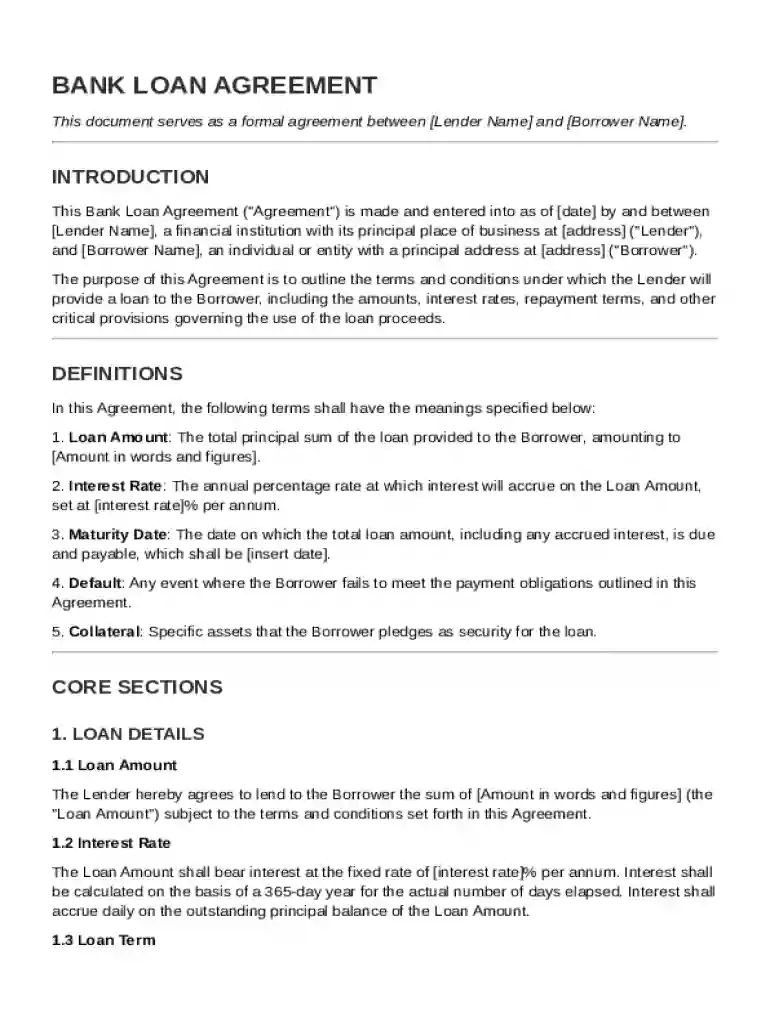
Definition and Meaning
A Bank Loan Agreement is a formalized contract between a lender, typically a bank, and a borrower. This document outlines the detailed terms of the loan arrangement, including the loan amount, interest rates, repayment schedule, and the authorized use of funds. It also defines critical terms such as default and collateral, setting the framework for the borrower's repayment obligations and the lender's rights if the terms are not met. This legal document aims to ensure clarity and protect the interests of both parties involved in the financial transaction.
Key Elements of the Bank Loan Agreement Template
The template of a Bank Loan Agreement typically includes several important components. These elements ensure that both parties are aware of their responsibilities and the conditions of the loan. Key components include:
- Loan Amount and Terms: Specifies the total amount borrowed and detailed repayment terms, including the payment schedule and due dates.
- Interest Rate: Outlines whether the interest is fixed or variable, and how it will be calculated over the loan period.
- Collateral Requirements: Details any assets pledged by the borrower as security for the loan, such as real estate or equipment.
- Default Conditions: Defines what constitutes a default and the subsequent actions the lender may take in such an event.
- Representations and Warranties: Lists assurances given by both parties, often about their ability to meet contractual obligations.
- Governing Law: Specifies which jurisdiction's laws will govern the agreement, important for resolving any legal disputes.
- Amendment Process: Details how and when agreements can be modified, typically requiring written consent from both parties.
Important Terms Related to the Bank Loan Agreement Template
Understanding the specific terminology is crucial for both parties involved in a bank loan agreement. Important terms include:
- Principal: The original sum of money borrowed, which must be repaid.
- Amortization: The process of gradually reducing the principal balance through regular payments.
- Guarantor: A third party who agrees to repay the loan if the borrower defaults.
- Covenants: These are conditions or clauses that require or prevent certain actions during the loan term.
- Prepayment: Paying off the loan or part of it before the maturity date, which might attract penalties or incentives.
Legal Use of the Bank Loan Agreement Template
The legal framework of a Bank Loan Agreement serves both as a guide and protection for involved entities. The agreement's legal validity:
- Ensures Clarity: By setting forth clear expectations and obligations, the agreement minimizes the risk of misunderstandings and disputes.
- Protects Borrower and Lender Rights: Provides a legal basis for enforcing terms, protecting interests if the borrower defaults or the lender breaches the agreement.
- Amendable Only in Writing: Legally, changes to the agreement require written amendments, preserving the integrity of the initial terms.
Steps to Complete the Bank Loan Agreement Template
Completing the Bank Loan Agreement Template involves a structured process to ensure accuracy and completeness:
- Gather Essential Information: Collect all necessary details about the loan amount, interest rate, repayment terms, and collateral.
- Fill in Borrower and Lender Information: Include full legal names, addresses, and contact information for both parties.
- Outline Loan Terms and Conditions: Clearly define the loan amount, interest rate, repayment schedule, and any applicable fees or charges.
- Define Collateral and Default Terms: Identify any collateral offered and the conditions under which a default is declared.
- Add Representations and Warranties: Document assurances regarding the parties' capacity to fulfill the agreement.
- Insert Governing Law: Indicate which state or federal laws will govern the agreement.
- Sign the Agreement: Obtain signatures from both the lender and the borrower to finalize the document.
How to Use the Bank Loan Agreement Template
The template serves as a starting point for drafting a customized agreement between a bank and a borrower:
- Customization: Adjust the template to reflect the specific terms of the loan by filling in all relevant fields and sections.
- Legal Review: Consider having a lawyer review the completed document to ensure it meets relevant legal standards and adequately protects interests.
- Execution: Once finalized, both parties should review and sign the agreement to make it legally binding.
Examples of Using the Bank Loan Agreement Template
Real-world applications highlight the versatility of the Bank Loan Agreement Template:
- Business Expansion Loan: A small business owner secures additional funding to expand operations and hires more staff. The agreement outlines terms for equipment used as collateral.
- Home Improvement Loan: A homeowner borrows funds to renovate their property. The agreement specifies repayment terms linked to the property's equity.
- Educational Loan for Tuition: A student acquires a loan to cover tuition fees, with a parent as guarantor. The agreement details payment deferral options until after graduation.