




01. Edit your documents cover online
Type text, add images, blackout confidential details, add comments, highlights and more.

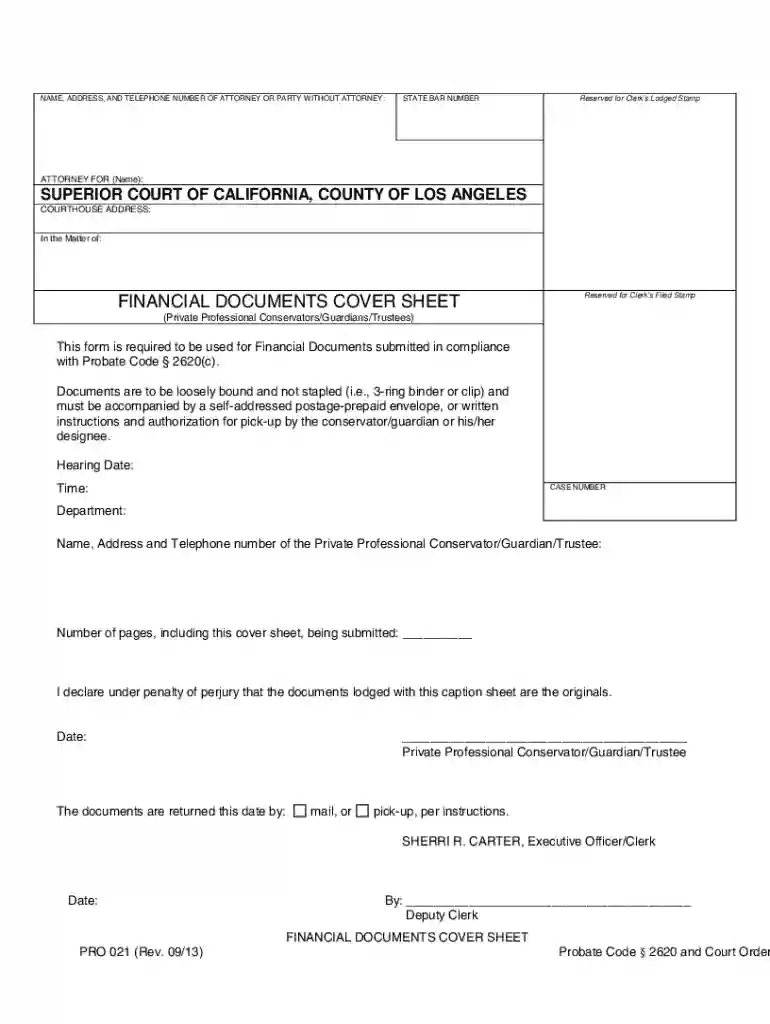
Type text, add images, blackout confidential details, add comments, highlights and more.

Draw your signature, type it, upload its image, or use your mobile device as a signature pad.

Send pro 021 via email, link, or fax. You can also download it, export it or print it out.
A financial cover sheet is an essential document used to organize and present financial records and statements required in various formal settings, such as court proceedings or financial audits. In the context of California's legal system, it serves as a transparent means of submitting financial documents in compliance with the state's Probate Code, specifically § 2620(c). This cover sheet typically acts as a summary page that outlines the requisite financial details, documentation authenticity, and identity of the involved parties, allowing for a streamlined evaluation process. Including attorney details, case-specific information, and a declaration of authenticity ensures that the presented documents are both complete and legally substantive.
Using a financial cover sheet requires a systematic and thorough approach to ensure all necessary information is accurately captured. Follow these steps to effectively use this form:
Gather All Necessary Financial Documents: Compile all relevant financial records that need to be submitted along with the financial cover sheet. This may include bank statements, asset inventories, and income reports.
Complete the Cover Sheet Details: Fill in the attorney information, case number, and details about the conservator, guardian, or trustee as required. Ensure that the financial data is accurately represented in the designated sections.
Attach Supporting Documentation: Securely attach all gathered financial documents to the cover sheet. Use binding methods as instructed to maintain document order and integrity.
Include a Self-Addressed Envelope or Pick-Up Authorization: Provide either a self-addressed envelope for document returns or pick-up authorization for convenience and quick access to finalized paperwork.
Review for Accuracy and Completeness: Double-check that all fields are completed and attachments are included. Verification of all entered information against the original documents is key to avoiding submission errors.
Submit to the Relevant Authority: Deliver the completed financial cover sheet and accompanying documents to the appropriate legal, financial, or institutional authority by the stipulated deadline.
Completing a financial cover sheet involves several critical steps to ensure accuracy and compliance:
Identify the Appropriate Form Version: Ensure you're using the correct version of the financial cover sheet for the jurisdiction or institution that requires it.
Enter Contact Information: Begin with recording the contact information of the attorney or responsible party handling the submission. This typically includes full names, addresses, and contact numbers.
Fill in Case Details: Accurately input the case details such as case number, court location, and involved parties. This section is vital for associating the documentation with the correct legal entity or proceeding.
Declare Document Authenticity: Complete the declaration statements as requested. This section serves as a legal attestation of the accuracy and integrity of the attached financial records.
Organize Financial Data: Systematically list the financial data required within the form, ensuring that each entry corresponds to the appropriate fields. This includes categorizing assets, liabilities, and any pertinent financial activities.
Ensure Compliance with Instructions: Follow any specific instructions provided for binding and submission, such as using particular types of fasteners or folders.
Understanding the key elements included in a financial cover sheet is crucial for proper execution and submission:
Various professionals and individuals rely on financial cover sheets, primarily in legal and financial contexts. Common users include:


While financial cover sheets serve a common purpose, specific rules and guidelines can vary significantly from state to state:
Using a financial cover sheet offers distinct advantages to both individuals and organizations:
Adhering to filing deadlines is critical when submitting a financial cover sheet, notably in legal contexts where timeliness is paramount:
We've got more versions of the documents cover form. Select the right documents cover version from the list and start editing it straight away!
At DocHub, your data security is our priority. We follow HIPAA, SOC2, GDPR, and other standards, so you can work on your documents with confidence.
Check the documents you are attaching to this cover sheet to be sealed: Income tax records. Pay stubs or other proof of earnings. Credit card statements.Read more
Financial Highlights ; Revenue. 15,260. 14,622 ; Gross profit margin. 41.2%. 40.3% ; EBIT. 1,336. 1,270 ; Profit attributable to Owners of the Company. 1,198. 1,122.Read more


