





Definition & Meaning
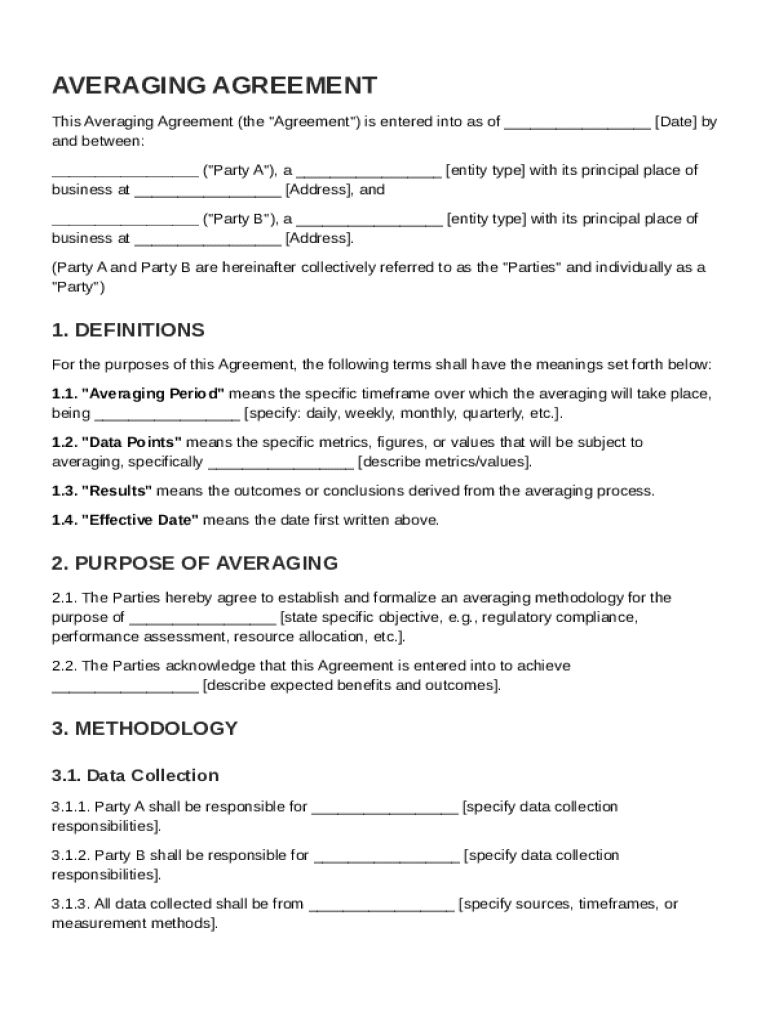
An Averaging Agreement Template outlines the structure and guidelines that two parties, commonly referred to as Party A and Party B, utilize to average specific data over a defined period. This legal document formalizes how data will be collected, calculated, and reported. It is often used to ensure regulatory compliance or to assess performance where averages provide pivotal insights. For instance, in industries where output or productivity must be reported, this template ensures that both parties abide by a standardized method to calculate and present data, maintaining consistency and reliability.
How to Use the Averaging Agreement Template
Using the Averaging Agreement Template effectively involves several steps. First, both parties should clearly define the data that will be subject to averaging. Next, set the timeframe over which the data will be averaged, and detail the methodology that will be used for calculation. Incorporate sections that outline the obligations of each party to provide accurate data. Additionally, it is crucial to document processes for handling discrepancies or disputes. Multiple examples of averages can be specified, such as weekly or monthly performance metrics, enhancing understanding of the process and expectations.
Steps to Complete the Averaging Agreement Template
Filling out the Averaging Agreement Template involves:
- Identify Parties: Clearly state the names and roles of Party A and Party B.
- Define Scope: Specify what data will be averaged and the purpose of averaging.
- Set Timeframe: Determine the period over which the data will be collected and averaged.
- Detail Methodology: Outline the steps involved in calculating the averages, including tools or formulas.
- Outline Responsibilities: Define each party's duties in data provision and compliance.
- Include Confidentiality Clauses: Provide measures to ensure data security and privacy.
- Resolve Disputes: Establish a procedure for addressing any disputes or inaccuracies.
- Signatures: Ensure both parties sign and date the agreement to confirm consent.
Key Elements of the Averaging Agreement Template
The template comprises several critical elements:
- Data Collection Methods: Details how data should be gathered, ensuring accuracy and regularity.
- Calculation Process: Specifies the formula or software used for averaging.
- Confidentiality Assurance: Includes clauses to protect sensitive information and intellectual property.
- Dispute Resolution: Offers a systematic approach for addressing disagreements between parties.
- Termination Clause: Sets conditions under which the agreement may be ended prematurely.
Why Use an Averaging Agreement Template
Opting for an Averaging Agreement Template is advantageous for ensuring legal clarity and operational consistency. It provides an explicit framework that both parties can refer to, minimizing misunderstandings and potential legal issues. The document also supports regulatory compliance by offering a documented approach that can be audited. In real-world scenarios, such as collaborations between business entities or research partnerships, the template aids in streamlining processes and managing expectations.
Who Typically Uses the Averaging Agreement Template
This template is commonly utilized by businesses, contractors, and organizations requiring regular data analysis for regulatory purposes or performance evaluations. Sectors like finance, manufacturing, and healthcare often engage in agreements where data averaging over time is crucial for decision-making or compliance. For example, an environmental agency might use it for tracking emissions data, ensuring its analyses are based on standardized data presentations.

Examples of Using the Averaging Agreement Template
In practice, the Averaging Agreement Template is applied in various scenarios:
- Manufacturing: A company uses the template to standardize the averaging of production rates across different facilities.
- Healthcare: Hospitals employ the contract to average patient throughput and staff performance metrics to enhance service delivery.
- Finance: Investment firms utilize it to calculate rolling average yields on investment portfolios, supporting strategic adjustments.
Legal Use of the Averaging Agreement Template
The legal significance of the Averaging Agreement Template is rooted in its ability to provide a binding framework that safeguards both parties' interests. It serves as proof of consent, outlining obligations that are enforceable by law. The template helps clarify the legal recourse available in the event of breaches, contributing to contract stability and trust. For example, the agreement may specify arbitration over litigation for certain disputes, reflecting nuanced legal considerations.
State-Specific Rules for the Averaging Agreement Template
While the template offers a general guideline, state-specific rules may apply. For instance, specific jurisdictions might have unique confidentiality requirements or data protection laws that must be integrated into the contract. It is vital to consult legal expertise to tailor the template to meet local legal standards. States known for stringent data protection regulations, such as California, often require these adaptations to ensure compliance.