Definition & Meaning
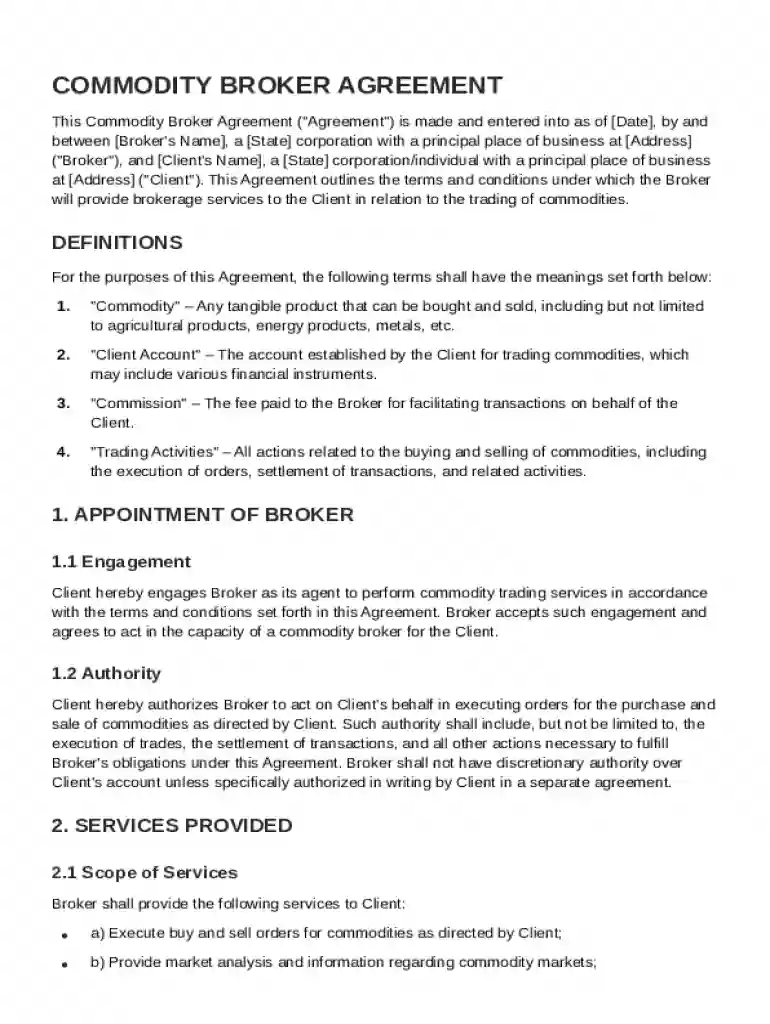
A Commodity Broker Agreement Template is a standardized document that outlines the terms and conditions under which a commodity broker provides their services to a client. This template specifies crucial details such as the broker's authority, services rendered, client responsibilities, fees, risk disclosures, confidentiality agreements, termination clauses, and applicable governing laws. The agreement aims to ensure that both parties—the broker and the client—understand their roles and responsibilities, minimizing potential conflicts. This type of agreement is particularly important in the realm of commodity trading due to the inherent risks involved and the complexity of financial transactions related to commodity markets.
Key Elements of the Commodity Broker Agreement Template
A comprehensive Commodity Broker Agreement Template should include several key elements that clearly define the framework of the broker-client relationship:
- Broker's Appointment and Authority: Details about how the broker is appointed and the extent of their authority to act on behalf of the client.
- Services Provided: A list of specific services the broker will provide, such as executing trades or offering market advice.
- Client Obligations: Responsibilities of the client, including providing accurate information and timely execution of payments.
- Fees and Compensation: Details on how the broker will be compensated for their services, whether through commissions, flat fees, or other methods.
- Risk Disclosure: Statements that inform the client about the risks involved in commodity trading, ensuring transparency.
- Confidentiality and Data Protection: Provisions for maintaining the confidentiality of client information, including restrictions on data sharing.
- Termination Clauses: Guidelines for how the agreement can be terminated by either party, including notice periods and conditions.
Steps to Complete the Commodity Broker Agreement Template
Completing the Commodity Broker Agreement Template involves several steps, ensuring the document is legally sound and applicable to both parties:
- Review the Template: Start by thoroughly reading the entire template to understand its structure and components.
- Fill in Basic Information: Insert the names, addresses, and contact details of both the broker and the client.
- Specify Services and Terms: Clearly outline the services provided and any specific terms relevant to the agreement.
- Detail Compensation: Enter the compensation structure, including any bonuses or variable fees.
- Include Specific Conditions: Add any specific conditions or clauses that apply to the particular relationship, such as exclusivity or non-compete clauses.
- Legal Review: Have the document reviewed by legal counsel to ensure compliance with applicable laws and to safeguard both parties' interests.
- Sign and Date: Once both parties agree to the terms, the document should be signed and dated to make it legally binding.
Important Terms Related to Commodity Broker Agreement Template
A solid understanding of the technical terms used within a Commodity Broker Agreement Template can clarify the agreement's scope and implications:
- Commodities: Physical goods that can be traded on commodity markets, such as oil, gold, or agricultural products.
- Futures Contract: A legal agreement to buy or sell a specific commodity at a predetermined price at a specified time in the future.
- Margin Call: A broker's demand on an investor to deposit additional money to cover potential losses.
- Leverage: The use of borrowed capital to increase the potential return of an investment.
- Stop-Loss Order: An order placed to sell a commodity once it reaches a certain price to limit an investor's loss.
- Hedging: Investment strategies used to offset potential losses.
Legal Use of the Commodity Broker Agreement Template
The legal use of the Commodity Broker Agreement Template involves ensuring that all terms comply with applicable laws and regulations, which may vary by jurisdiction. This section typically focuses on:
- Regulatory Compliance: Ensuring that the agreement adheres to regulations set by bodies such as the Commodity Futures Trading Commission (CFTC).
- Governing Law Clause: Specifying which state or federal laws will govern the agreement.
- Dispute Resolution: Outlining how disputes will be resolved, whether through arbitration or court proceedings.
- Amendment Procedures: Defining how the agreement may be modified or updated.
Examples of Using the Commodity Broker Agreement Template
Real-world scenarios demonstrate how a Commodity Broker Agreement Template can be utilized effectively:
- Scenario One: A small agricultural firm uses the agreement to hire a broker to mitigate the risks of price fluctuations for corn futures.
- Scenario Two: An individual investor engages a broker to diversify their investment portfolio by adding precious metal commodities.
- Scenario Three: A multinational corporation employs a broker to manage risk exposure in volatile oil markets.
Each use case illustrates the necessity of having a structured agreement to safeguard interests and ensure professional conduct.
Who Typically Uses the Commodity Broker Agreement Template
The Commodity Broker Agreement Template is primarily used by individuals and organizations involved in commodity trading:
- Individual Investors: Those seeking to diversify their portfolios through commodity investment.
- Agricultural Producers: Farmers and agricultural companies aiming to hedge against market volatility.
- Energy Companies: Firms that trade oil, gas, or renewable energy sources.
- Multinational Corporations: Businesses with a global reach involved in raw materials trading.
These diverse user groups highlight the template's versatility and necessity across various sectors.

Software Compatibility & Digital Use
In today's digital age, using the Commodity Broker Agreement Template electronically offers numerous advantages:
- Digital Signature Compatibility: Utilizing platforms like DocHub allows for quick and secure signing of digital agreements.
- Cloud Storage Integration: Facilitates easy access and management of agreements through services like Google Drive and Dropbox.
- Software Interoperability: Compatibility with common software like Microsoft Word and Google Docs ensures ease of editing and sharing.
These features enhance the efficiency and accessibility of managing broker agreements in a professional setting.