






Definition & Meaning
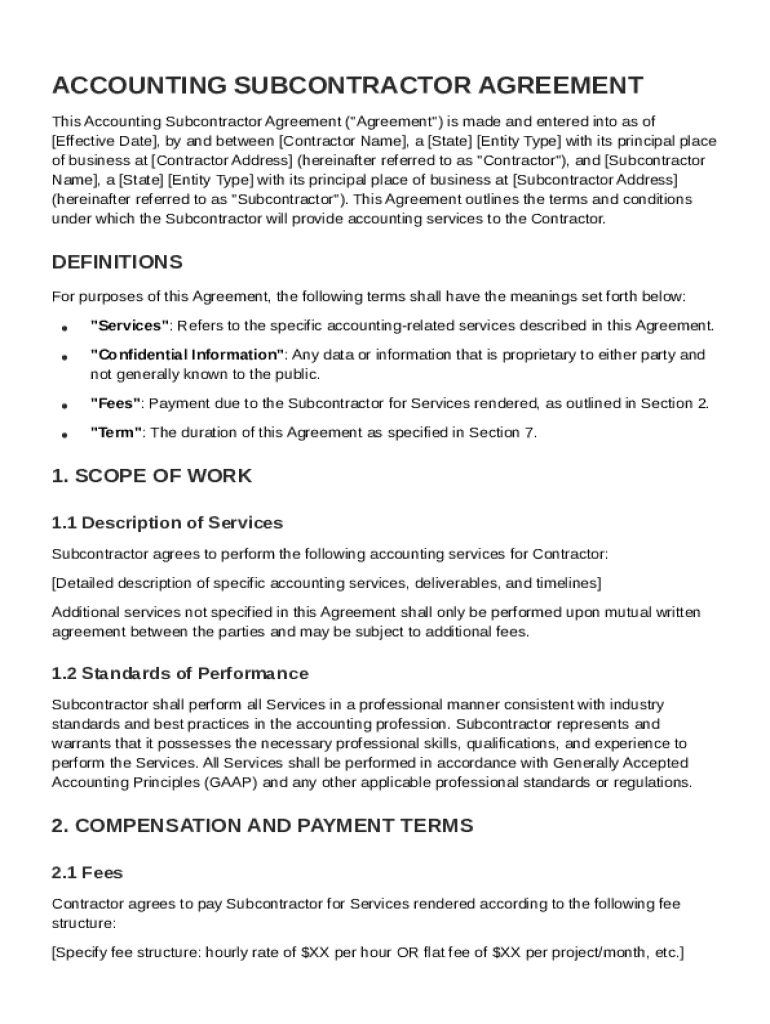
An Accounting Subcontractor Agreement Template serves as a foundational document that outlines the terms and conditions under which a subcontractor provides accounting services to a contractor. This legally-binding template includes essential clauses—such as the scope of work, compensation details, intellectual property rights, and confidentiality obligations. It emphasizes the independent contractor status of the subcontractor, delineating their responsibilities while protecting the interests of all parties involved.
The agreement ensures clarity by defining specific terms utilized throughout the document, enabling both parties to have a mutual understanding of their roles and expectations. It outlines how subcontractors must comply with relevant laws and standards, thereby safeguarding the contractual relationship against potential disputes. Through detailed explanations, the template streamlines the process of drafting individualized agreements suited to specific contractor-subcontractor relationships.
Key Elements
- Scope of Work: Detailed description of the services to be provided.
- Compensation and Payment Terms: Information on payment schedules and amounts.
- Confidentiality Obligations: Guidelines for handling sensitive information.
- Intellectual Property Rights: Ownership of work products and creations.
- Compliance with Laws and Standards: Adherence to applicable legal and ethical standards.
How to Use the Accounting Subcontractor Agreement Template
Employers and subcontractors can effectively utilize the Accounting Subcontractor Agreement Template by tailoring it to suit their specific contractual needs. Begin by reviewing each section to ensure that all required details, such as names, addresses, and specifics of the accounting services, are accurately filled in. This customization ensures the agreement reflects the unique business arrangement and mitigates misunderstandings.
Step-by-Step Usage
- Customize Parties: Enter names and contact information of the contractor and subcontractor.
- Define Services: Clearly outline the accounting services provided, along with deadlines, if any.
- Stipulate Compensation: Specify payment structure, milestones, and any bonuses or penalties.
- Confidentiality and IP Clauses: Establish terms for maintaining confidentiality and intellectual property rights.
- Include Legal Requirements: Embed compliance obligations to adhere to state or federal laws.
- Review and Amend: Have both parties review the document and make necessary amendments.
- Sign and Execute: Both parties sign to validate the agreement, acknowledging understanding and acceptance of the terms.
Steps to Complete the Accounting Subcontractor Agreement Template
Completing the Accounting Subcontractor Agreement Template involves a methodical approach that ensures all essential components are accurately covered. This step-by-step process aids in crafting an agreement that both parties can rely on, preventing future disputes.
- Identify Parties: Clearly indicate the names, roles, and contact information.
- Service Specification: Enumerate the specific accounting services the subcontractor will perform.
- Duration and Milestones: Set the timeline for services and key delivery milestones.
- Compensation Details: Define the payment terms, including frequency and method of payment.
- Include Legal Clauses: Add necessary legal terms such as confidentiality, indemnification, and termination conditions.
- Signatures: Obtain signatures from both parties to finalize the agreement.
Vital Sections to Review
- Details of Work and Deliverables: Clearly specify what is expected of the subcontractor.
- Legal Compliance: Ensure the agreement aligns with statutory requirements relevant to both parties.
Who Typically Uses the Accounting Subcontractor Agreement Template
The template is commonly used by businesses in need of specialized accounting skills without the necessity of hiring full-time employees. It is especially beneficial for small to medium-sized enterprises looking to enhance their financial management with expertise that supports their growth. Accounting firms also use the template when subcontracting specialized tasks to freelancers or other firms to meet their clients' needs.


Common Users
- Small to Medium Enterprises (SMEs): For accessing specialized accounting services.
- Freelance Accountants: To formalize engagements with various clients.
- Large Corporations: When outsourcing specific accounting functions.
- Accounting Firms: Subcontracting work during peak periods or for projects requiring specific expertise.

Important Terms Related to the Accounting Subcontractor Agreement Template
Understanding the important terms within the Accounting Subcontractor Agreement Template is crucial for both signing parties. Accurately defined terms prevent miscommunications and serve to mitigate legal risks.
Key Definitions
- Subcontractor: The independent entity providing services to the contractor.
- Contractor: Entity engaging the services of the subcontractor.
- Confidential Information: Any non-public information provided as part of the agreement.
- Intellectual Property: Any creations or work products resulting from the delivered services.
- Indemnification: A contractual obligation to compensate for any incurred losses or damages.
Key Elements of the Accounting Subcontractor Agreement Template
The critical elements of the Accounting Subcontractor Agreement Template are strategically developed sections covering various aspects of the business relationship between the contractor and subcontractor. These elements ensure all facets of the agreement are addressed, leading to a comprehensive and enforceable contract.
Detailed Overview
- Service Scope: Describes in detail the services provided by the subcontractor.
- Terms of Payment: Clearly stipulates how and when payments will be made.
- Confidentiality Agreement: Protects sensitive company data from unauthorized distribution.
- Intellectual Property Rights: Outlines the ownership of output produced by the subcontractor.
- Termination Clauses: Describes the conditions under which the agreement may be terminated.
Additional Considerations
- Amendment Procedures: How changes to the agreement can be introduced.
- Insurance Requirements: Any necessary insurance policies the subcontractor must maintain.
Examples of Using the Accounting Subcontractor Agreement Template
Practical examples can illustrate how businesses might use the Accounting Subcontractor Agreement Template to address specific scenarios, demonstrating its flexibility and adaptability.
Scenarios
- Scaling Financial Operations: An SME hires a freelance accountant during tax season to manage increased workloads.
- Outsourcing Specialized Tasks: A corporation hires a subcontractor for forensic accounting services during an audit.
- Project-Based Engagements: A startup engages a subcontractor to design and implement a financial reporting system over a specified period.
Legal Use of the Accounting Subcontractor Agreement Template
Legal considerations play a central role in the formulation and use of the Accounting Subcontractor Agreement Template. The template ensures compliance with federal and state regulations, establishing a lawful framework that protects all parties involved.
Legal Compliance Elements
- Compliance with Applicable Laws: The agreement specifies adherence to relevant U.S. laws, such as the Fair Labor Standards Act.
- Dispute Resolution: Procedures for addressing conflicts, such as mediation or arbitration, are outlined.
- Termination and Indemnity Clauses: Legal clauses built to protect both parties in case of disputes or contract ends.
Including these legal elements enriches the template's utility, providing a robust foundation for lawful transactions.