
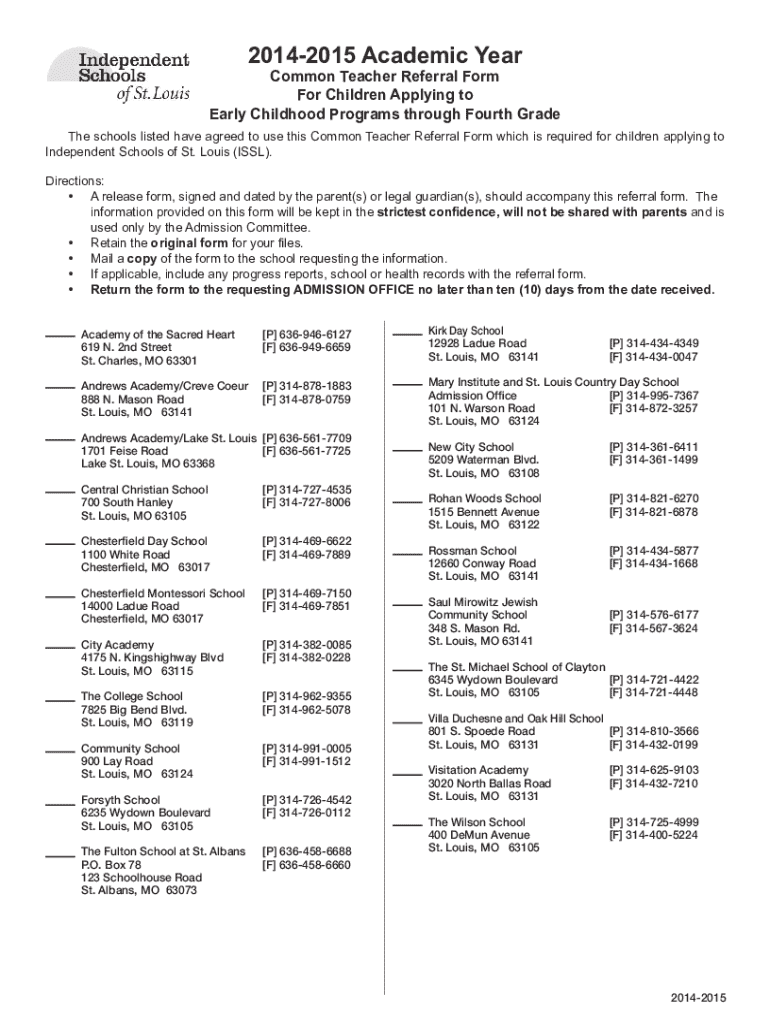







Definition and Purpose of the Common Teacher Referral Form
The "Common Teacher Referral Form" serves as a critical tool for educators assisting with the placement and evaluation of children applying to early childhood programs through fourth grade at the Independent Schools of St. Louis (ISSL). It includes input from teachers about a child's personal, academic, and physical development. This structured feedback is vital for schools to assess the individual needs and strengths of each applicant, ensuring the best educational fit. The data provided by the teachers include observations on behavior, learning styles, and social interactions, which contribute to a comprehensive understanding of the child.
How to Use the Common Teacher Referral Form
Educators are tasked with completing the Common Teacher Referral Form by providing detailed and candid assessments of the student. The process involves observing the student's interactions within the classroom, their response to instruction, and their overall development. Teachers should document:
- Academic achievements and challenges
- Behavioral characteristics, including cooperation and motivation
- Social skills and relationships with peers
- Emotional responses under various conditions
Teachers must ensure their observations are objective and supported by specific examples to avoid subjective interpretations. This thorough documentation helps admission committees make informed decisions regarding student placements.
Steps to Complete the Common Teacher Referral Form
-
Gather Necessary Information: Teachers should begin by collecting relevant details about the student's academic performance, behavior, and social interactions.
-
Documentation: Clearly and concisely fill out each section of the form, providing examples where possible. Use specific instances that illustrate the child's abilities and challenges.
-
Review and Reflect: Before submission, review the information to ensure accuracy and completeness. Reflect on whether the details provided truly capture the student’s profile.
-
Submission: Follow the instructions for submission, whether it’s digital or paper-based, ensuring that any additional required documentation, such as evidence of work or assessments, is included.
Important Terms Related to the Common Teacher Referral Form
Understanding key terminology is crucial when working with the Common Teacher Referral Form:
- Developmental Milestones: Expected abilities or behaviors that typically develop during certain age ranges.
- Assessment: The evaluation of a student's abilities, often through observation and documentation.
- Confidentiality: Ensuring that the information provided remains secure and is shared only with pertinent parties.
- Feedback Loop: The ongoing process of providing, receiving, and responding to feedback in an educational setting.
These terms help in framing the responses within the context of educational evaluations and ensure clarity in communication.
Legal Use of the Common Teacher Referral Form
The information contained in the Common Teacher Referral Form must adhere to legal standards set forth under educational privacy laws in the U.S., such as the Family Educational Rights and Privacy Act (FERPA). This law ensures that all student information collected is handled with confidentiality and integrity, and only authorized personnel should access the completed forms. Additionally, teachers must ensure that their evaluations are free from bias and based on factual observations to prevent any legal repercussions from misinformation.
Key Elements of the Common Teacher Referral Form
The form is composed of several key elements designed to capture different aspects of a student's development:
- Academic Performance: In-depth insights into the child's ability to understand and apply knowledge in classroom settings.
- Social Interactions: Observations on how the child interacts with classmates and teachers.
- Emotional and Physical Development: Notes on the child's emotional resilience, coping mechanisms, and physical milestones.
These elements provide a holistic view of the child's capabilities and areas that may require additional support or enrichment.
Form Submission Methods
The Common Teacher Referral Form can typically be submitted through various channels:
- Online Submission: Some schools offer digital portals for secure submission.
- Mail: Paper forms can be sent via postal services, ensuring they are well-packaged to prevent loss or damage.
- In-Person: Hand-delivered to the admissions office, allowing for face-to-face communication and addressing any immediate questions.
The chosen method often depends on the specific requirements of the school or district, with each mode having its own timelines for confirmation of receipt.
Examples of Using the Common Teacher Referral Form
Several scenarios demonstrate the application of the Common Teacher Referral Form:
-
Scenario One: A teacher evaluates a student named Emily, noting her exceptional aptitude in reading comprehension but struggles with math. These insights help the admissions team consider her for a reading enrichment program.
-
Scenario Two: In the case of Jordan, the teacher documents behavioral challenges in group settings. This feedback initiates a meeting with school counselors to discuss potential support plans.
Each example illustrates how the form is instrumental in crafting targeted educational strategies for applicant success.
Versions or Alternatives to the Common Teacher Referral Form
The Common Teacher Referral Form is specifically designed for the Independent Schools of St. Louis; however, other regions may have versions adapted for their specific needs or educational focus. Some schools may employ a more generalized form that does not align precisely with the detailed approach of the ISSL, while others may integrate additional components such as psychological assessments if deemed necessary. It's important for educators to familiarize themselves with the specific forms required by their district to ensure compliance and accuracy.




