Lummi nation benefits 2026

Get Form
lummi service community form free Preview on Page 1

Here's how it works

01. Edit your lummi service community form free online
Type text, add images, blackout confidential details, add comments, highlights and more.

02. Sign it in a few clicks
Draw your signature, type it, upload its image, or use your mobile device as a signature pad.

03. Share your form with others
Send lummi nation organization request free via email, link, or fax. You can also download it, export it or print it out.

How to use or fill out Lummi Nation Benefits with Our Platform

Form edit decoration
9.5
Ease of Setup
DocHub User Ratings on G2
9.0
Ease of Use
DocHub User Ratings on G2
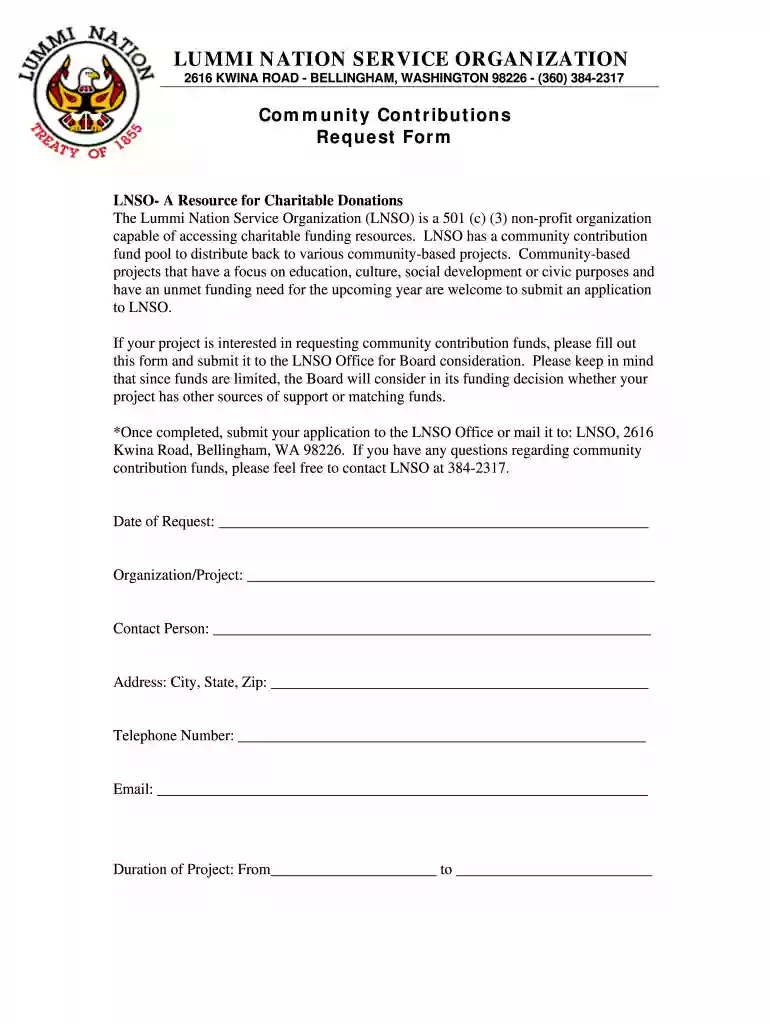
  1. Click ‘Get Form’ to open the Lummi Nation Benefits form in the editor.
  2. Begin by entering the 'Date of Request' at the top of the form. This helps track your application timeline.
  3. Fill in the 'Organization/Project' field with the name of your project or organization seeking funding.
  4. Provide a 'Contact Person' who will be responsible for communication regarding this request.
  5. Complete the 'Address' section, including City, State, and Zip code for accurate correspondence.
  6. Enter your 'Telephone Number' and 'Email' for follow-up inquiries from the LNSO Board.
  7. Indicate the 'Duration of Project' by specifying start and end dates to clarify your project's timeline.
  8. State the 'Amount Requested' clearly to ensure proper consideration of your funding needs.
  9. Attach a detailed 'Proposed Budget' outlining all expenses related to your project for transparency.
  10. In the summary section, provide a brief overview of your project and its purpose for requesting funds.
  11. Explain how your project fulfills social, educational, cultural, or civic purposes in detail.
  12. Describe who will benefit from your project and how it will positively impact the Lummi community.
  13. If applicable, indicate any expected funds from other sources and specify whether they are anticipated or committed.
  14. Finally, include any additional information that may support your application for funding consideration.

Start filling out your Lummi Nation Benefits form today using our platform for free!

be ready to get more

Complete this form in 5 minutes or less

Get form

Got questions?

We have answers to the most popular questions from our customers. If you can't find an answer to your question, please contact us.
Contact us
The Lummi Indian Reservation is situated on a peninsula east of the island, but it does not include Lummi Island. The island has a land area of 23.97 square kilometres (9.25 square miles) and had a population of 822 as of the 2000 census.
Nationally recognized as a leader in tribal self-governance and education, the Lummi Nation is home to the Northwest Indian College, which is accredited as a 4-year, baccalaureate-granting college serving 1,200 students annually from tribes throughout the nation.
The Lummi Comprehensive Economic Development Strategy (CEDS) sets the direction for economic development, recovery, and long-term resilience for the Lummi Nation. It will guide federal, state, and county funding, policy, and cross-sector implementation over the next five years from 2023 through 2027.
Home to the third-largest tribe in Washington, this reservation has a population of 5,000 people known as the Lummi People or the Lhaqtemish meaning People of the Sea. It is also a self-governing community managing nearly 13,000 acres of tidelands.
Connections to the land and water have remained strong among the Lummi People. Many are fishermen and artists, actively preserving their ancient traditions. Each June the community celebrates its past, present, and future at the Lummi Stommish Water Festival, with cedar canoe races, games, song and dance.

Security and compliance

At DocHub, your data security is our priority. We follow HIPAA, SOC2, GDPR, and other standards, so you can work on your documents with confidence.

Learn more
ccpa2
pci-dss
gdpr-compliance
hipaa
soc-compliance

People also ask

Visitors to the Lummi Nation have the opportunity to immerse themselves in this unique cultural landscape, learning about traditional practices and exploring the natural beauty that has shaped the identity of the Coast Salish people for generations.
The island was originally called Sa nam a o (High Mountain) and Skallaham by the native Lummi people. In 1792 Spanish explorers dubbed it Isla de Pacheco, and British colonists later called it McLoughlin Island. In 1853, the U.S. National Geodetic Survey charted the island as Lummi, naming it after the local tribe.

lummi community contributions request form sample