Equine Activity Release and Hold Harmless Agreement 1 I Horse Template PrintableEquine Liability Rel 2026

Get Form
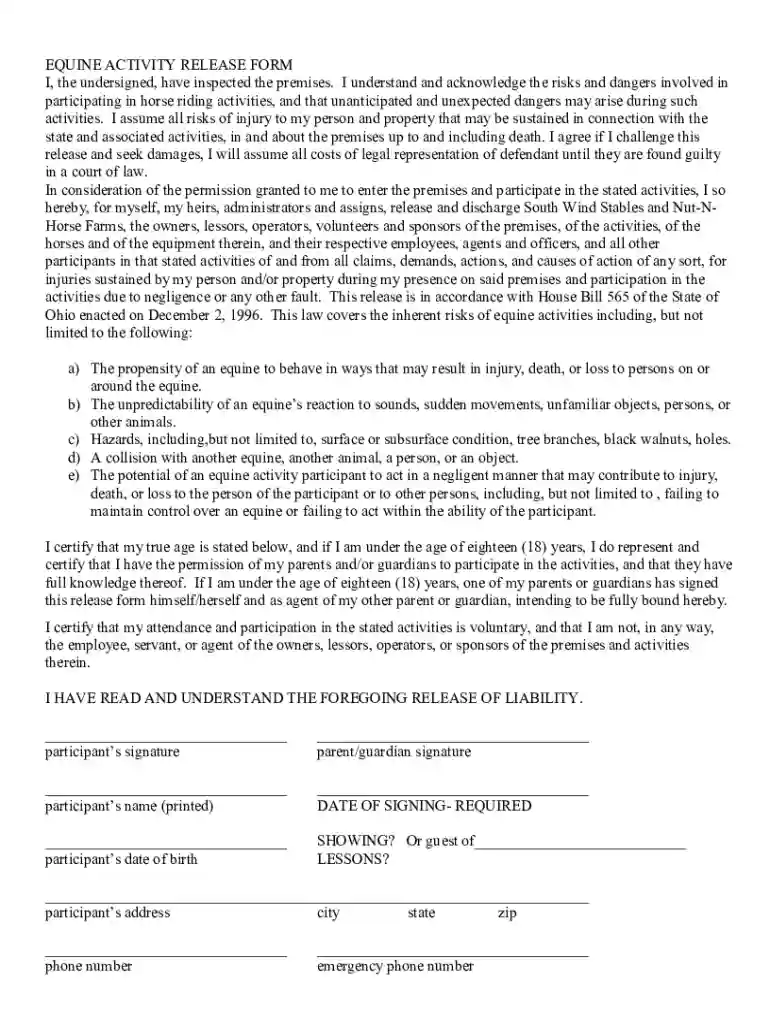
Equine Activity Release and Hold Harmless Agreement 1 I Horse Template PrintableEquine Liability Rel Preview on Page 1

Here's how it works

01. Edit your form online
Type text, add images, blackout confidential details, add comments, highlights and more.

02. Sign it in a few clicks
Draw your signature, type it, upload its image, or use your mobile device as a signature pad.

03. Share your form with others
Send it via email, link, or fax. You can also download it, export it or print it out.

Definition & Meaning

The Equine Activity Release and Hold Harmless Agreement is a legal document often used in the equine industry to protect horse owners, stable operators, and event organizers from liability due to accidents or injuries that may occur during horse-related activities. This agreement acknowledges the inherent risks associated with horses and equine activities, which can include riding, training, and handling. By signing this document, participants agree to assume the risks involved and waive their right to pursue legal claims against the equine professional or venue.

Key Points

  • Assumption of Risk: Participants acknowledge that horseback riding and related activities carry inherent risks and accept responsibility for any potential injuries or damages.
  • Waiver of Liability: The agreement includes a clause where participants release the equine entity from any claims of negligence.
  • Voluntary Participation: The participant's involvement is consensual, acknowledging their understanding of the risks.
  • Parental Consent: For minors, parental or guardian consent is generally required for validity.

How to Use the Equine Activity Release and Hold Harmless Agreement

This agreement is typically used in various settings where horse activities happen, such as stables, horse riding schools, and equine events. It serves as a formal document that participants need to sign before engaging in horse-related activities.

Usage Scenarios

  • Equestrian Centers: Centers require participants to sign before riding lessons.
  • Horse Shows and Competitions: Organizers use this document to ensure all competitors have agreed to the terms.
  • Trail Riding Companies: Before embarking on trail rides, companies have all participants complete this form.

Practical Steps

  1. Provide Information: Begin by filling out the participant's details, including name and contact information.
  2. Read the Terms: Carefully review the release and assumption of risk statements.
  3. Sign and Date: The participant, along with a parent or guardian if a minor, must sign and date the form.
  4. Collection: The signed forms are collected and stored by the managing entity to ensure compliance and reference.

Important Terms Related to the Agreement

Several key legal terms are integral to the Equine Activity Release and Hold Harmless Agreement. Understanding these will provide clarity when navigating the document.

Important Terms

  • Negligence: Failure to exercise the care that a reasonably prudent person would exercise in like circumstances.
  • Indemnification: A contractual obligation to compensate another party for loss or damage.
  • Equine Activities: They include riding, training, cutting, and caring for horses.
  • Release Clause: A legal promise that the participant will not hold the provider liable for injury or damage.

Steps to Complete the Equine Activity Release and Hold Harmless Agreement

Filling out this agreement accurately is vital for both compliance and legal protection.

Step-by-Step Completion

  1. Participant Information: Enter full name, address, and contact details.
  2. Risk Acknowledgment: Initial where requested to indicate understanding and acceptance of risks.
  3. Parental Section: If the participant is a minor, the parent or guardian must provide their information and consent.
  4. Signature: Ensure that the participant's signature matches the name provided.
  5. Witness or Notarization: Some agreements may require a witness or notary; follow all specific instructions provided within the form.

State-Specific Rules for the Agreement

Equine Activity Liability Acts vary by state, influencing the necessity and enforcement of these agreements.

Examples of State Variations

  • Colorado: Provides statutory protection for equine activities but requires specific warning language included in the agreement.
  • California: Does not have specific equine liability statutes, making waivers and releases crucial for operators.

Key Considerations

  • Legal Consultation: It is recommended to consult with a legal professional who specializes in equine law to ensure state compliance.
  • Custom Language: Modify the agreement to incorporate mandatory legal language specified by state statutes.

Legally Binding Electronic Signatures

DocHub streamlines the signing process by providing tools for legally binding electronic signatures, which comply with the ESIGN Act.

Features of Electronic Signatures

  • Creation Options: Draw, type, or upload your signature.
  • Storage for Future Use: Signatures can be saved for seamless application on future documents.
  • Convenient Requests: Send signature requests via email, specifying the signing order if multiple parties are involved.
  • Audit Trail: Provides detailed logging of document views and signatures.

Key Elements of the Agreement

Several components form the backbone of the agreement, ensuring comprehensive coverage of legal requirements.

Core Components

  • Acknowledgment of Risks: Clearly outlines the inherent risks tied to equine activities.
  • Hold Harmless Clause: A section where participants agree not to hold the stable or provider liable.
  • Certification of Authority: A statement verifying that the signer has the authority to execute the agreement, particularly relevant for organizational signatories.
  • Applicable Laws: Disclosure of the governing state laws to clarify jurisdiction and enforceability.

Examples of Using the Agreement

Practical examples abound, emphasizing the utility of the agreement in various scenarios.

Case Studies

  • Riding Camps: Summer camps use the agreement to manage the influx of novice riders, ensuring parents understand the potential risks.
  • Professional Stables: Owners utilize these agreements to protect their business from liability claims during lessons and competitions.
  • Equine-Assisted Therapy Sessions: Participants agree to hold the therapy provider harmless from claims related to therapeutic activities involving horses.
be ready to get more

Complete this form in 5 minutes or less

Get form

Got questions?

We have answers to the most popular questions from our customers. If you can't find an answer to your question, please contact us.
Contact us
Equestrian Liability releases, also known as hold harmless agreements and waivers, do two very important things: They discourage people from suing in the first place; and. They help protect the person being sued.
A release of liability, also known as a liability waiver or a hold harmless agreement, is a contract in which one party agrees not to hold another party liable for damages or injury.
A liability waiver form is a legal contract that educates one party about the risks associated with an activity. Once signed, it prevents the participant from opening a lawsuit against the company in the event of damage or loss, effectively shifting responsibility for injuries from the company to the customer.
They monitored horses for heart rate, breathing rate, temperature and loin muscle condition when carrying loads of 15, 20, 25 and 35 percent of their bodyweight. The researchers found that an average adult light riding horse could comfortably carry about 20 percent of their ideal bodyweight.
Scientifically it is believed that these releases licking and chewing, yawning, etc. are signs that the horse is shifting from a state of stress (sympathetic, sometimes called fight/flight) to a state of relaxation (parasympathetic, sometimes called rest and digest).

Security and compliance

At DocHub, your data security is our priority. We follow HIPAA, SOC2, GDPR, and other standards, so you can work on your documents with confidence.

Learn more
ccpa2
pci-dss
gdpr-compliance
hipaa
soc-compliance

People also ask

Use a Posting Simulator Many riding schools and equestrian centers have simulators or mechanical horses. These devices can mimic the motion of a horse, allowing you to practice posting without the real animal. - How to Use a Simulator: - Mount the simulator and adjust the saddle to ensure Page 2 2 proper fit.

Related links