Irrevocable trustors 2026

Get Form
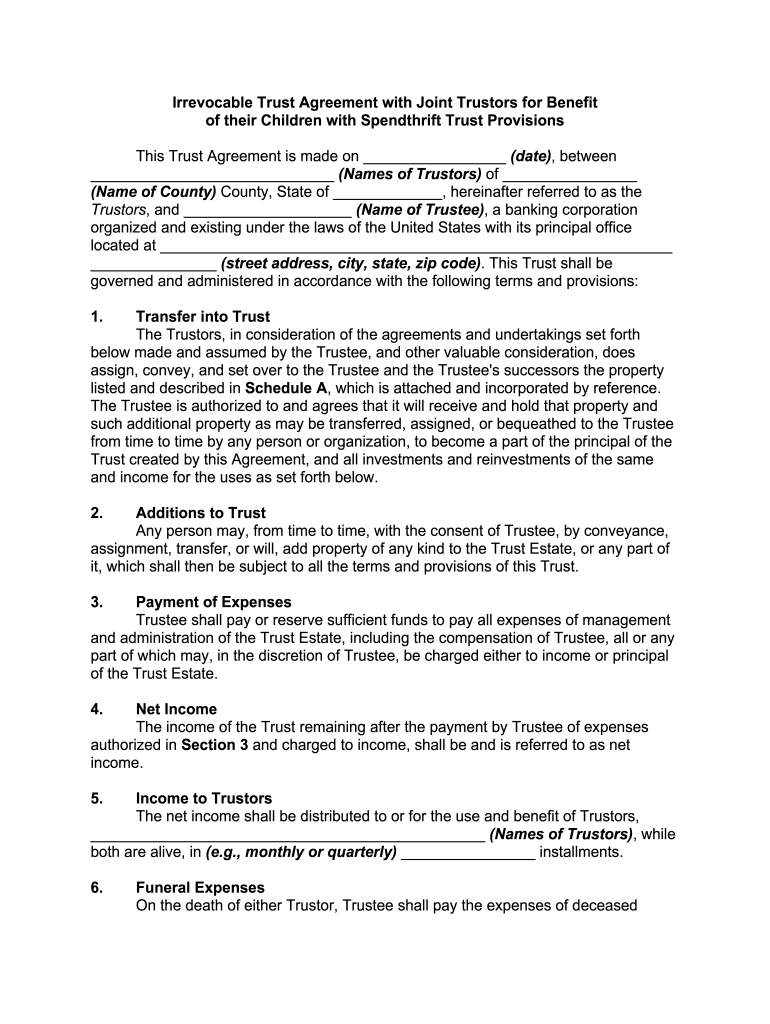
irrevocable trustors Preview on Page 1

Here's how it works

01. Edit your form online
Type text, add images, blackout confidential details, add comments, highlights and more.
02. Sign it in a few clicks
Draw your signature, type it, upload its image, or use your mobile device as a signature pad.
03. Share your form with others
Send it via email, link, or fax. You can also download it, export it or print it out.

How to use or fill out irrevocable trustors with our platform

Form edit decoration
9.5
Ease of Setup
DocHub User Ratings on G2
9.0
Ease of Use
DocHub User Ratings on G2
  1. Click ‘Get Form’ to open the Irrevocable Trust Agreement in the editor.
  2. Begin by entering the date of the agreement in the designated field. This is crucial for establishing the timeline of the trust.
  3. Fill in the names of the Trustors and their county and state. Ensure accuracy as this identifies who is creating the trust.
  4. Specify the name of the Trustee, including their address. This section outlines who will manage the trust assets.
  5. Complete Schedule A by listing all properties being transferred into the trust. This is essential for defining what assets are included.
  6. Review sections regarding payment of expenses and income distribution to ensure they align with your intentions for managing funds.
  7. Finalize by signing and dating where indicated, ensuring all parties involved have completed their signatures.

Start using our platform today to effortlessly complete your irrevocable trustors form online, for free!

be ready to get more

Complete this form in 5 minutes or less

Get form

Got questions?

We have answers to the most popular questions from our customers. If you can't find an answer to your question, please contact us.
Contact us
Be mindful of the key difference between a revocable trust and an irrevocable trust. An irrevocable trust cannot be modified or terminated without permission of the beneficiary. Once the grantor transfers the assets into the irrevocable trust, he or she removes all rights of ownership to the trust and assets.
Revenue Ruling 2023-2, issued in March 2023, made a major change to how assets in irrevocable trusts are treated. The rule states those assets in an irrevocable trust that are not included in the grantors taxable estate cannot receive a step-up in basis.
Whenever a beneficiary receives a distribution from an irrevocable trusts principal balance, the beneficiary doesnt have to pay any taxes on that distribution. The trust doesnt have to pay taxes on that distribution either. The IRS automatically assumes the money was taxed before it was placed in the trust. Irrevocable Trusts and Taxes: An Overview - Dominion dominion.com trusts irrevocable-trust-ta dominion.com trusts irrevocable-trust-ta
Potential Risks and Disadvantages of Irrevocable Trusts Once you move assets into one, youre locked into a long-term arrangement. Its important to understand the trade-offs before you commit, such as giving up control, facing tax issues, or relying on someone else to manage your assets.
From my experience, loan officers at banks do not like dealing with irrevocable trusts because (1) they do not have the requisite knowledge on how to deal with them; or (2) irrevocable trusts provide asset protection that lenders do not like dealing with.

Security and compliance

At DocHub, your data security is our priority. We follow HIPAA, SOC2, GDPR, and other standards, so you can work on your documents with confidence.

Learn more
ccpa2
pci-dss
gdpr-compliance
hipaa
soc-compliance

People also ask

An Irrevocable Trust can be a tax-advantageous strategy that your loved ones can benefit from after youve passed away. By putting your assets and property into the Irrevocable Trust, those items cant be taxed after your death. In this sense, an Irrevocable Trust can actually help to reduce the value of an estate. Revocable vs Irrevocable Trust: Differences Benefits trustandwill.com learn revocable-vs-irrevocabl trustandwill.com learn revocable-vs-irrevocabl
Who needs an irrevocable trust? If you expect your estate will be over the estate tax threshold ($13,610,000 in 2024), have large debts, or are at risk of lawsuits, an irrevocable trust could be a valuable option to ensure your assets get transferred to your beneficiaries as you intend. Revocable vs Irrevocable Trusts - New York Life Insurance newyorklife.com articles revocable-vs-ir newyorklife.com articles revocable-vs-ir

Related links