






Definition and Purpose of the Family Responsibility Office (FRO): Statement of Arrears
The Family Responsibility Office (FRO): Statement of Arrears is an official document used to outline outstanding child support payments. This statement serves as a comprehensive record of any unpaid amounts owed by the payor to the recipient. It is typically used in legal and administrative contexts to ensure that child support obligations are met in accordance with court orders or agreements.
Key Features
- Outstanding Balance: The statement details the exact amount of arrears—unpaid or overdue payments at the time the document is issued.
- Payment History: It includes a record of prior payments, helping to trace financial compliance over time.
- Interest and Penalties: It may also list any accrued interest or financial penalties due to late payments, which can increase the total owed.
Real-life applications of the statement include legal proceedings, negotiations for payment arrangements, and personal record-keeping to manage child support responsibilities effectively.
Steps to Complete the Family Responsibility Office (FRO): Statement of Arrears
Completing the FRO Statement of Arrears involves ensuring that all required information is accurately filled out. Here are the general steps:
- Gather Essential Information: Collect all relevant details concerning the payor and recipient, including full names, addresses, and contact information.
- Enter Financial Details: Input the amount of outstanding arrears. This should reflect any missed payments along with any additional fees.
- Review Legal Instructions: Adhere to state-specific guidelines that dictate how the form should be completed.
- Attach Necessary Documentation: Include any supporting documents like previous payment records or court orders to validate the arrears amount.
- Sign and Submit: Ensure the form is signed and dated before submitting it via the specified method, whether online, by mail, or in person.
These steps are critical to guarantee the form’s validity and acceptance.
How to Obtain the Family Responsibility Office (FRO): Statement of Arrears
Acquiring the FRO Statement of Arrears typically involves interacting with specific governmental or administrative offices. Here’s how to acquire the form:
- Contact the FRO: Reach out to the Family Responsibility Office in your jurisdiction, often available online or via telephone support.
- Online Platforms: Many state departments have digitized their processes, allowing users to request and download forms directly from their websites.
- Visit Local Offices: If preferring a paper version, visiting local government offices or FRO offices may be necessary to request the document in person.
The process can vary by location, so confirm specific instructions with your jurisdiction.
Who Typically Uses the Family Responsibility Office (FRO): Statement of Arrears
The FRO Statement of Arrears is used by various individuals and institutions involved in the management and enforcement of child support obligations:
- Payors: Individuals responsible for making child support payments use this document to track their arrears.
- Recipients: The custodial parents or guardians who receive support payments can request this statement for their records.
- Legal Professionals: Attorneys might use these documents in negotiations or court proceedings to represent their clients.
- Courts: Judicial entities utilize this form to make determinations in family law cases.
Its broad utility underscores its importance across various facets of family support management.


Important Terms Related to the Family Responsibility Office (FRO): Statement of Arrears
Understanding the terminology associated with the FRO Statement of Arrears can enhance clarity and ensure precision in its completion and usage:
- Arrears Balance: The total amount of unpaid obligations.
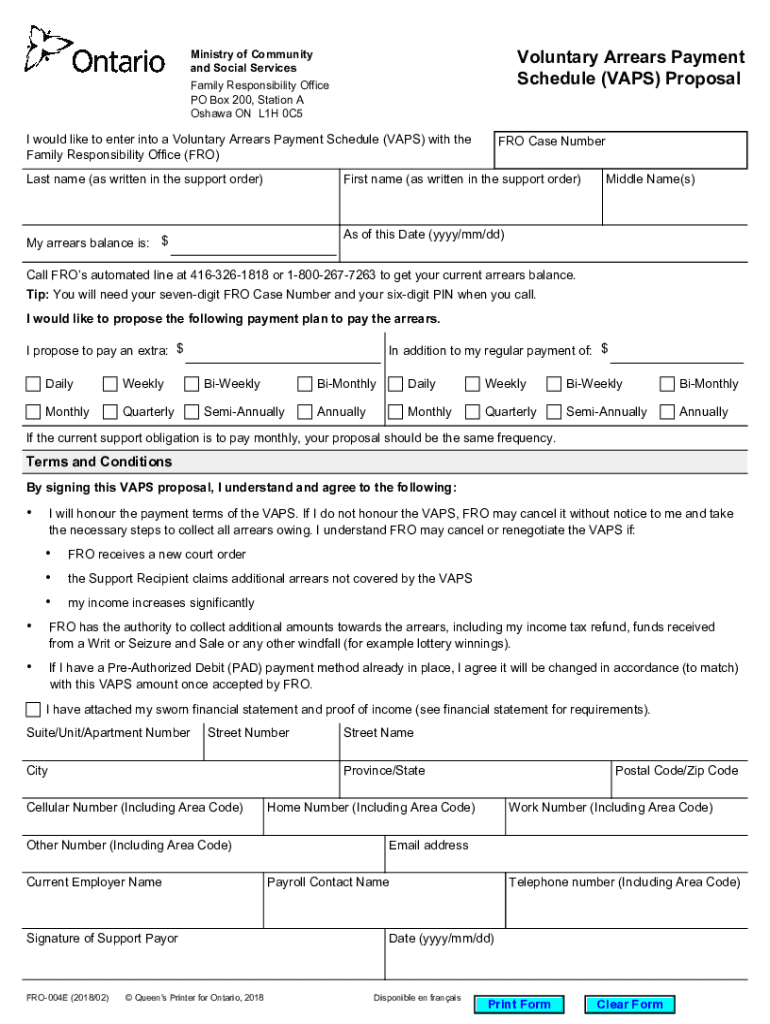
- Voluntary Arrears Payment Schedule (VAPS): A proposal for clearing outstanding arrears through a structured payment plan.
- Payor: The individual required to pay child support.
- Interest Costs: Additional charges accrued on unpaid amounts.
- Notice of Default: A warning issued when payments are not submitted according to the established schedule.
Grasping these terms helps mitigate misunderstandings and increases the effective management of child support responsibilities.
Legal Use of the Family Responsibility Office (FRO): Statement of Arrears
The legal application of the FRO Statement of Arrears is critical in ensuring compliance with child support laws:
- Court Proceedings: This document is often presented in court as evidence of child support non-compliance.
- Enforcement Actions: It can trigger governmental enforcement measures, such as wage garnishment or revocation of licenses.
- Payment Arrangements: Used as part of setting up agreed payment plans to address arrears.
Its legal standing helps to ensure fair and consistent application of support enforcement mechanisms.
Key Elements of the Family Responsibility Office (FRO): Statement of Arrears
To ensure completeness and validity, the FRO Statement of Arrears must include several key elements:
- Payor and Recipient Information: Names, contact details, and any identifying numbers.
- Arrears Total: The comprehensive amount of unpaid child support, including any interest or penalties.
- Payment History: Detailed records of past transactions for verification.
- Signatures: Authentication via signatures by relevant parties to certify the document’s accuracy and intention.
These components are foundational to the statement’s functionality and enforceability.
State-Specific Rules for the Family Responsibility Office (FRO): Statement of Arrears
Due to variations in state laws, the FRO Statement of Arrears may be subject to state-specific regulations:
- Different Penalty Rates: Some states impose higher interest rates on missed payments.
- Unique Submission Processes: Methods for submitting these documents can vary, with some states offering exclusive online or paper-only submissions.
- Special Requirements for Military Personnel: Some jurisdictions have special provisions for service members.
Consult state-specific guidelines to ensure compliance and reduce the risk of administrative issues.