
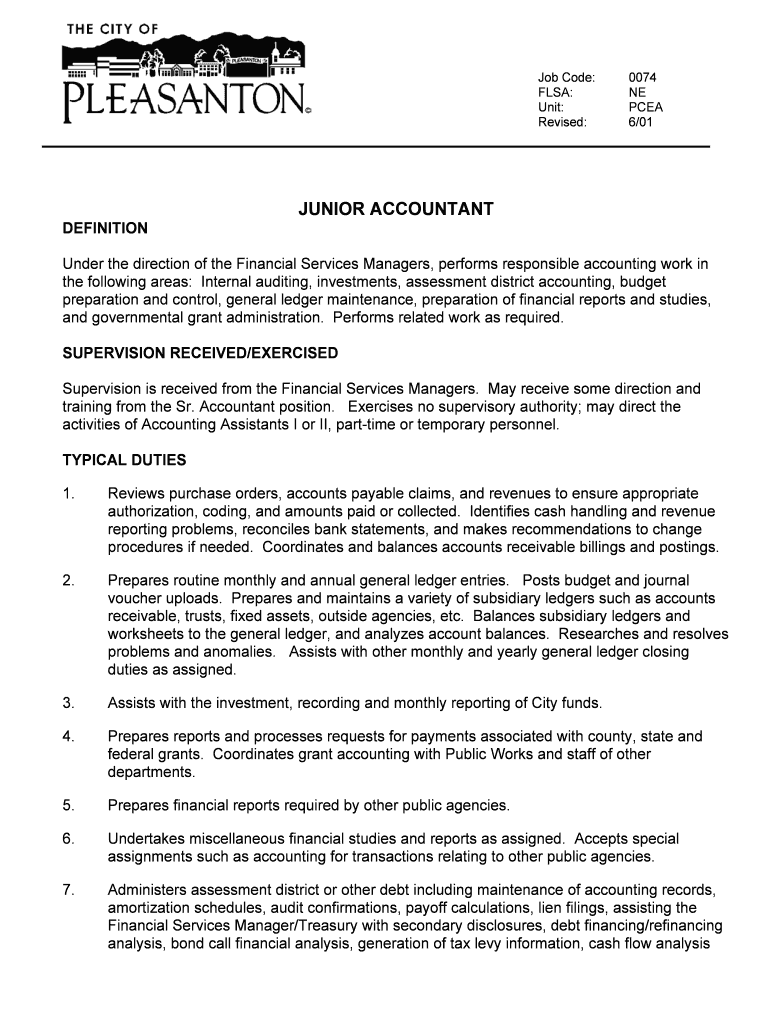







Definition and Meaning of Junior Accountant
A Junior Accountant plays a crucial role in financial and accounting functions within an organization. This entry-level position typically involves supporting senior accountants by managing day-to-day financial transactions, preparing budget reports, and maintaining accurate financial records. Key responsibilities include bookkeeping, reconciling accounts, and assisting in the preparation of financial statements under the guidance of Financial Services Managers. Understanding fundamental accounting principles and proficiency in financial systems are essential skills for this position.
Who Typically Uses the Junior Accountant Role
The Junior Accountant role is typically filled by recent graduates or individuals with some experience in accounting or finance. It is ideal for those looking to start or advance their careers in accounting. Organizations that frequently hire Junior Accountants include accounting firms, corporations, non-profit organizations, government agencies, and educational institutions. Professionals in this role often work closely with senior accountants and financial managers, gaining valuable insights and experience that can lead to advanced positions within the finance sector.


Key Elements of a Junior Accountant Position
A Junior Accountant's responsibilities typically include several key elements that are essential for maintaining the financial health of an organization. These include:
- Internal auditing to ensure compliance with financial policies.
- Budget preparation to assist in financial planning.
- Financial reporting to provide insights into the company's financial status.
- Grant administration, particularly in non-profit organizations.
- Reconciliation of bank statements and ledgers to ensure accuracy.
By handling these elements, Junior Accountants ensure that the financial operations are conducted smoothly and efficiently.
Important Terms Related to Junior Accountant
In the role of a Junior Accountant, there are several critical terms and concepts one must be familiar with:
- Bookkeeping: The process of recording daily financial transactions consistently.
- Reconciliation: Matching the entries in the organization’s financial records with external records like bank statements to ensure accuracy.
- Budgeting: Predicting revenue and expenses to create a financial plan.
- Fiscal Year: A one-year period that companies use for accounting purposes.
- Accounts Receivable/Payable: Managing incoming payments from clients/customers and outgoing payments to suppliers/vendors.
Understanding these terms is vital for successful financial management and communication within the accounting field.
Steps to Complete Accounting Tasks as a Junior Accountant
As a Junior Accountant, completing daily tasks involves a systematic approach:
-
Gather Financial Data: Collect and organize financial information from various sources, such as invoices, receipts, and bank statements.
-
Record Transactions: Input the gathered data into accounting software or ledgers accurately.
-
Reconcile Accounts: Confirm that the balances in accounts match with external records to ensure they are up to date and correct.
-
Assist in Budget Preparation: Work with senior accountants to draft budget reports based on current financial data.
-
Prepare Financial Statements: Create reports that summarize the company’s financial status, such as income statements and balance sheets.
-
Report Findings: Communicate any discrepancies or financial insights to senior accountants or managers.
By diligently following these steps, a Junior Accountant can effectively support the financial decision-making processes.
Legal Use of Accounting Techniques
Junior Accountants must adhere to legal standards and practices while performing their duties to ensure compliance and avoid legal issues. This involves following Generally Accepted Accounting Principles (GAAP) and any relevant federal, state, or local regulations. Additionally, maintaining confidentiality of financial data is crucial to comply with privacy laws and protect the organization's interests.
Software Compatibility for Junior Accountants
For a Junior Accountant, proficiency in commonly used accounting software such as QuickBooks, SAP, and Microsoft Excel is often required. These tools help manage financial data, automate tasks, and generate reports efficiently. Additionally, understanding software integrations with document management platforms like DocHub can enhance productivity, especially for those involved in document-related tasks, such as preparing and signing financial agreements.
State-Specific Rules for Junior Accountants
Accounting regulations can vary by state, affecting the work of Junior Accountants, especially for those in roles that involve tax preparation or financial reporting. It is essential for accountants to be aware of any state-specific requirements, such as different filing deadlines, unique tax codes, or licensing requirements. Staying informed about these variations ensures compliance and helps avoid potential penalties.
Examples of Using Junior Accountant Skills
The application of Junior Accountant skills can be seen in various organizational scenarios:
-
In a non-profit organization, a Junior Accountant might assist in grant management by tracking fund allocation.
-
In a corporate setting, they could support the preparation of quarterly budget reports.
-
At an accounting firm, Junior Accountants might help audit small business clients by reconciling financial statements and ensuring compliance with financial regulations.
These examples demonstrate the diverse environments in which Junior Accountants operate, showcasing the flexibility and applicability of their skills across different sectors.




