




01. Edit your form online
Type text, add images, blackout confidential details, add comments, highlights and more.

Type text, add images, blackout confidential details, add comments, highlights and more.

Draw your signature, type it, upload its image, or use your mobile device as a signature pad.

Send it via email, link, or fax. You can also download it, export it or print it out.
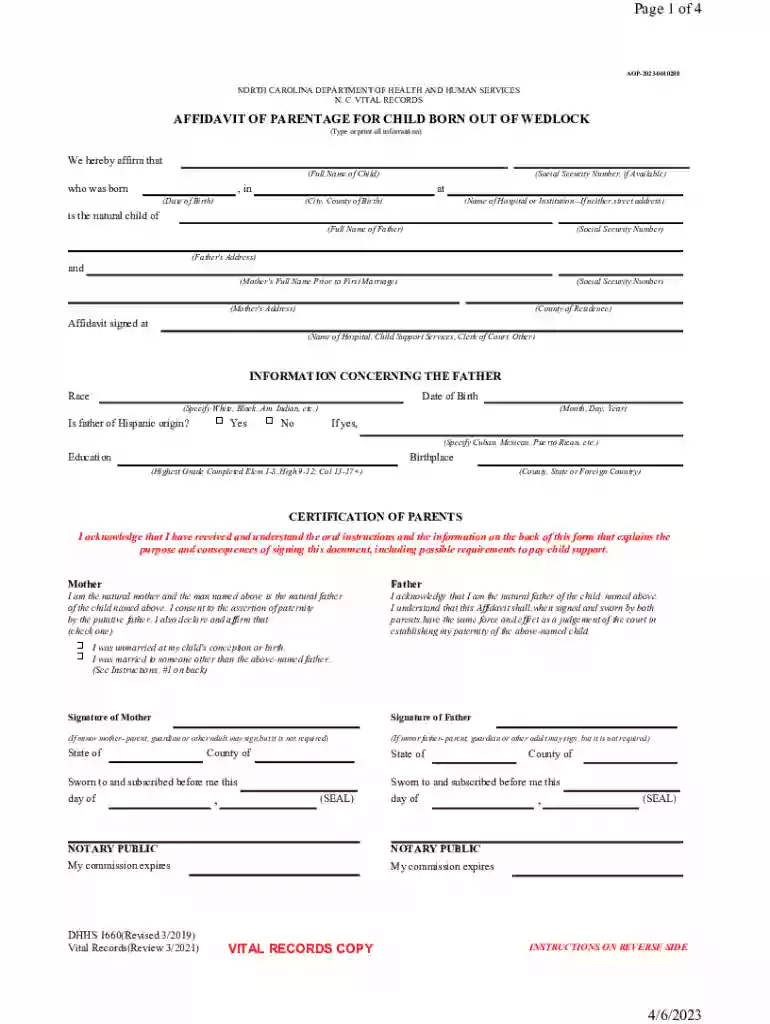
The "Affidavit of Parentage for Child Born out of Wedlock" is a legal document used primarily in the United States to establish the parentage of a child born to unmarried parents. By completing this form, both parents affirm their biological relationship to the child, which can have legal implications for custody, child support, and inheritance rights. The document requires both parents to sign in the presence of a notary public, ensuring the authenticity of their declarations. This affidavit is an essential tool for parents who wish to legally recognize paternity without the need for court intervention.
This form is used to legally establish a father's relationship to a child when the parents are not married at the time of the child's birth. Here's how it works:
Personal Information: Both parents must provide their personal details, including full names, addresses, and dates of birth.
Declaration of Parentage: Each parent confirms their relationship to the child and acknowledges their responsibilities.
Notarization: The form requires notarization, making it crucial to complete in front of a certified notary public.
Submission: Once completed and notarized, the affidavit is typically filed with the state's vital records office or health department.
To obtain the Affidavit of Parentage form, you can check with your state's Department of Health and Human Services, often available through their website or local offices. Some states may offer downloadable PDF versions that can be completed digitally or printed. Alternatively, a visit to a local vital records office can provide you with the necessary documentation. Make sure to verify any state-specific requirements or additional paperwork that may be needed alongside this form.
Completing the Affidavit of Parentage involves several key steps to ensure its validity:
Gather Information: Collect all required personal information for both parents and the child, including birth certificates and identification.
Fill in Details: Carefully enter all required information in the form, ensuring accuracy and consistency.
Review Legal Rights: Understand the legal rights and obligations being acknowledged by signing the form. This may include child support and custody implications.
Notarization: Schedule an appointment with a notary public to witness the signing of the affidavit.
Submit: Once signed and notarized, submit the form to the appropriate state office.
The form is predominantly used by unmarried parents who wish to legally affirm the paternity of a child. This includes parents who are in a committed relationship but have not married, those who have separated, and even those who intend to co-parent without pursuing a romantic relationship. It is also used by parents who wish to ensure that the father's name is included on the child's birth certificate.


There are several key elements incorporated within the Affidavit of Parentage:
Identification Information: Detailed sections for both parents and the child, ensuring clarity in their identities.
Parental Acknowledgment: Each parent must acknowledge understanding the legal implications of signing.
Signatures and Witnessing: Both parents must provide signatures, authenticated by a notary public.
Instructional Guidelines: Outlines requirements for completion and submission, ensuring that no steps are missed.
Each state might have its own set of rules and variations for the affidavit. For instance:
Age of Parents: Some states have age requirements or conditions if parents are minors.
Timeframes: Certain states may have deadlines for submitting the document after the child's birth.
Additional Documents: Some jurisdictions might require supplemental forms or affidavits to accompany the main document.
Legally, the affidavit is pivotal in:
Establishing Paternity: Without a court order, this document serves as legal evidence of paternity.
Custody and Visitation Rights: Helps in determining a father’s rights concerning custody and visitation.
Child Support Obligations: Sets the groundwork for responsibilities regarding child support.
The affidavit stands as a binding legal declaration that can be used in court if disputes arise over parental rights or responsibilities.
Notary Public: An official authorized to witness the signing of legal documents.
Paternity: A legal acknowledgment of being the father of a child.
Custody: Legal right to make decisions affecting the child and responsibility for their care.
Child Support: Financial payments made by a parent to support a child’s upbringing.
Understanding these terms is essential when dealing with legal forms involving parental rights and obligations.
At DocHub, your data security is our priority. We follow HIPAA, SOC2, GDPR, and other standards, so you can work on your documents with confidence.



Affidavit Of Parentage For Child Born Out Of Wedlock could not inherit from a child born out wedlock since he had not filed acknowledgement with clerk ofRead more
Jul 3, 2026 Standard form available at registrar office or crsorgi.gov.in. Both parents sign Form 1 single parent needs notarised affidavit. accept


