






Definition & Meaning
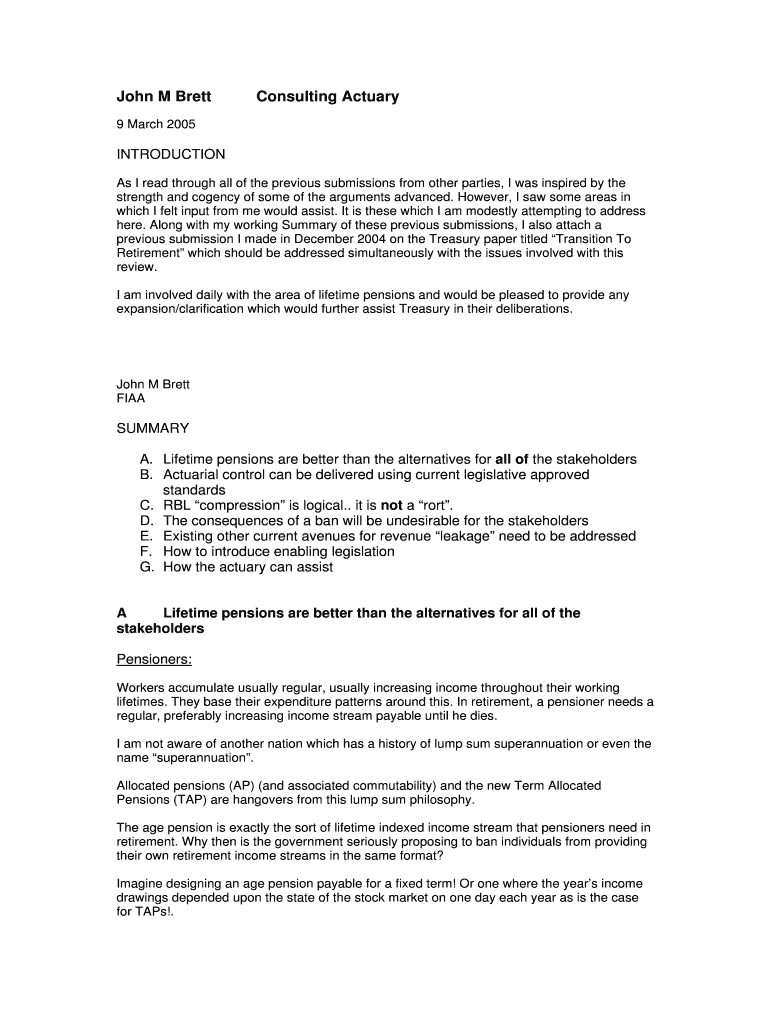
"John M Brett" generally refers to the consulting actuary John M. Brett and his expertise in retirement income streams, particularly lifetime pensions. In this context, Brett's work is instrumental for stakeholders involved in the financial planning and management of retirement funds. The focus is largely on the advantages of lifetime pensions over other alternatives, like term allocated pensions. Brett’s analysis plays a crucial role in understanding how actuarial controls can be leveraged within existing legislative frameworks without extensive regulatory changes. His work critiques proposed bans, highlighting adverse effects for self-funded retirees. Understanding Brett’s principles is essential for anyone looking into actuarial strategies or the intricacies of retirement income streams.
How to Use the Work of John M Brett
Leveraging the insights provided by John M Brett involves analyzing his arguments on the superiority of lifetime pensions and the role of actuarial control. Financial professionals can apply these principles in advising clients on optimal retirement income strategies. When evaluating pension options, Brett’s work suggests a need for integrating government policies to maximize retirement income goals effectively. To use his insights, examine retirement plans against the background of his recommendations and consider the implications of legislative controls on actuarial practices. Be mindful of how these principles can influence retirement planning advice, particularly for those managing self-funded retirement strategies.
Steps to Complete a Review Based on John M Brett’s Recommendations
- Evaluate the Current Legislative Framework: Understand the existing rules and controls within the retirement income sector.
- Analyze Lifetime Pension Benefits: Compare these against allocated and term allocated pensions to appreciate Brett’s preferences.
- Consider the Role of Actuarial Controls: Investigate how these controls can optimize pension outcomes within current regulations.
- Examine Critiques of Proposed Bans: Analyze Brett’s arguments against banning lifetime pensions to grasp potential repercussions.
- Integrate Government Policies: Ensure any pension plan aligns with governmental retirement income objectives.
By following these steps, actuaries and financial consultants can align their strategies with Brett's recommendations, ensuring that their clients receive informed and up-to-date advice.
Key Elements of John M Brett's Analysis
Several pivotal elements define John M Brett’s analysis of retirement income streams:
- Preference for Lifetime Pensions: Long-term benefits and security over gradual payouts.
- Critique of Proposed Bans: Potential harm to self-funded retirees.
- Importance of Actuarial Controls: Leveraging existing legislation to enhance pension outcomes.
- RBL Compression: Logical reasoning to ensure sustainable retirement incomes.
- Government Policy Integration: Aligning personal retirement strategies with broader policy objectives.
These elements highlight the comprehensive nature of Brett’s work and form the foundation for any review or assessment based on his analyses.
Important Terms Related to John M Brett
To fully grasp John M Brett’s analyses, understanding several key terms is essential:
- Lifetime Pensions: Regular retirement income without a fixed term.
- Allocated Pensions: Income derived from allocated pension funds.
- Self-funded Retirees: Individuals supporting their own retirement without relying solely on government pensions.
- RBL Compression: Regulatory term concerning benefits limits in pension schemes.
- Actuarial Controls: Techniques using mathematical and statistical methods to assess pension schemes.
These terms form the glossary that accompanies Brett’s work, ensuring clarity and precision in discussions about his contributions to retirement planning.
Legal Use of Analyses Derived from John M Brett
John M Brett’s analyses carry significant implications for legal and regulatory compliance. His focus on actuarial control suggests that compliance with existing regulations can enhance pension outcomes without necessitating legislative change. His critiques may also inform policy debates, shaping legal discussions around the viability of proposed pension bans. Financial planners and actuaries can use Brett’s analyses legally to support advising strategies that align with current laws. Legal frameworks often require adherence to his insights when devising strategies that involve lifetime pensions and other retirement income streams.
Examples of Using John M Brett's Recommendations
In practice, John M Brett’s recommendations can be seen in several scenarios:
- Retirement Planning for Professionals: Advisors recommend lifetime pensions as a secure income stream.
- Self-funded Retirement Strategies: Emphasize the role of actuarial controls to safeguard retirement income.
- Policy Debates: Use Brett's critiques to advocate against potentially harmful pension bans before legislative bodies.
- Financial Advisory Services: Incorporate Brett’s insights into portfolio strategies for retirees seeking stable income sources.
These examples illustrate the practical applications of Brett’s analyses in real-world financial planning and policy-making contexts.
Digital vs. Paper Version Advocacy in John M Brett's Context
John M Brett’s analyses, while not originally tailored to digital versus paper debates, can inform opinions on document management practices related to retirement planning. With the rise of platforms like DocHub, the capability to streamline document workflows — for instance, through secure digital storage and transfer of important analyses and communications — aligns with Brett’s emphasis on efficiency and comprehensive control. Moreover, digital access to his work can facilitate broader dissemination and rapid updates, ensuring that actuaries and policymakers are equipped with the latest insights.