






Definition and Meaning
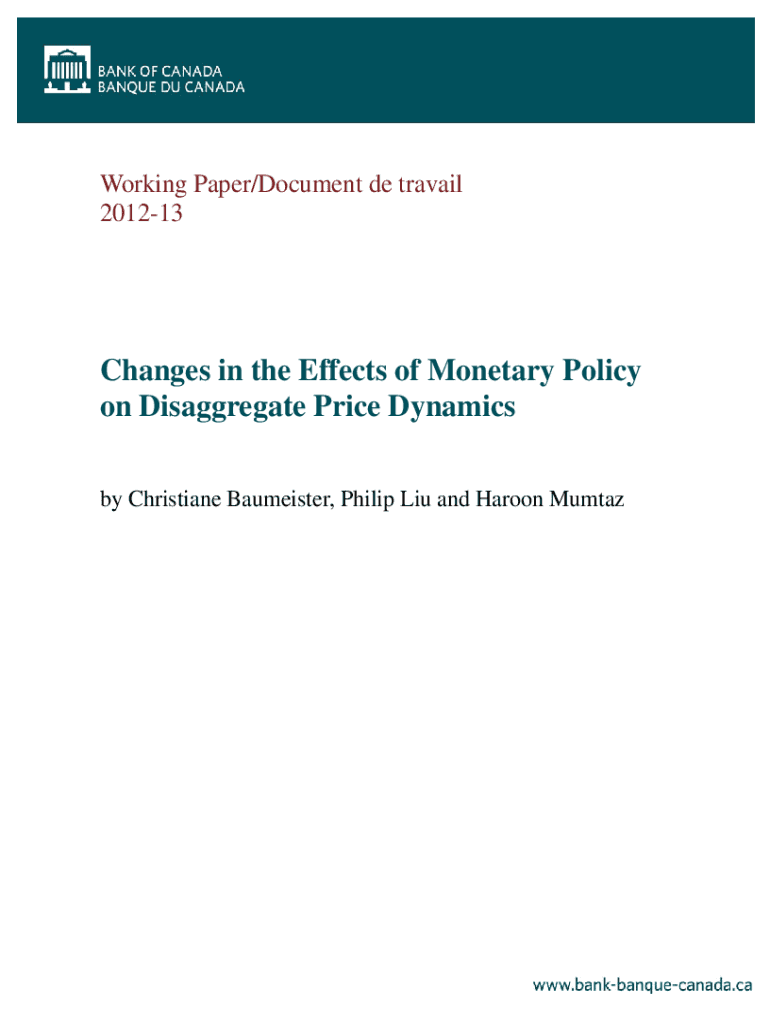
The "Changes in the Effects of Monetary Policy on - IDEAS RePEc" pertains to research exploring how modifications in monetary policy impact disaggregated price dynamics within the U.S. economy using data and theoretical frameworks. This analysis is crucial for understanding how sectoral price responses vary over time and how diverse economic sectors react to monetary shocks. The form serves as a comprehensive resource for economists, policymakers, and researchers to assess and model the changing effects of monetary policies.
How to Use the Changes in the Effects of Monetary Policy on - IDEAS RePEc
To effectively use this research paper, first identify the key variables of interest such as sectoral price dynamics and monetary policy tools. The study employs a factor-augmented vector autoregression model, making it essential to understand its computational aspects and implications. Engage with the paper's empirical findings and theoretical models to interpret results and apply them within appropriate economic contexts, aiding in policy formulation or academic analysis.
Steps to Complete the Changes in the Effects of Monetary Policy on - IDEAS RePEc
- Access the Document: Start by downloading or accessing the paper through IDEAS RePEc or related platforms.
- Familiarize with Terminology: Understand key economic terms like DSGE models and monetary policy shocks.
- Data Analysis: Examine the dataset and methodologies used for simulating disaggregate price dynamics.
- Interpret Findings: Analyze how changes in the cost channel affect inflation dynamics and sectoral responses.
- Apply Insights: Utilize insights for academic work or policy development by integrating findings into broader economic models or strategies.
Important Terms Related to Changes in the Effects of Monetary Policy on - IDEAS RePEc
- Monetary Policy Shocks: Sudden changes in monetary policy that can affect economic variables such as interest rates or inflation.
- Disaggregate Price Dynamics: Observations of price changes across different sectors, rather than at an aggregate level.
- DSGE Model: Dynamic Stochastic General Equilibrium model, used for macroeconomic analysis.
- Factor-Augmented Vector Autoregression (FAVAR): A statistical model used to analyze the impact of unobservable factors on observed variables.
- Cost Channel of Monetary Policy: The mechanism by which interest rates impact production costs and hence pricing decisions.
Key Elements of the Changes in the Effects of Monetary Policy on - IDEAS RePEc
- Sector-Specific Analysis: Provides detailed insights into how different industry sectors respond to monetary policies.
- Historical Contextualization: Examines changes over time, specifically noting shifts since the early 1980s.
- Empirical Findings: Highlights significant variations in price responses, offering evidence for heterogeneous effects.
- Theoretical Integration: Links empirical observations to theoretical models for a comprehensive understanding of pricing behavior.
Examples of Using the Changes in the Effects of Monetary Policy on - IDEAS RePEc
Real-world application of this research might include:
- Policy Making: Developing monetary policies that consider sector-specific responses and historical shifts.
- Economic Forecasting: Improving predictive models by integrating empirical data on disaggregate price dynamics.
- Academic Research: Utilizing findings as a basis for scholarly articles or further research in monetary economics.
Software Compatibility
While not typically associated with tax-related software, analyzing the research paper may involve compatibility with statistical software like STATA, R, or MATLAB for modeling purposes. These tools allow users to replicate the methodologies and analyses presented in the research, enabling deeper insights into monetary effects.
Eligibility Criteria
Usage of the "Changes in the Effects of Monetary Policy on - IDEAS RePEc" research is primarily targeted at:
- Economists and Researchers: Individuals engaged in macroeconomic studies and policy development.
- Policy Makers: Decision-makers at governmental or financial institutions looking to refine monetary strategies.
- Higher Education Students: Individuals pursuing advanced studies in economics, particularly in fields related to monetary dynamics.


Application Process and Approval Time
While there is no formal application or approval process for using this research paper, gaining access typically involves:
- Resource Access: Ensure access through educational resources or subscriptions to databases like IDEAS RePEc.
- Understand Contextual Use: Recognize how the information applies to your field or research requirements, interpreting the data in light of your specific projects or policy concerns.