






Definition & Meaning
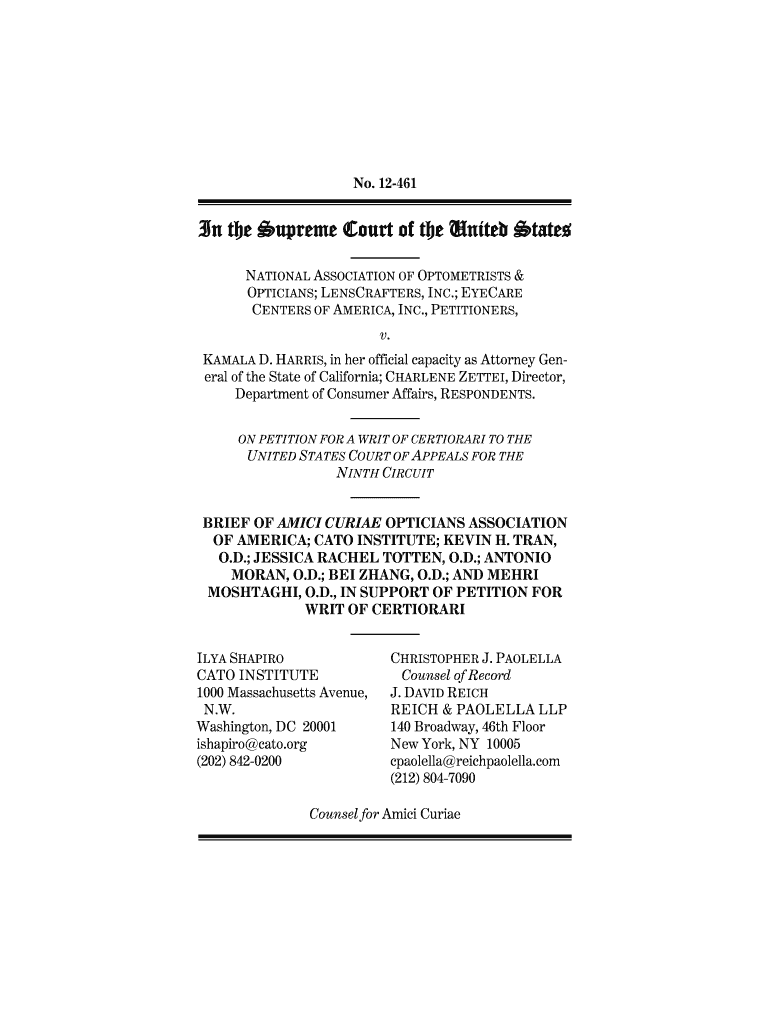
The case titled "12461 In the Supreme Court of the United States: National Association of Optometrists and Opticians et al. v. Kamala Harris, Attorney General of California, et al." involves a legal challenge to certain California laws. At its core, this case is about regulations that affect the sale of eyewear and affiliations between optometrists and retail chains. The plaintiffs argue that these laws unfairly limit commerce by preventing out-of-state businesses from entering the Californian market on equal footing, potentially violating the Commerce Clause. This case may impact not only the optometry industry but also broader principles of interstate commerce.
Key Elements of the Case
- Parties Involved: The plaintiffs include the National Association of Optometrists and Opticians, representing professionals and businesses affected by these regulations. The defendant is the Attorney General of California, defending the state's regulations.
- Primary Legal Concern: The crux of the case is whether California's laws, which allow in-state optometrists to sell eyewear but restrict out-of-state chain affiliations, are protectionist and thus unconstitutional under the Commerce Clause.
- Impact on Communities: The regulations are argued to disproportionately affect underserved minority communities by increasing eyewear costs and limiting service access.
Legal Use in the Context
The form and case involve the use of legal briefs and documents submitted to the Supreme Court. These documents are critical in presenting arguments, legal precedents, and evidence for the Court to consider. Legal practitioners use detailed briefs to persuade the Court to either hear the case or decide in a certain way. Understanding the legal ramifications as argued in the brief can illuminate how state laws intersect with federal commerce regulations.
Steps to Complete a Legal Brief
- Identify Relevant Statutes and Case Law: Gather applicable laws and precedents that support the argument.
- Draft Argumentative Sections: Outline key points, including legal rationales and commercial impacts.
- Compile Supporting Evidence: Include data, testimonies, and documented economic impacts.
- Submit to Court: Follow the Court's submission guidelines to ensure the brief is accepted.
Importance of the Case to Optometrists
- Impact on Business Models: This case challenges restrictions that limit how optometrists can structure their businesses, potentially opening pathways for more flexible business models.
- Access to Markets: A ruling in favor of the plaintiffs may enable out-of-state eyewear chains to compete, fostering market competition and consumer choice.
Who Typically Uses This Legal Process
- Optometry Associations: To protect member interests against potentially discriminatory statutes.
- Retail Chains: Interested in expanding into regulated markets like California.
- Legal Advocacy Groups: Focused on commerce clause implications and economic fairness.
State-Specific Rules for the Case
- California's Unique Regulations: States may have unique regulations affecting business operations within their borders. California's rules are specific to how optometry services can be combined with retail operations.
- Comparative Analysis: Understanding how California’s laws contrast with those of other states provides context for the argument that these laws are protectionist.
Examples of Legal Outcomes
- Historical Precedents: Referencing previous Supreme Court decisions may help predict outcomes. Cases where state laws were challenged under the Commerce Clause often set important precedents.
- Potential for Supreme Court Review: Cases that reach the Supreme Court, such as this, could have far-reaching implications on interstate commerce laws.
Required Documents for Filing
- Legal Briefs: These include the primary arguments and evidence.
- Amicus Briefs: Submitted by interested third parties, such as other professional organizations or industry groups, to support one side.
- Appendices and Attachments: Detailed evidence and data backing the claim.
Penalties for Non-Compliance
Failure to adhere to the Supreme Court's procedural rules can result in briefs being rejected. This might include incorrect formatting, missing deadlines, or incomplete documentation, potentially disadvantaging a party’s position in the legal proceedings.
Software Compatibility for Legal Submissions
Most legal documents, including those related to Supreme Court submissions, can be prepared using standard word processing software. Tools facilitating legal citation and document formatting, like Microsoft Word or Adobe Acrobat, are commonly used.
Business Types That Benefit
- Optometry Practices: Especially those seeking to expand or affiliate with retail chains.
- Retail Eyewear Chains: Interested in penetrating restricted markets.
- Legal Firms: Specializing in commerce law would find this case an important precedent.