IOWA COMMERCIAL LEASE AGREEMENT 2026

Get Form
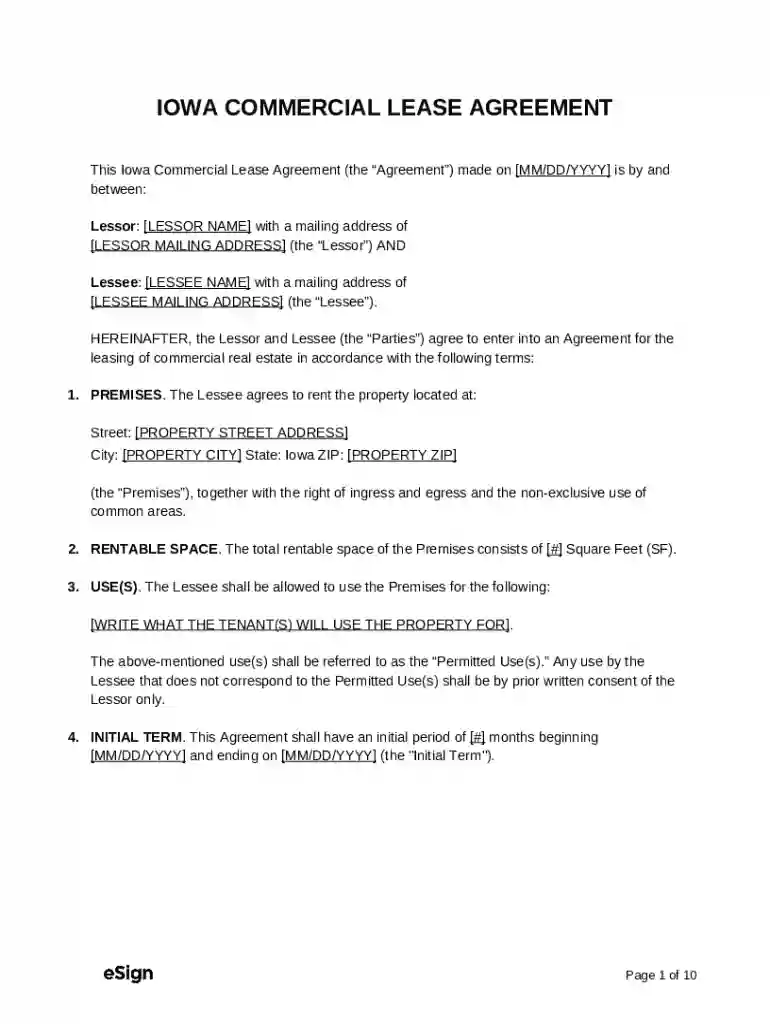
IOWA COMMERCIAL LEASE AGREEMENT Preview on Page 1

Here's how it works

01. Edit your form online
Type text, add images, blackout confidential details, add comments, highlights and more.

02. Sign it in a few clicks
Draw your signature, type it, upload its image, or use your mobile device as a signature pad.

03. Share your form with others
Send it via email, link, or fax. You can also download it, export it or print it out.

Definition and Meaning of the Iowa Commercial Lease Agreement

The Iowa Commercial Lease Agreement is a legally enforceable contract that governs the leasing relationship between a property owner, known as the lessor, and a tenant, referred to as the lessee. Designed specifically for commercial properties in Iowa, this document outlines key terms such as the location of the premises, rent amount, lease duration, and permissible uses. Compliance with state laws, indemnification clauses, and stipulations for renewal and termination are essential components, ensuring that both parties understand their rights and obligations.

Practical Implications

  • Premises Location: Clearly defines the physical space subject to the lease.
  • Rental Amount and Payment Schedule: Outlines the financial obligations of the lessee, including the frequency and method of payment.
  • Lease Duration: Specifies the start and end dates of the lease term and conditions for renewal.
  • Permitted Uses: States what business activities can legally be conducted on the premises.
  • Amendments: Any changes to the agreement must be mutually agreed upon in writing.

How to Use the Iowa Commercial Lease Agreement

Utilizing the Iowa Commercial Lease Agreement effectively requires understanding its structure and components. Parties interested in establishing a lease must carefully complete and review the form to ensure accuracy and compliance with legal standards.

Detailed Steps

  1. Review the Document: Thoroughly read the entire agreement to understand each provision and ensure it meets your needs.

  2. Complete Required Sections: Fill out the necessary information, such as tenant and landlord details, property description, and financial terms.

  3. Negotiate Terms: Discuss and finalize any negotiable terms, such as rent increase protocols or maintenance responsibilities.

  4. Execute the Agreement: Sign and date the document, ensuring that both parties have a copy for their records.

How to Obtain the Iowa Commercial Lease Agreement

Accessing the Iowa Commercial Lease Agreement is straightforward, with several options available to those in need of this legal document.

Acquisition Methods

  • Online Platforms: Many legal sites offer downloadable templates of the Iowa Commercial Lease Agreement.
  • Legal Counsel: Lawyers specializing in commercial real estate can provide customized agreements.
  • Government Resources: Certain state or local government websites may offer standard forms for public use.

Key Elements of the Iowa Commercial Lease Agreement

A robust Iowa Commercial Lease Agreement includes several critical sections that delineate the responsibilities and rights of both the lessor and lessee.

Core Sections

  • Security Deposit: Amount required, use, and conditions for return.
  • Maintenance and Repairs: Details on who handles maintenance and how issues should be reported.
  • Insurance Requirements: Minimum coverage obligations each party must maintain.
  • Indemnity and Liability: Provisions protecting each party against losses or damages.
  • Termination Conditions: Grounds for ending the lease early and associated penalties.

Important Terms Related to the Iowa Commercial Lease Agreement

Understanding the terminology used within the Iowa Commercial Lease Agreement helps parties grasp their commitments and rights more fully.

Key Terms and Definitions

  • Lessor and Lessee: Identifies the property owner and the tenant.
  • Sublease: Whether the tenant can lease part of the leased space to another party.
  • Default: Conditions under which the lease is considered breached.
  • Force Majeure: Circumstances under which a party is excused from fulfilling contract terms.

Legal Use of the Iowa Commercial Lease Agreement

The lawful application of the Iowa Commercial Lease Agreement ensures that the contract is enforceable and protects the interests of both the lessor and lessee.

Compliance Considerations

  • Regulatory Adherence: Agreement must comply with Iowa state laws and relevant federal regulations.
  • Registration and Recording: Some leases may require recording with local government bodies to be recognized legally.
  • Dispute Resolution: Procedures for addressing conflicts, typically involving mediation or legal proceedings.

Who Typically Uses the Iowa Commercial Lease Agreement

Commercial lease agreements are pivotal for multiple types of entities, each utilizing the form to suit its specific business needs.


decoration image ratings of Dochub

Common Users

  • Property Management Companies: Facilitate leases on behalf of property owners.
  • Business Owners: Secure premises for conducting business operations.
  • Real Estate Brokers: Assist clients in navigating lease negotiations and documentation.
decoration image

State-Specific Rules for the Iowa Commercial Lease Agreement

Leases in Iowa must adhere to regulations unique to the state, distinguishing them from agreements in other jurisdictions.

Notable State Rules

  • Disclosure Requirements: Certain disclosures may be mandated, such as the presence of environmental hazards.
  • Termination Notices: State-specific notice periods for ending a lease.
  • Zoning Compliance: Ensures leased property use aligns with local zoning ordinances.

These insights into the Iowa Commercial Lease Agreement provide a foundational understanding for creating, managing, and executing these essential legal documents in the state of Iowa.

be ready to get more

Complete this form in 5 minutes or less

Get form

Got questions?

We have answers to the most popular questions from our customers. If you can't find an answer to your question, please contact us.
Contact us
Gross Lease Gross leases are most common for commercial properties such as offices and retail space. The tenant pays a single, flat amount that includes rent, taxes, utilities, and insurance. The landlord is responsible for paying taxes, utilities, and insurance from the rent fees.
Distinction Between NNN and Other Lease Agreements A Triple Net Lease (NNN) places the responsibility for property expenses on the tenant. This includes common area maintenance (CAM), property taxes, and insurance. In contrast, a Gross Lease includes these costs in a single rent payment, making it simpler for tenants.
Negotiate lease length Commercial leases do not have specific minimum or maximum durations. However, they typically span from one to 25 years, with the majority falling within the range of three to ten years.
If youre wondering what is the most common type of residential lease, the answer is the fixed-term lease. This lease type locks in tenants for a set period, typically 12 months, giving landlords predictable rental income and financial security.
The most common types include Full Repairing and Insuring Lease (FRI) lease, Gross Lease, Net Lease and Percentage Lease.

Security and compliance

At DocHub, your data security is our priority. We follow HIPAA, SOC2, GDPR, and other standards, so you can work on your documents with confidence.
Learn more
ccpa2
pci-dss
gdpr-compliance
hipaa
soc-compliance

People also ask

However, generally a well-drafted lease should begin with a contents page and the lease itself will be ordered as follows: Details of the parties. Definitions and interpretation. Operative clauses. Schedules. Provisos. Signature.
Compare Commercial Lease Agreements Gross leases tend to benefit the tenant, whereas net leases are more landlord friendly. In a gross lease, the tenant has more control over how much is spent on such expenses as janitorial services and utilities.
Typically, a commercial lease will cover the following matters: The type of property being let. The address of the property. The length of the tenancy, and whether it is a fixed term or a term that can be renewed periodically. The amount of rent charged, and when the rent will be paid.

Related links