Parallel Structure Exercise 3 2026

Get Form
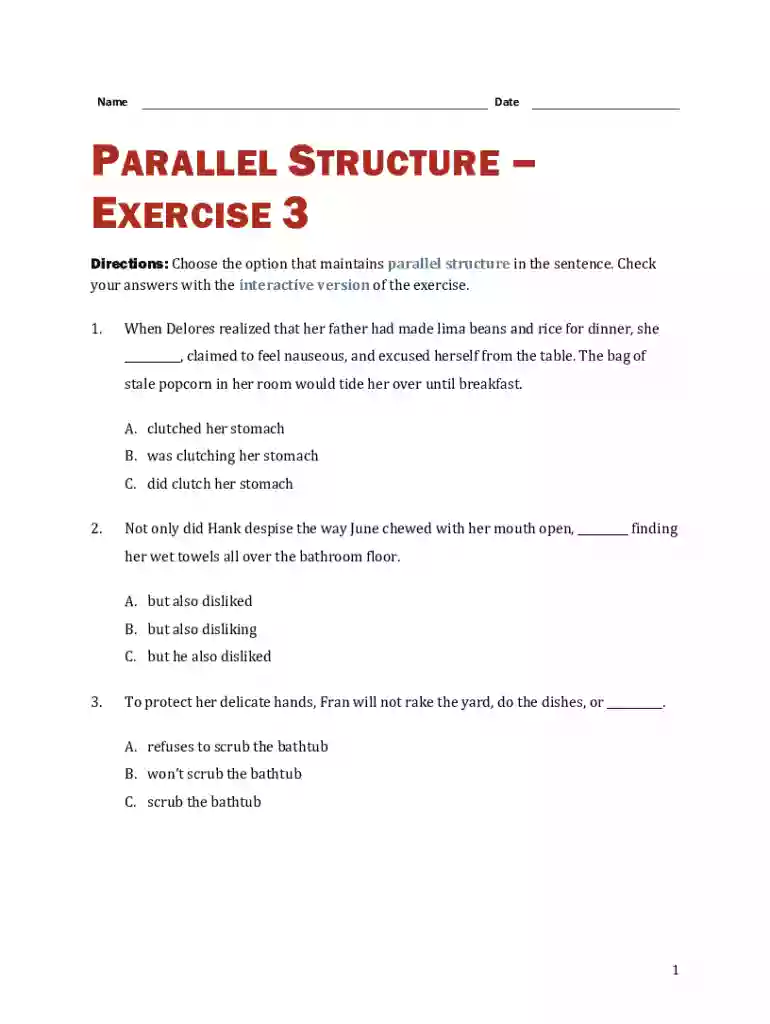
Parallel Structure Exercise 3 Preview on Page 1

Here's how it works

01. Edit your form online
Type text, add images, blackout confidential details, add comments, highlights and more.

02. Sign it in a few clicks
Draw your signature, type it, upload its image, or use your mobile device as a signature pad.

03. Share your form with others
Send it via email, link, or fax. You can also download it, export it or print it out.

Definition and Meaning of Parallel Structure Exercise 3

Parallel Structure Exercise 3 is a linguistic exercise commonly used in grammar studies to help individuals and students practice the principle of parallelism in sentence construction. Parallelism, or parallel structure, refers to the use of consistent patterns within sentences to create a smooth and coherent flow of language. This exercise focuses on identifying and correcting sentences that lack parallel structure, thereby enhancing the clarity, readability, and aesthetic quality of writing. Through this exercise, participants are trained to recognize faulty parallel structures and to apply consistent grammatical structures such as verbs, nouns, and clauses within a sentence.

How to Use the Parallel Structure Exercise 3

  1. Identify Patterns: Begin by reviewing sentences and identifying the lists or paired elements. Look for verbs, nouns, and adjectives that must follow the same grammatical pattern to maintain parallelism.

  2. Select Correct Options: Use multiple-choice questions where participants are required to select the most appropriate option that retains parallel structure. This reinforces understanding through immediate application.

  3. Check for Consistency: Ensure all items in a series, or elements in comparisons, follow the same grammatical pattern. For example, if a series starts with a gerund (e.g., running), subsequent items should also begin with gerunds (e.g., swimming, biking).

Practical Examples

  • Correct: She enjoys reading, writing, and cycling.
  • Incorrect: She enjoys reading, writing, and to cycle.

Edge Cases

  • When items are complex and contain sub-elements, ensure subordinate clauses are also parallel.

Key Elements of the Parallel Structure Exercise 3

The exercise emphasizes several crucial elements that apply to both simple and complex sentence structures:

  • Verb Consistency: Ensures verbs within a sentence are uniformly used, such as maintaining either all infinitive verbs or all gerunds where appropriate.
  • Noun Uniformity: Aligns nouns to be singular or plural across the sentence to avoid awkward or incorrect constructions.
  • Clause Equivalence: In sentences with multiple clauses, ensuring each clause is constructed similarly to maintain clarity and flow.

Enhanced Bulleted Details

  • Parallel Verb Forms: Utilizes same verb forms in running lists (e.g., ‘to run, to jump, to swim’).
  • Balanced Nouns: Aligns subjects consistently (e.g., 'cats and dogs' instead of 'a cat and chasing dogs').
  • Uniform Adjectives: Promotes consistent adjective use in descriptive lists.

Steps to Complete Parallel Structure Exercise 3

  1. Read Instructions: Carefully study the exercise instructions to understand the requirements.
  2. Evaluate Sentences: Examine each sentence for patterns or series that require parallel structure.
  3. Choose Answers: Select the answer that best maintains parallelism.
  4. Revise Sentences: Rewrite sentences as needed for better parallel construct.

Detailed Step-by-Step Approach

  • Analyze Each Sentence: Break down the sentence components to identify faulty parallelism.
  • Substitute Options: Use the most suitable option from multiple choices to correct errors.
  • Review and Reflection: Cross-check revised sentences for cohesiveness and make additional adjustments if necessary.

Benefits of Completing Parallel Structure Exercise 3

Understanding and applying parallel structure enhances writing skills by:

  • Improving Readability: Sentences that follow parallel structure are smoother and easier to understand.
  • Increasing Engagement: Well-constructed sentences can maintain reader interest more effectively.
  • Professional Writing Standards: Mastery of parallel structure is crucial in academic, professional, and creative writing.

Variations and Exceptions

  • Complex sentences often hold exceptions where semantic significance may override strict parallelism for effect or tone.

Who Typically Uses the Parallel Structure Exercise 3

Primarily employed by:

  • Students and Educators: As an educational tool for strengthening grammatical skills.
  • Writers and Editors: To refine and polish written content for publication or submission.
decoration image ratings of Dochub

Additional Users

  • Language Learners: To enhance writing level in accordance with advanced grammar rules.
  • Professional Trainers: For corporate training programs focusing on effective communication skills.

Important Terms Related to Parallel Structure Exercise 3

  • Parallelism: Consistent grammatical structure within a sentence.
  • Series: A list of items in a sentence that need uniform grammatical treatment.
  • Grammatical Terms: Nouns, verbs, clauses, adjectives, and descriptive phrases relevant to the exercise.

Clarified Examples

  • Understanding terms like 'series' and 'clauses' helps identify areas requiring parallel treatment.

Practical Examples of Using the Parallel Structure Exercise 3

  • Correct Application: "The committee was tasked with reviewing the policy, drafting amendments, and presenting their recommendations" showcases all verbs in the gerund form.
  • Incorrect Application: "She wanted to make sure that everyone got their bonus, were thanked for their efforts, and the meeting ended on time" illustrates a lack of parallelism.

Nuanced Scenarios

  • Scenarios with mixed needs for formal and informal tones in a document require careful application of parallel structure principles to avoid sounding disjointed.

Through these detailed sections, "Parallel Structure Exercise 3" can be effectively understood and applied in various writing contexts to enhance clarity and coherence in language use.

be ready to get more

Complete this form in 5 minutes or less

Get form

Got questions?

We have answers to the most popular questions from our customers. If you can't find an answer to your question, please contact us.
Contact us
Parallelism Checklist Identify any conjunctions or lists in your sentence. Look at the structure of your words and phrases on either side of those conjunctions. Look at the clauses you have in a sentence. Are your verbs in the same tense on both sides of a conjunction and within your modifying clauses?
How to Make a Sentence Parallel The first step is to identify coordinating conjunctions, such as and, or, and but. The second step is to identify correlative conjunctions, such either/or and neither/nor. Third, writers need to ensure that the items on either side of the conjunctions are parallel.
Parallel structure means using the same pattern of words to show that two or more ideas have the same level of importance. This can happen at the word, phrase, or clause level. The usual way to join parallel structures is with the use of coordinating conjunctions such as and or or.
Mary likes to hike, to swim, and to ride a bicycle. Mary likes to hike, swim, and ride a bicycle. (Note: You can use to before all the verbs in a sentence or only before the first one.)
To make them parallel, the sentences should be rewritten with just gerunds or just infinitives. Note that the first nonparallel example, while inelegantly worded, is grammatically correct: cooking, jogging, and to read are all grammatically valid conclusions to She likes.

Security and compliance

At DocHub, your data security is our priority. We follow HIPAA, SOC2, GDPR, and other standards, so you can work on your documents with confidence.

Learn more
ccpa2
pci-dss
gdpr-compliance
hipaa
soc-compliance

People also ask

Achieving Parallel Structure To achieve parallelism, you must use the same verb, noun, adverb, or adjective forms consistently throughout a sentence. Consider the following examples: e.g., Paul likes dancing, swimming, and running. e.g., Paul likes to dance, swimming, and run.
It provides three rules for using parallel structure: 1) elements in a parallel list must be joined with conjunctions and use the same grammatical structure, 2) elements that begin with clauses must continue using clauses, and 3) lists of actions should use the same verb tense.
Here is an idea for a fun, interactive exercise to practice parallel structure! On an index card, have students write three action verbs. Some examples include walk, jog, and talk, or scheme, erase, and connect, or run, swim, and wring. Students exchange their cards with a partner.

Related links