01. Edit your form online
Type text, add images, blackout confidential details, add comments, highlights and more.

Type text, add images, blackout confidential details, add comments, highlights and more.

Draw your signature, type it, upload its image, or use your mobile device as a signature pad.

Send it via email, link, or fax. You can also download it, export it or print it out.
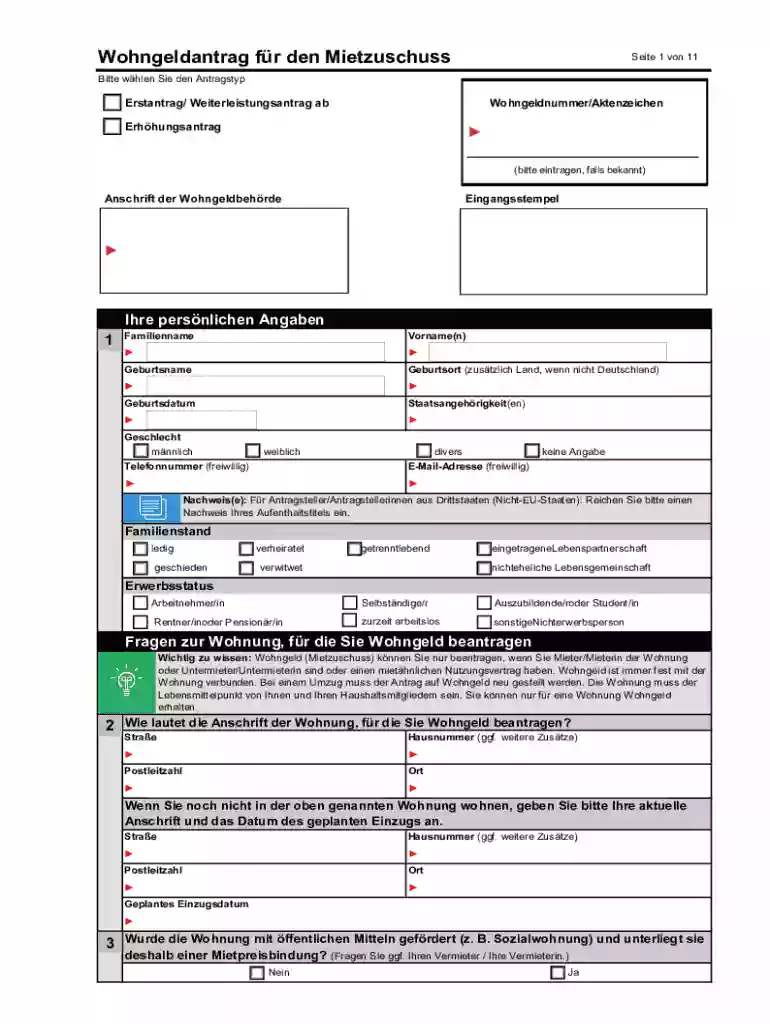
Wohngeld is a housing benefit provided to individuals and families in Germany who require financial assistance to manage their rental costs. It targets low-income households, with the amount of the benefit being contingent on various factors such as household size, total income, and rental amounts. The purpose of Wohngeld is to alleviate financial burdens and ensure access to adequate housing.
To qualify for Wohngeld, applicants must meet specific criteria. These typically include:
Consider a family of four living in Berlin, where the rental cost is a significant portion of their budget. With the father working in a moderate-paying job and the mother handling part-time work, their combined income may still be insufficient, qualifying them for Wohngeld to subsidize their monthly rent and maintain their standard of living.
The application form for Wohngeld is accessible through various means, allowing flexibility for applicants:
Before filling out the Wohngeld application, gather essential documents:


The income threshold is a crucial eligibility factor:
Households with more members may have higher income allowances, acknowledging the increased cost of living. Ensuring every member's details are accurately reported enhances the application's success rate.
Providing false information on Wohngeld applications can lead to legal repercussions:
Applicants must verify all details before submission, ensuring transparency and alignment with eligibility criteria.
Applicants can choose from several submission methods:
The average processing time for Wohngeld applications varies but typically ranges from four to eight weeks. Efficiency can be improved by:
While Wohngeld serves as a primary housing subsidy, other programs might be relevant:
Providing a comprehensive understanding of available supports facilitates better decision-making by applicants, ensuring they maximize the aid they receive.
For instance, a single-parent household might find that combining Wohngeld with child benefits offers a more substantial safety net, enhancing their ability to provide for the family.
By comprehensively understanding the Wohngeld system, applicants can more effectively navigate the application process, optimizing their chances of receiving this crucial financial support.
At DocHub, your data security is our priority. We follow HIPAA, SOC2, GDPR, and other standards, so you can work on your documents with confidence.