01. Edit your form online
Type text, add images, blackout confidential details, add comments, highlights and more.

Type text, add images, blackout confidential details, add comments, highlights and more.

Draw your signature, type it, upload its image, or use your mobile device as a signature pad.

Send it via email, link, or fax. You can also download it, export it or print it out.
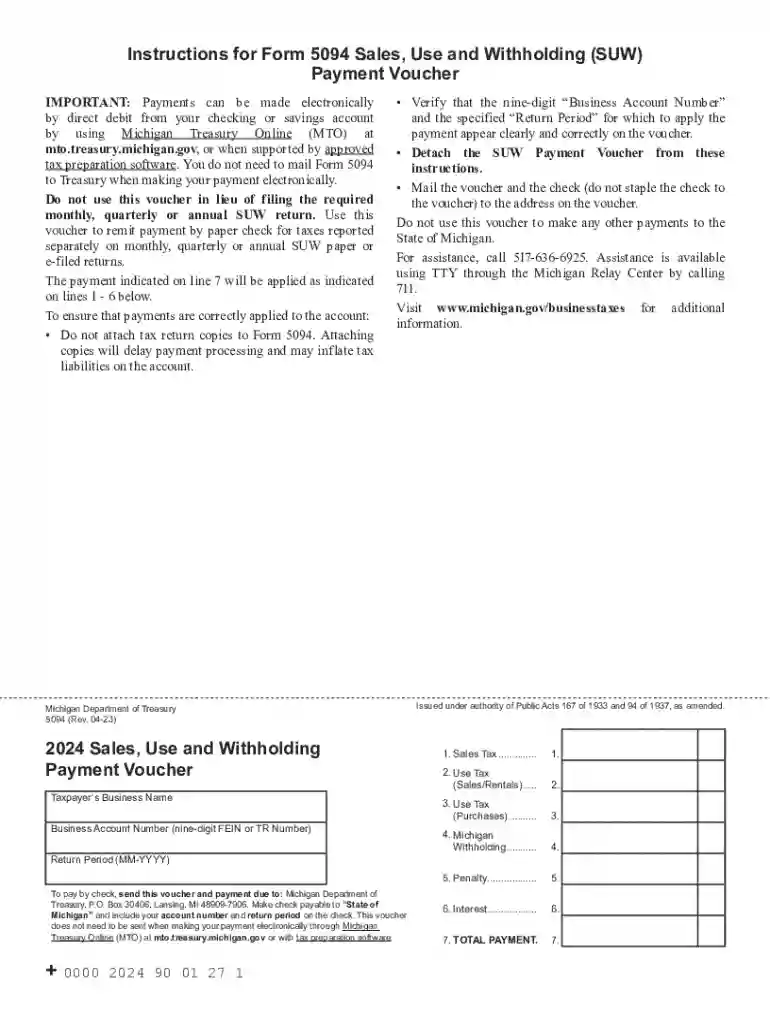
The Instructions for Form 5094, Sales, Use, and Withholding (SUW), are guidelines issued by the State of Michigan for completing the SUW Payment Voucher. This form is integral when businesses need to report and pay sales, use, and withholding taxes. These taxes often apply to the sale of goods and services that are not subject to traditional sales tax laws, thus requiring businesses to remit these taxes directly to the state. The voucher guides users on how to submit payments either electronically or via paper check, ensuring compliance with state tax regulations.
Gather Information: Collect all relevant tax data, including sales figures, tax amounts collected, and any withholding amounts.
Calculate Dues: Use the figures to calculate the total amount of tax due. This step is crucial to avoid underpayment, which could lead to penalties.
Fill Out the Voucher: Accurately fill in the required fields on Form 5094. This includes entering the taxpayer's identification number, tax period, and the calculated tax due.
Choose Payment Method: Decide whether to submit the payment electronically or by paper check. Establish an account with the Michigan Department of Treasury if you opt for electronic submission.
Submit the Form: Send the completed Form 5094 along with the payment by the due date to avoid late fees. Online submissions can be done through the state's tax portal, while checks should be mailed to the designated address provided in the instructions.
Keep Records: Maintain copies of the completed Form 5094 and payment confirmation for your records. This documentation is crucial for any future audits or discrepancies.
The instructions serve as a legal guide for businesses in Michigan to ensure proper compliance with state tax laws. Failure to adhere to these instructions can result in penalties, interest on unpaid taxes, and potential legal consequences. Businesses are advised to closely follow the guidelines provided to ensure they fulfill their tax obligations accurately and timely.
Michigan’s SUW instructions are tailored to the state’s specific tax codes and regulations. Unlike other states, Michigan requires detailed documentation of sales and use taxes for all applicable goods and services. Furthermore, businesses operating within the state must comply with additional reporting requirements, such as providing separate disclosure for each type of tax on the SUW form. Understanding these state-specific nuances is crucial for accurate submission and compliance.
Taxpayers must be vigilant about the specific deadlines for filing the SUW Payment Voucher. In Michigan, payments are typically due monthly, quarterly, or annually, depending on the filing frequency assigned by the Department of Treasury. Missing these deadlines can result in late fees and penalties. Ensure all submissions are postmarked or electronically submitted by the specified date to be considered timely.
Non-compliance with the SUW instructions can result in significant financial penalties. The state may impose fines for late submissions or underpayment of taxes. There is also a possibility of interest charges accruing on overdue taxes. In severe cases, prolonged non-compliance might lead to legal action or additional audits by the Michigan Department of Treasury. It's imperative to understand the importance of timely and accurate tax reporting practices to avoid these repercussions.
These instructions are primarily used by Michigan-based businesses that are responsible for collecting sales, use, and withholding taxes. This includes retailers, service providers, and employers who must comply with the state tax regulations. Sole proprietors, partnerships, corporations, and any business entities engaged in taxable activities within Michigan rely on these guidelines to ensure they meet their tax obligations correctly.


We've got more versions of the Instructions for Form 5094 Sales, Use and Withholding (SUW form. Select the right Instructions for Form 5094 Sales, Use and Withholding (SUW version from the list and start editing it straight away!
At DocHub, your data security is our priority. We follow HIPAA, SOC2, GDPR, and other standards, so you can work on your documents with confidence.