







Definition and Meaning
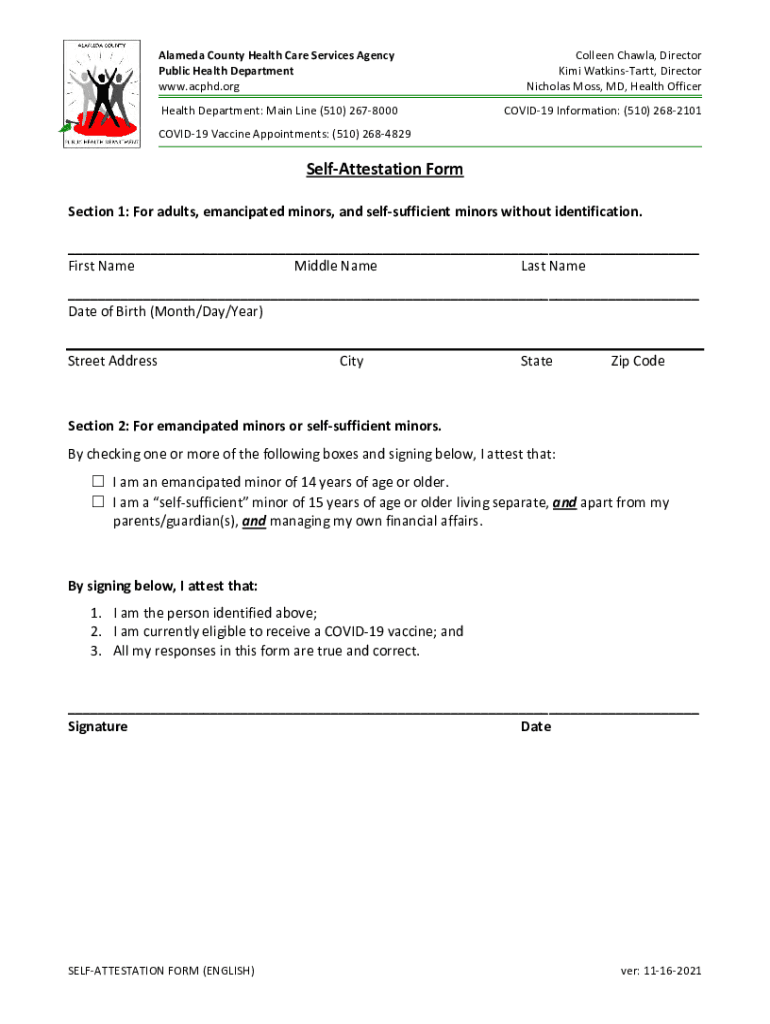
Self-attestation is a process where individuals certify their own statements to be true without needing external verification. The "Self Attestation Form Self Attestation," typically used in legal and administrative contexts, allows individuals to affirm their eligibility or identity-related claims. This document is designed for scenarios where providing government-issued identification might be challenging or unnecessary. Self-attestation simplifies documentation requirements and empowers individuals to self-declare their status or qualifications.
Steps to Complete the Self Attestation Form
-
Personal Information Section: Begin by entering your personal details. This typically includes your full name, address, contact information, and any identification numbers if applicable. Be sure to use accurate and current information to ensure validity.
-
Statement Section: Clearly state the claim you are attesting to. This might relate to eligibility for a program, verification of identity, or confirmation of specific facts. Ensure that your statement is concise and directly addresses the requirement of the attestation.
-
Signature Section: The form usually requires a signature area where you should sign and date the document. This not only serves as your certification but also signifies your acknowledgment of potential legal implications in the case of false declarations.
-
Witness or Notary (Optional): Some self-attestation forms may require a witness or notary public's signature to further validate the form. Check if this applies to your specific form and complete this section accordingly.
How to Use the Self Attestation Form
-
Eligibility Confirmation: If you are required to demonstrate eligibility for a service or program, this form can be used to attest that you meet the necessary criteria without requiring additional documentation.
-
Identity Verification: In situations where identity confirmation is needed and official documents are unavailable, you can use this form to self-verify your identity.
-
Assurances and Declarations: Use the form to certify various declarations, such as residential status or compliance with certain regulations, by affirming the veracity of your statements.
Legal Use of the Self Attestation Form
Understanding the legal implications of self-attesting is critical. By completing this form, you are legally affirming that the information provided is true and accurate. False statements can result in penalties, including fines or legal action. Always ensure that you have a clear understanding of what you are attesting to and consult legal guidance if necessary to avoid unintended consequences.
Who Typically Uses the Self Attestation Form
The form is widely utilized by individuals who may find it convenient or necessary to self-certify their status or statements. This includes:
-
Students: For educational purposes where confirmation of student status or income might be required.
-
Eligible Low-Income Individuals: In applications for government assistance programs where self-certification of income or household size is permissible.
-
Certain Businesses: Small businesses or entrepreneurs certifying compliance with certain regulations or eligibility for business grants.


Important Terms Related to Self Attestation
-
Certification: The act of officially recognizing or validating a particular statement or status by one's own authority.
-
Declarant: The individual making the self-declaration, whose responsibility is to provide true and accurate information.
-
Notarization: The process of having a document authenticated by a notary public, which may or may not be required depending on the form’s instructions.
Key Elements of the Self Attestation Form
Key elements that define and structure the form include:
-
Identification Information: Basic details that assert the identity of the person completing the form.
-
Attestation Statement: A clearly articulated statement that details what is being attested to or declared.
-
Signature and Date: Signature blocks that must be filled in to authenticate the form along with the date of signing.
-
Optional Attachments: Space for any additional documents that might support the attested statement, such as letters or declarations from relevant authorities.
Examples of Using the Self Attestation Form
For practical understanding:
-
Vaccination Eligibility: Many states allow individuals to use self-attestation forms to affirm their eligibility for receiving vaccines, such as attesting to having underlying health conditions without producing medical records.
-
Housing Applications: Self-attestations can be used to certify income or residency status when applying for housing assistance programs or rental agreements.
-
Employment Verification: Job applicants may provide self-attestations of previous employment or skills when standard background checks are not viable.
State-Specific Rules for the Self Attestation Form
The application and acceptance of self-attestation forms can vary significantly by state due to local regulations. It is crucial to ensure compliance with state-specific mandates when using such forms. For instance, some states might have specific language requirements or additional fields that need to be completed. Familiarize yourself with these rules to ensure that the form is properly prepared and accepted.




