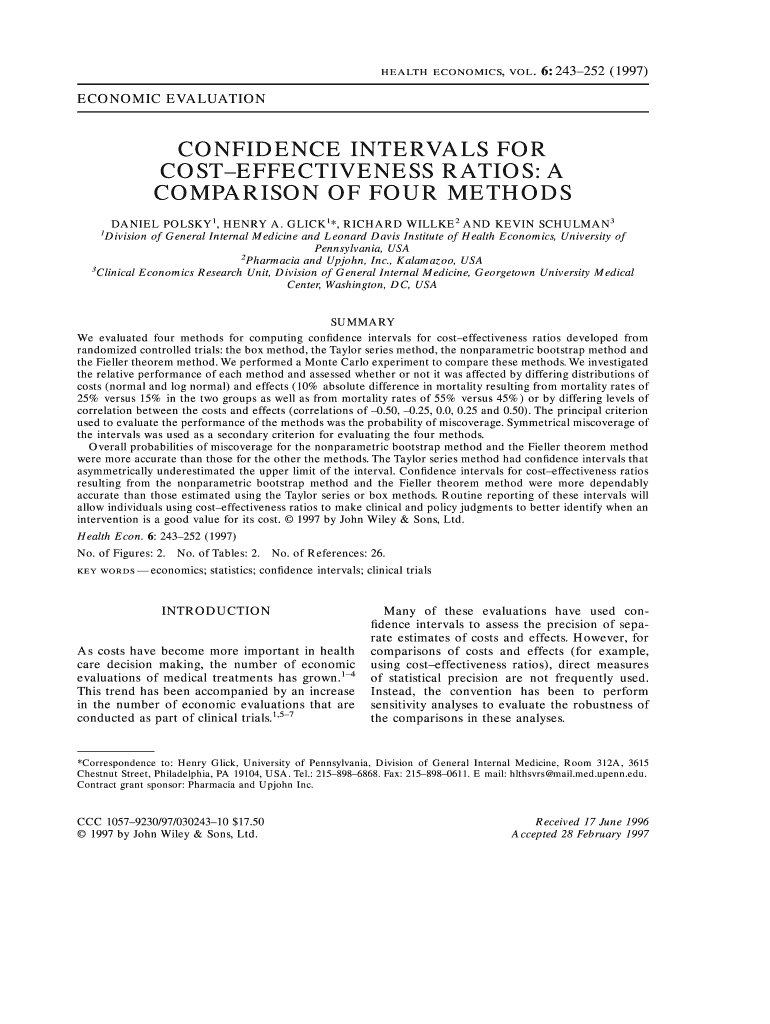







Definition & Meaning
The term "HEALTH ECONOMICS, VOL" is often associated with scholarly publications and academic journals that focus on the field of health economics. This area of study examines how health care resources are allocated and evaluates the costs and outcomes of those allocations on health care systems. The "VOL" part typically signifies a specific volume of the journal, indicating regular compilations of research articles published periodically. Health economics plays a critical role in understanding the economic factors that affect health care decisions and policies.
How to Use the HEALTH ECONOMICS, VOL
Engaging with a volume of a health economics journal can offer valuable insights into contemporary research and discussions. Readers, such as researchers, policymakers, and students, can use these volumes to:
- Explore recent studies evaluating economic models in health care.
- Understand diverse methodologies employed to measure cost-effectiveness.
- Examine policy recommendations based on applied health economic theories.
To effectively use the volume, readers should identify the topics most relevant to their interests or research areas, read summaries or abstracts to determine which articles provide the most valuable information, and consider accessing supplementary materials often cited in these studies for more detailed analysis.
Steps to Obtain the HEALTH ECONOMICS, VOL
Obtaining a specific volume of a health economics publication typically involves:
- Library Access: Visit academic libraries, especially in universities with strong health or economics departments, to access print or digital versions.
- Online Databases: Use online academic databases such as JSTOR, PubMed, or Google Scholar that frequently house journals related to health economics.
- Purchase or Subscription: Subscribing to the journal or purchasing individual volumes or articles directly from the publisher’s website for personal access.
- Institutional Affiliation: Leverage access provided by an affiliation with academic or professional institutions that may have subscriptions to these journals.
Who Typically Uses the HEALTH ECONOMICS, VOL
The users of health economics volumes are diverse, encompassing:
- Researchers and Academics: For conducting studies, reference, and teaching.
- Policymakers and Government Officials: To inform policy decisions and understand economic implications of health interventions.
- Health Care Professionals: To gain insights into the cost-effectiveness of treatments and health care strategies.
- Students: Following health economics courses who require resources for study or dissertations.
The audience typically seeks a thorough understanding of economic factors affecting health care and employs this knowledge to inform decision-making or academic endeavors.

Important Terms Related to HEALTH ECONOMICS, VOL
Several terms frequently appear in health economics literature that are crucial for understanding articles in these volumes:
- Cost-effectiveness Analysis (CEA): A method used to evaluate the outcomes of different interventions through the costs and benefits associated with them.
- Quality-Adjusted Life Year (QALY): A measure used in health economics to assess the value for money of medical interventions.
- Incremental Cost-Effectiveness Ratio (ICER): A statistic used in cost-effectiveness analysis; it compares the relative costs and outcomes of two or more courses of action.
- Fieller’s Theorem: A method for calculating confidence intervals, particularly valuable in evaluating cost-effectiveness ratios.
Familiarity with these and other related concepts is essential when reading health economics literature for a nuanced comprehension of the analyses and discussions.
Legal Use of the HEALTH ECONOMICS, VOL
Health economics volumes primarily serve an informational and educational purpose rather than a legal one, offering data analysis and interpretations that may influence policy but do not constitute legal documents themselves. For instance:
- Informing Legislation: Articles may assess the economic impact of potential policies, aiding legal drafters in evaluating economic consequences.
- Guide Regulatory Bodies: Empirical data from these volumes can support regulatory bodies in developing guidelines that govern health care practices.
While not legally binding, the research within can significantly influence legal and policy-making processes through data-driven advocacy and analysis.
Key Elements of the HEALTH ECONOMICS, VOL
Volumes of health economics journals generally include these key elements:
- Research Articles: In-depth studies that utilize various methodologies to explore economic aspects of health care interventions and policies.
- Reviews: Systematic reviews or meta-analyses summarizing and synthesizing existing research on specific health economic topics.
- Commentaries: Opinion pieces or editorials that provide perspectives on current health economic issues and debates.
- Case Studies: Real-world applications of economic theory to health care settings, illustrating practical implications of research findings.
These elements collectively contribute to a comprehensive understanding of the ongoing discourse in health economics.
Examples of Using the HEALTH ECONOMICS, VOL
Practical examples of how health economics journals may be used include:
- Policy Evaluation: Policymakers use economic analyses from these volumes to evaluate the potential impacts of proposed health policies.
- Cost Analyses in Clinical Trials: Researchers employ economic insights from these volumes to design and interpret the economic components of clinical trials.
Such examples illustrate how the insights provided by health economics volumes can be leveraged in various sectors to support decision-making and strategic planning.