




01. Edit your your prehospital care report is online
Type text, add images, blackout confidential details, add comments, highlights and more.

Type text, add images, blackout confidential details, add comments, highlights and more.

Draw your signature, type it, upload its image, or use your mobile device as a signature pad.

Send prehospital care report via email, link, or fax. You can also download it, export it or print it out.
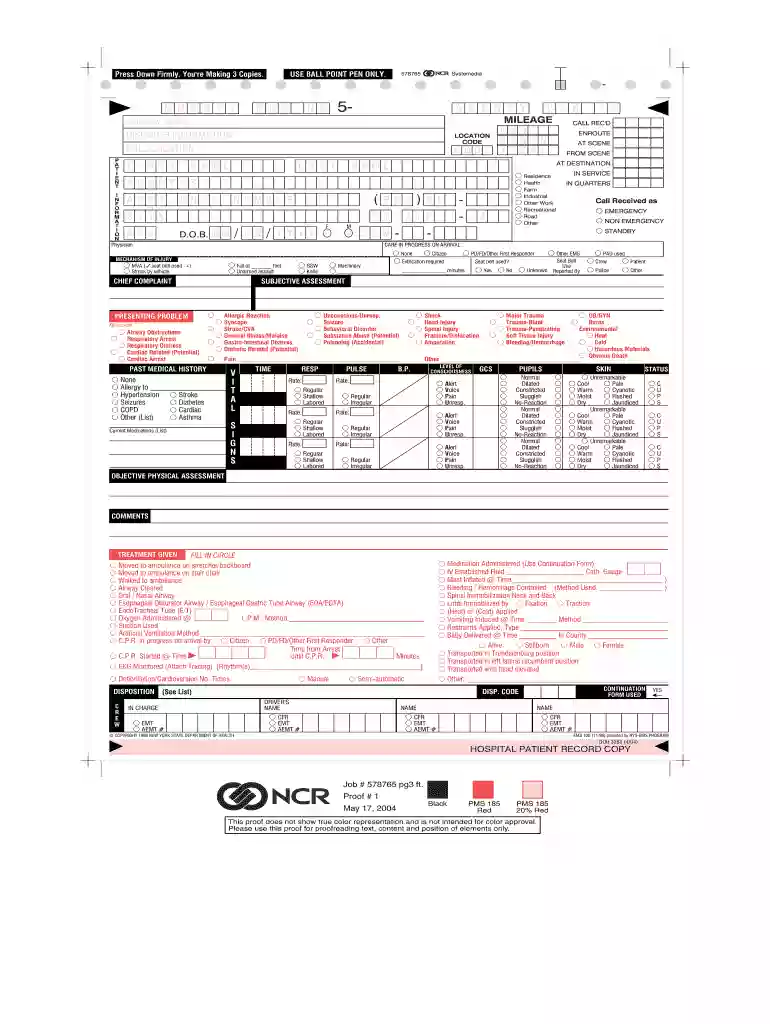
The Prehospital Care Report (Version 5) acts as a vital document used by emergency medical services (EMS) to capture critical information during patient interactions prior to hospital admission. This report documents various aspects of a medical emergency, ensuring a comprehensive record for patient care continuity.
Key elements of this report include:
The thoroughness of the Prehospital Care Report not only aids in immediate medical assessment but also enhances communication between care teams and informs subsequent treatment decisions.
Completing the Prehospital Care Report effectively requires several steps to ensure that all pertinent information is accurately documented. This process enhances the quality of patient care and streamlines information flow.
Collect Patient Information:
Document Call Details:
Assess and Record Medical Condition:
Provide Treatment Information:
Complete Crew Information:
Accuracy in completing each section enhances the effectiveness of care provided and keeps all involved parties informed.
The Prehospital Care Report (Version 5) has several critical sections that focus on comprehensive documentation for patient care. Each component is designed to capture specific data relevant to patient management during an emergency.
Incident and Patient Summary:
Assessment Findings:
Treatment Summary:
Patient Transport Details:
The clarity and depth of these components enable healthcare providers to align treatment plans effectively with the documented history presented upon patient arrival at healthcare facilities.
The Prehospital Care Report must adhere to various legal standards to ensure data protection and compliance with applicable regulations. Understanding these legal considerations is crucial for EMS providers.
Confidentiality: Patient information documented within the report is classified and must be protected under the Health Insurance Portability and Accountability Act (HIPAA). Access to this information is typically restricted to authorized personnel only.
Accuracy of Information: Ensuring the accuracy of the data entered in the report is paramount, as discrepancies can lead to legal ramifications or compromised patient safety.
Retention Requirements: The report must be kept for a specified duration following the service date, typically ranging between five to seven years, based on state regulations.
Failure to comply with these legal requirements can result in penalties for EMS providers and can compromise the integrity of patient care.
Practical examples of Prehospital Care Reports highlight their role in emergency medical services and their impact on patient outcomes.
Cardiac Event: An EMS crew responds to a call for chest pain. They complete the Prehospital Care Report, noting vital signs, treatment with aspirin, and transport to a cardiology unit. This documentation helps receiving staff understand the interventions performed pre-hospital.
Trauma Response: Following a vehicle accident, an EMS team records vital signs, injuries, and the treatments provided to stabilize the patient. This report informs trauma surgeons of the patient’s condition, ensuring they are prepared for surgery upon arrival.
These scenarios illustrate the importance of accurately completing the Prehospital Care Report to facilitate effective communication and ensure high-quality patient care.
At DocHub, your data security is our priority. We follow HIPAA, SOC2, GDPR, and other standards, so you can work on your documents with confidence.
by JL Jarvis 2024 Cited by 52 One of the first reported US civilian field endotracheal intu- bations was performed in the early 1970s by John Moon, a paramedic with Freedom House AmbulanceRead more
To help public health professionals address the needs of persons living or working near hazardous waste sites, the information in this section is organizedRead more


