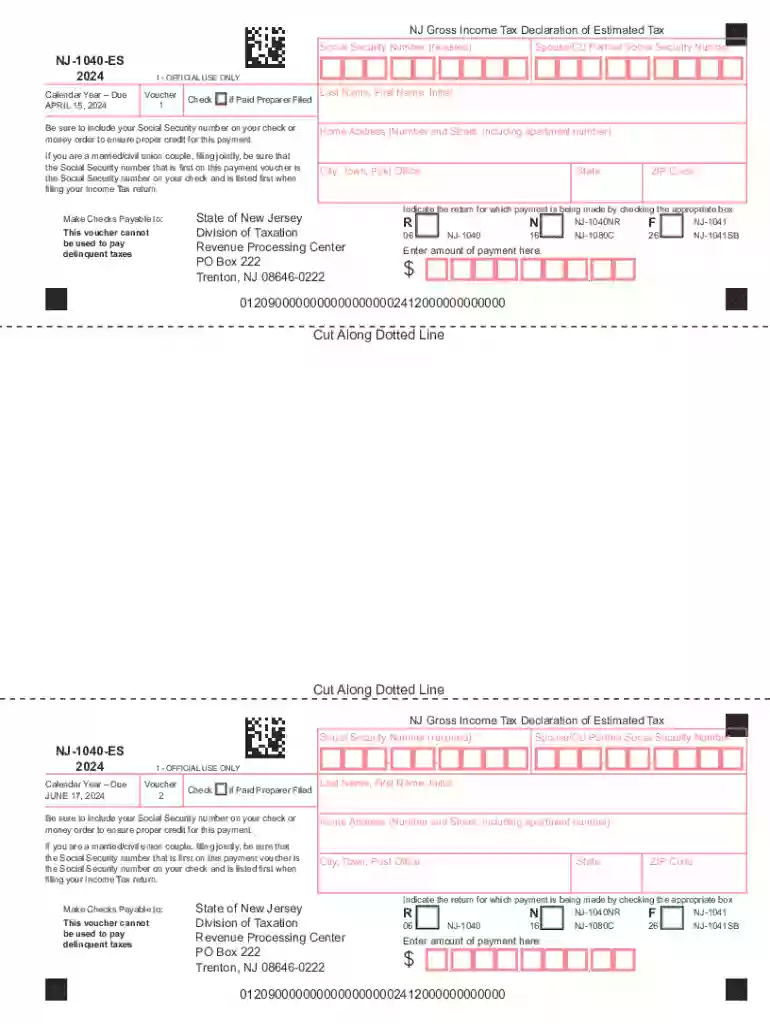
2024 NJ Gross Income Tax Declaration of Estimated Tax, form NJ-1040-ES 2024 NJ Gross Income Tax Decl-2026

Get Form
2024 NJ Gross Income Tax Declaration of Estimated Tax, form NJ-1040-ES 2024 NJ Gross Income Tax Decl Preview on Page 1

Here's how it works

01. Edit your form online
Type text, add images, blackout confidential details, add comments, highlights and more.

02. Sign it in a few clicks
Draw your signature, type it, upload its image, or use your mobile device as a signature pad.

03. Share your form with others
Send it via email, link, or fax. You can also download it, export it or print it out.

Definition & Meaning

The 2024 NJ Gross Income Tax Declaration of Estimated Tax, form NJ-1040-ES for the year 2024, serves as a vital instrument for taxpayers in New Jersey who anticipate owing gross income tax during the year. Its primary function is to assist taxpayers in estimating and declaring their expected tax liabilities throughout the year, thereby enabling compliance with state tax obligations. This form is essential for those who do not have tax withheld through payroll deductions, such as self-employed individuals or those receiving substantial income from other sources.

How to Use the NJ-1040-ES 2024 Form

Utilizing the NJ-1040-ES involves a multi-step approach:

  1. Estimate Taxable Income: Begin by determining your expected gross income for the year, including wages, investment income, and other earnings.
  2. Calculate Estimated Tax Due: Use the current tax rates and brackets defined by the New Jersey Division of Taxation to calculate the tax owed.
  3. Schedule Payments: Divide the total estimated tax into four payments, due quarterly. This helps in managing cash flow and ensuring full compliance by the end deadline.
  4. Submit Payment Vouchers: Fill out each payment voucher accurately and include it with your payment. Ensure amounts are correct to avoid penalties.

How to Obtain the Form NJ-1040-ES

Accessing the NJ-1040-ES form is a straightforward process:

  • Online Download: The form can be downloaded directly from the New Jersey Division of Taxation's official website.
  • Request by Mail: You can also request a physical copy by contacting the taxation office, which can be mailed directly to your address.
  • Pick-up Locations: Visit a local taxation office or public library in New Jersey where forms are often available.

Steps to Complete the NJ-1040-ES Form

Each step in completing the NJ-1040-ES requires careful attention to detail:

  1. Personal Information: Begin by entering your name, Social Security number, and home address.
  2. Determine Tax Period: Indicate the specific tax period for which the estimated payment is being made.
  3. Estimate Taxable Income: Provide an accurate estimate of your gross income for the tax year.
  4. Calculate Estimated Tax: Using the state’s tax tables, compute the estimated tax based on your income.
  5. Fill Payment Vouchers: Complete each payment voucher with the correct amounts and submission dates.

Practical Example:

A self-employed consultant earning fluctuating income throughout the year should project annual income, calculate estimated quarterly tax, and ensure each voucher accompanies the respective payment.

Filing Deadlines / Important Dates

Adhering to deadlines is crucial to avoid penalties:

  • April 15, 2024: First quarter payment due
  • June 17, 2024: Second quarter payment due
  • September 16, 2024: Third quarter payment due
  • January 15, 2025: Final quarter payment due

Missing these dates can result in interest and penalties, emphasizing timeliness and accurate payment scheduling.

Required Documents

Before completing the NJ-1040-ES, gather the following documents:

  • Previous Tax Returns: Useful for estimating current year income.
  • Income Statements: W-2s, 1099s for freelancers, and other proof of income.
  • Tax Rate Tables: Current year tables to aid in tax computation.

Penalties for Non-Compliance

Failing to comply with the NJ-1040-ES filing and payment requirements may lead to:

  • Interest Charges: On unpaid taxes past the due date.
  • Late Payment Penalty: A percentage of underpayment or late payment, compounded monthly.
  • Underpayment Estimates: Inaccurate estimates can lead to penalties; hence, make realistic income assessments.

Taxpayer Scenarios

Various taxpayer scenarios highlight the form’s versatility:

  • Self-Employed Individuals: With no automatic tax withholding, using the NJ-1040-ES ensures quarterly obligations are met.
  • Entrepreneurs: Small business owners use the form to organize tax liabilities effectively.
  • Investors: Those who earn significant dividend or interest income can calculate expected tax obligations appropriately.

In each scenario, accurately forecasting annual taxable income is key to using the NJ-1040-ES successfully.


decoration image ratings of Dochub
be ready to get more

Complete this form in 5 minutes or less

Get form

Got questions?

We have answers to the most popular questions from our customers. If you can't find an answer to your question, please contact us.
Contact us
Factors like your income level, filing status, residency, and available deductions or credits will determine how much you owe. While New Jerseys top rates are among the highest in the country, the state also offers several tax credits and deductions to help lower your bill.
2024 New Jersey Estimated Tax Form NJ-1040-ES. The 2024 Form NJ-1040-ES is used for making estimated tax payments for New Jersey income tax. This form is essential for residents and nonresidents who expect to owe more than $400 in taxes. It helps taxpayers manage their tax liabilities throughout the year.
However, if you do not have withholdings (or enough withholdings) taken out of a paycheck, you may have to make estimated payments. If you estimate that you will owe more than $400 in New Jersey Income Tax at the end of the year you are required to make estimated payments.
If you estimate that you will owe more than $400 in New Jersey Income Tax at the end of the year you are required to make estimated payments. Failure to make required estimated payments could result in additional interest when you file your New Jersey Income Tax return.
In most cases, to avoid a penalty, you need to make estimated tax payments if you expect to owe $1,000 or more in taxes for the yearover and above the amount withheld from your wages or other income.

Security and compliance

At DocHub, your data security is our priority. We follow HIPAA, SOC2, GDPR, and other standards, so you can work on your documents with confidence.

Learn more
ccpa2
pci-dss
gdpr-compliance
hipaa
soc-compliance
be ready to get more

Complete this form in 5 minutes or less

Get form

People also ask

Tips for Avoiding Penalties Make timely payments: Ensure you make payments by the due dates to avoid penalties and interest. Accurate estimates: Make accurate estimates of your tax liability to avoid underpayment penalties. Keep records: Keep records of your payments and tax returns in case of an audit.
If the amount of income tax withheld from your salary or pension is not enough, or if you receive income such as interest, dividends, alimony, self-employment income, capital gains, prizes and awards, you may have to make estimated tax payments.
To order State of New Jersey tax forms, call the Divisions Customer Service Center (609-292-6400) to request income tax forms and instructions. To obtain State of New Jersey tax forms in person, make an appointment to visit a Division of Taxation Regional Office.

Related links