






Definition and Meaning
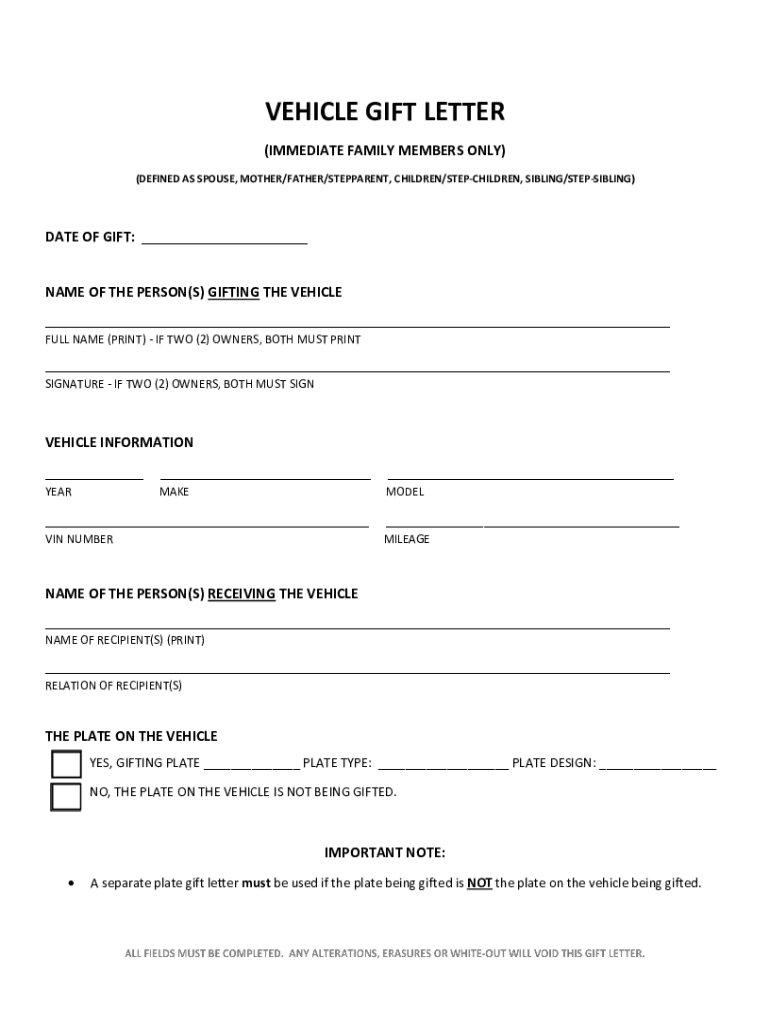
A Gift Letter for Car is a formal document used to transfer ownership of a vehicle from one individual to another as a gift without any exchange of money. This letter is important for legal and tax purposes, as it confirms that the vehicle was transferred as a gift and not through a sale. It typically includes the names of the giver and recipient, the vehicle's details, and pertinent information about the gift transaction such as the date and any conditions of the transfer.
Key Elements of the Gift Letter for Car
- Giver and Recipient Details: Names, addresses, and contact information of both parties.
- Vehicle Information: Year, make, model, vehicle identification number (VIN), and current mileage.
- Date of Gift: Clearly specify the date when the vehicle is being transferred as a gift.
- Signatures: Both the giver and recipient need to sign and date the letter to validate the transfer.
- License Plate Information: Indicate whether the license plate is included in the gift.
Legal Use of the Gift Letter for Car
The document ensures the transaction is legally recognized and helps in preventing any potential disputes regarding the ownership transfer. It may also assist in waiving state sales tax, as many states exempt vehicle gifts from sales tax if the relationship between the giver and recipient meets specific criteria. Always check local laws to confirm any additional legal requirements or exemptions.
Who Typically Uses the Gift Letter for Car
This type of letter is primarily used by family members who gift vehicles to one another. It is common among parents transferring cars to their children, siblings gifting a vehicle, or relatives helping each other out. It is also used in charitable situations where a vehicle is donated to a non-profit organization.


Steps to Complete the Gift Letter for Car
- Prepare the Document: Start with a blank document or a template for a gift letter.
- Include All Necessary Information: Fill in details regarding the giver, recipient, vehicle, and transaction.
- Review for Accuracy: Check all included information for correctness, especially the vehicle details and parties involved.
- Sign the Document: Both parties should sign and date the letter to make it legally binding.
- Notarization: While not always required, notarizing the letter could further legitimize the transaction in some states.
- Share Copies: Both the giver and recipient should retain copies, and additional copies may be needed for registration and tax purposes.
State-Specific Rules for Gift Letter for Car
Each U.S. state might have different requirements regarding vehicle gift transactions:
- Sales Tax Exemption: Several states require proof of family relationship for tax exemption.
- Notarization: Some states may require the letter to be notarized to be valid.
- Additional Forms: States might require accompanying forms for registration or to claim tax exemption.
Always verify with local DMV or tax authorities to comply with state-specific rules.
IRS Guidelines Related to Vehicle Gifts
The IRS considers a vehicle given as a gift to be non-taxable for the recipient, but the giver may need to file a gift tax return if the vehicle's fair market value exceeds the annual exclusion limit. Review IRS regulations or consult a tax professional to ensure compliance in reporting the gift, especially if it exceeds the current exclusion limits.
Required Documents for the Gift Letter for Car
- Gift Letter: Completed and signed document.
- Title Transfer: Updated title showing change of ownership.
- Local DMV Forms: State-specific forms might be required for registration.
- Proof of Family Relationship (if applicable): Documents that verify the relationship between giver and recipient for tax exemption purposes.
Ensure all documents are completed accurately to facilitate smooth processing of the gift transaction.