
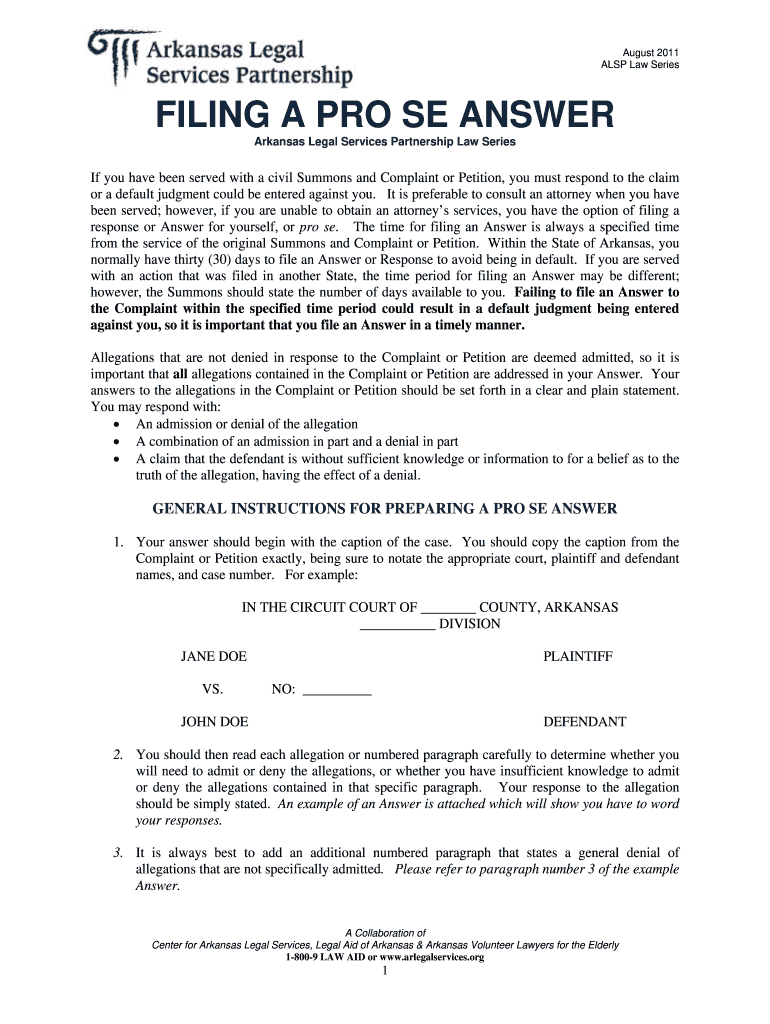







Definition and Meaning of the Arkansas Answer to Complaint Form
The Arkansas answer to complaint form is a legal document submitted in response to a civil complaint filed in an Arkansas court. This form serves as the defendant’s official response and is essential for addressing the allegations made against them. It allows the defendant to admit or deny the claims presented in the complaint and to assert any relevant defenses or counterclaims.
Understanding the form's importance is vital to avoid a default judgment, which can occur if the defendant fails to respond within the specified timeline. As such, timely and accurate filing is crucial in protecting the defendant's legal rights.
Steps to Complete the Arkansas Answer to Complaint Form
- Review the Complaint: Thoroughly read the complaint to understand the allegations and claims made against you.
- Gather Information: Collect any necessary evidence, documents, or statements that relate to the allegations.
- Draft Your Response:
- Admission or Denial: For each allegation in the complaint, explicitly state whether you admit or deny the claim.
- Defenses: Outline any defenses you may have against the allegations.
- Counterclaims: If applicable, include any counterclaims you wish to make against the plaintiff.
- Follow Formatting Guidelines: Ensure the document adheres to court requirements concerning format, including caption, title, and signature.
- Sign and Date the Form: Sign the answer to verify authenticity and include the date of submission.
Providing clear and specific responses helps maintain the integrity of the legal proceedings.
Key Elements of the Arkansas Answer to Complaint Form
- Caption: This includes the court’s name, names of the parties involved, and the case number.
- Introduction: A brief section that identifies the purpose of the document and who is filing it.
- Responses to Allegations: Clearly structured responses that either admit, deny, or explain each specific allegation presented in the complaint.
- Defenses: Section to outline any affirmative defenses that might apply, such as claims of lack of jurisdiction or failure to state a claim.
- Counterclaims: If the defendant wishes to file any claims against the plaintiff, this section provides a structured space to do so.
- Signature Block: Signed by the defendant or their attorney, including the contact information of the signing party.
Understanding and accurately completing these elements is vital to ensure the document is legally valid and effectively communicates your position.
State-Specific Rules for the Arkansas Answer to Complaint Form
Different jurisdictions may have specific rules regarding the filing of answers to complaints. In Arkansas, the following points must be considered:
- Filing Deadline: Defendants have thirty days from the date of service to respond to the complaint to avoid default judgment. Timely or timely responses must be adhered to strictly.
- Format Requirements: The answer must comply with local court rules regarding document formatting, including font type, margin size, and numbering.
- Submission Methods: Answers can be submitted either in hard copy to the courthouse or electronically, depending on the court's policies.
Understanding these rules is crucial for ensuring that the answer is accepted by the court and does not lead to unintended consequences.
Important Terms Related to the Arkansas Answer to Complaint Form
- Defendant: The person or entity being accused in the civil complaint.
- Plaintiff: The party filing the complaint and seeking relief from the defendant.
- Default Judgment: A ruling in favor of one party due to the failure of another party to respond or defend itself properly in court.
- Affirmative Defense: A defense that admits the facts alleged in the complaint but adds additional facts that justify or excuse the defendant's conduct.
- Counterclaim: A claim made by the defendant against the plaintiff in response to the original complaint.
Familiarity with these terms is important in navigating court procedures effectively.
Examples of Using the Arkansas Answer to Complaint Form
In practice, utilizing the Arkansas answer to complaint form can vary based on individual circumstances:
-
Example Scenario 1: A business receives a complaint about a breach of contract. In its answer, the business admits to some facts but denies others, and asserts an affirmative defense claiming that the plaintiff did not fulfill their contractual obligations.
-
Example Scenario 2: An individual faces a personal injury lawsuit claiming negligence. The defendant’s answer outlines their denial of the allegations and includes a counterclaim for damages incurred as a result of the plaintiff's actions.
These examples illustrate how the form can be tailored to fit various legal circumstances while ensuring compliance with necessary protocols.
Filing Deadlines for the Arkansas Answer to Complaint Form
Understanding filing deadlines is crucial in legal proceedings. In Arkansas:
- General Rule: The answer must be filed within thirty days after being served with the complaint. Failing to meet this deadline can result in a default judgment against the defendant.
- Extension Requests: In certain situations, defendants may file a motion for an extension before the deadline expires, but such requests are subject to court approval and specific requirements.
Being aware of these deadlines ensures that defendants can adequately defend themselves against claims.




