




01. Edit your confession judgment online
Type text, add images, blackout confidential details, add comments, highlights and more.

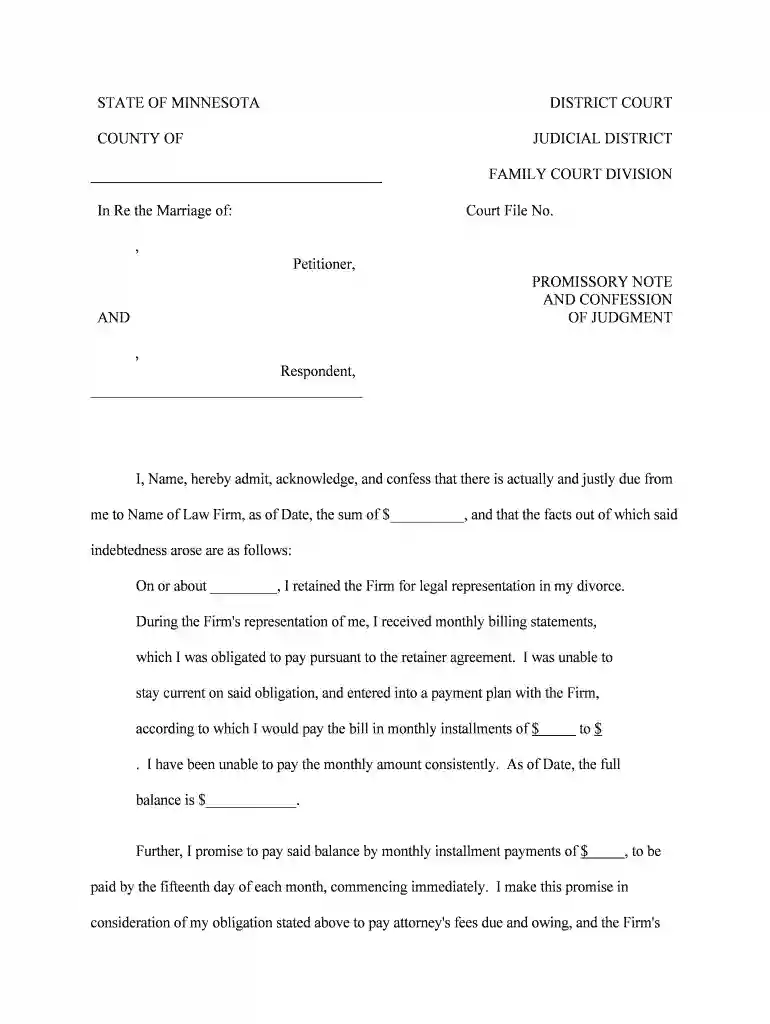
Type text, add images, blackout confidential details, add comments, highlights and more.

Draw your signature, type it, upload its image, or use your mobile device as a signature pad.

Send minnesota confession via email, link, or fax. You can also download it, export it or print it out.
A Minnesota Confession of Judgment is a legal document used in the state of Minnesota as part of a debt settlement process. This document enables a debtor to acknowledge a debt owed to a creditor and permits the court to enter a judgment against the debtor without initially requiring a full court proceeding. The confession is typically utilized in situations where a debtor admits to the debt and agrees to a repayment plan but is at risk of defaulting on payments. Upon signing, the creditor can enforce the judgment if the debtor fails to abide by the payment terms agreed upon in the document.
To effectively utilize a Minnesota Confession of Judgment, both parties must understand its function and agree on its terms. The document serves as a formal acknowledgement of debt and an agreement for a repayment plan. Here are the key steps involved:
Agreement on Terms: Both the debtor and creditor need to negotiate and agree on the repayment plan's terms, including the total amount, interest rate if applicable, and payment schedule.
Drafting the Document: The Minnesota Confession of Judgment must be meticulously drafted, specifying the debt amount and the circumstances under which the creditor can enter judgment against the debtor.
Signing: The debtor must sign the document willingly, often before a notary, to legitimize the agreement.
Court Filing: The creditor typically files the document with the court to secure the right to enter judgment if the debtor defaults on the payment plan.
Obtaining a Minnesota Confession of Judgment involves several steps to ensure legal compliance and mutual agreement between the involved parties. Here's a breakdown of the process:
Engage Legal Counsel: It is advisable for both parties to engage with legal counsel to understand their rights and responsibilities fully.
Negotiation and Drafting: The creditor and debtor negotiate the terms, which are then documented in a formal agreement. This document should clearly outline the payment plan and conditions for judgment.
Signing and Notarization: The document must be signed by the debtor and notarized to confirm the debtor’s voluntary consent to the terms.
Court Procedures: For the creditor to secure a legal right to enforce the judgment, the document should be filed with the appropriate Minnesota court.
Completing a Minnesota Confession of Judgment requires careful attention to legal protocol and mutual agreement. Here are the essential steps:
Draft the Document: Clearly outline the debt amount, payment terms, and any conditions under which the creditor may exercise judgment rights.
Review by Legal Counsel: Both parties should seek legal advice to ensure the document's enforceability and fairness.
Get the Agreement Signed and Notarized: A notary public should witness the debtor's signature to validate the confession of judgment.
File with Court: The creditor should file the notarized document with the court to ensure it’s recognized and enforceable if needed.
Understanding specific terms related to the Minnesota Confession of Judgment is crucial for both legal parties:
Debtor: The individual or entity who owes the debt and acknowledges the obligation through the confession of judgment.
Creditor: The individual or entity to whom the debt is owed, who holds the right to enter judgment upon the debtor's default.
Judgment: A legal decision by a court recognizing the valid debt and specifying actions for satisfaction if the debtor defaults.
Default: Failure of the debtor to make agreed-upon payments, triggering the creditor's right to seek court judgment.
Minnesota imposes specific legal rules governing the use and enforceability of a Confession of Judgment:
Voluntary Participation: The debtor must voluntarily sign the confession, ensuring no coercion or undue influence.
Notarization Requirement: To be enforceable, the confession must be notarized, confirming the debtor’s knowledgeable consent.
Court Filing: The filed confession must adhere to Minnesota court standards ensuring the creditor's ability to pursue judgment.
The legal use of a Minnesota Confession of Judgment centers on providing an efficient resolution to debt settlement:
Creates a Binding Agreement: Serves as a formal acknowledgment of debt and prevents further disputes regarding the amount owed.
Enforceable by Law: Once filed, allows creditors to bypass lengthy litigation in enforcing payment collections upon default.
Flexible for Both Parties: Encourages negotiated repayment plans tailored to the debtor's financial situation, reducing litigation costs.
The Minnesota Confession of Judgment includes several critical elements ensuring its proper function and enforceability:
Debt Acknowledgment: Clear identification of the debt amount, source, and acknowledgment by the debtor.
Repayment Terms: Specifics of the agreed payment schedule, including deadlines and acceptable methods of payment.
Judgment Conditions: Conditions under which the creditor may seek judgment, often triggered by payment default.
Various parties may resort to a Minnesota Confession of Judgment as part of debt management solutions:
Law Firms: Often use these documents in cases involving outstanding legal fees where mutual agreement can be easily reached.
Businesses and Individuals: Business owners and individual debtors experiencing temporary financial strain may use them to avoid litigation while managing repayment.
Divorce Settlements: Parties dealing with divorce settlements and asset division sometimes find these confessions an effective tool for clear resolution of debt obligations.
This content comprehensively covers each aspect of the Minnesota Confession of Judgment, providing practical and in-depth insights aimed at anyone considering this legal tool for debt management purposes.


We've got more versions of the confession judgment form. Select the right confession judgment version from the list and start editing it straight away!
| Versions | Form popularity | Fillable & printable |
|---|---|---|
| 2020 | 4.5 Satisfied (37 Votes) |
At DocHub, your data security is our priority. We follow HIPAA, SOC2, GDPR, and other standards, so you can work on your documents with confidence.


