Partnership dissolution 2026

Get Form
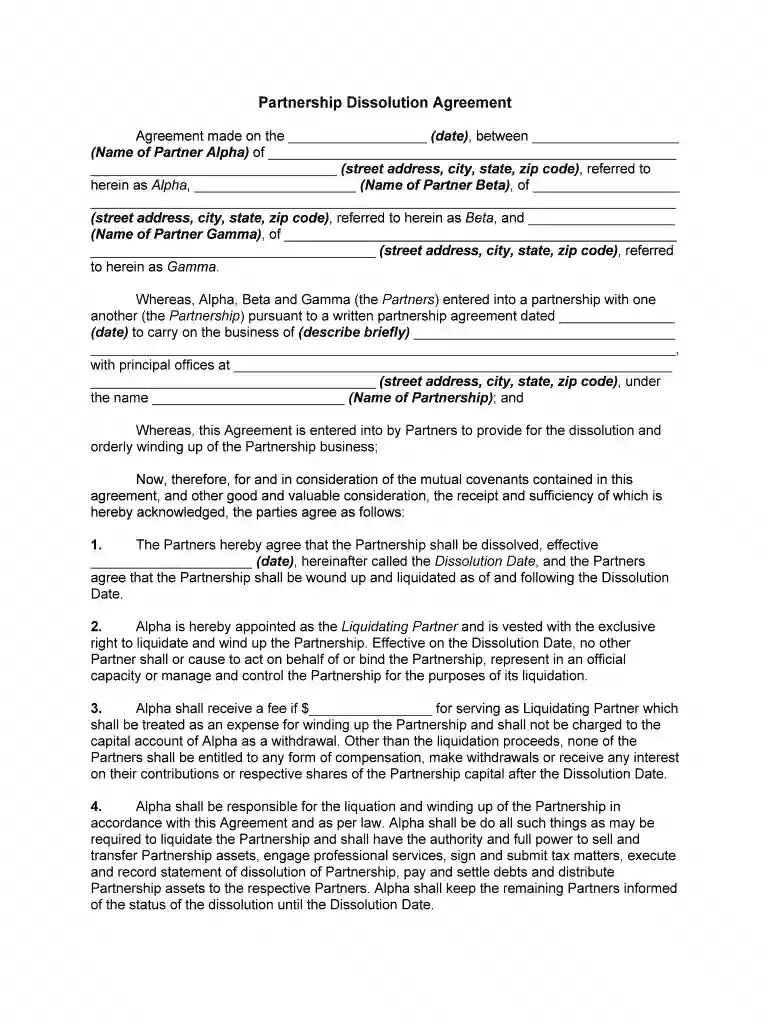
dissolation agreement form Preview on Page 1

Here's how it works

01. Edit your dissolation agreement form online
Type text, add images, blackout confidential details, add comments, highlights and more.

02. Sign it in a few clicks
Draw your signature, type it, upload its image, or use your mobile device as a signature pad.

03. Share your form with others
Send dissolution of partnership via email, link, or fax. You can also download it, export it or print it out.

Definition and Meaning of Partnership Dissolution

Partnership dissolution refers to the process by which a partnership, a legal business relationship between two or more parties, is terminated or dissolved. This process involves concluding the partnership's business activities, settling its obligations, and distributing any remaining assets among the partners. It's a formal procedure that typically requires documentation to ensure that each partner's rights and responsibilities are addressed comprehensively. A Partnership Dissolution Agreement often outlines the effective date of the dissolution, assigns roles such as the Liquidating Partner, and provides a framework for asset and liability distribution.

Key Components of Partnership Dissolution

  • Effective Date: Specifies when the dissolution comes into effect.
  • Liquidating Partner: One partner, often called the Liquidating Partner, is appointed to handle the winding up of the partnership’s affairs.
  • Distribution: Details on how assets and liabilities are divided among the partners.
  • Indemnification and Arbitration: Includes provisions to protect partners from certain legal liabilities and outlines methods for dispute resolution.

By understanding the meaning and components of partnership dissolution, partners can ensure they navigate the dissolution process smoothly and equitably.

Steps to Complete a Partnership Dissolution

Completing a partnership dissolution requires several important steps to ensure a smooth transition. It's crucial to adhere to these steps meticulously to fulfill all legal and financial obligations.

Step-by-Step Process

  1. Review the Partnership Agreement: Begin by reviewing the existing partnership agreement, which may include clauses regarding dissolution procedures.

  2. Agree on the Terms: Partners should mutually agree on the terms of dissolution, including how to handle outstanding debts and distribute any remaining assets.

  3. Draft a Partnership Dissolution Agreement: Create a formal document detailing the dissolution terms, including roles, responsibilities, and timelines.

  4. Notify Creditors and Stakeholders: Inform all relevant parties, such as creditors, employees, and stakeholders, of the impending dissolution.

  5. Settle Obligations: Pay off any debts and liabilities. The Liquidating Partner may handle this task as part of winding up the business.

  6. Distribute Assets: Upon settling obligations, distribute any remaining assets as per the dissolution agreement.

  7. File Necessary Documentation: Submit any required state-specific dissolution forms to relevant authorities to legally dissolve the partnership.

Each step involves careful documentation and may require legal advice to ensure compliance with state regulations and protect partners’ interests.

Who Typically Uses a Partnership Dissolution

A variety of business entities and individuals may need to use a partnership dissolution, based on their business needs and relationships.

Applicable Business Entities

  • General Partnerships: Partners in a general partnership often use dissolution agreements to conclude business relationships.
  • Limited Partnerships: Both general and limited partners in a limited partnership can engage in this process.
  • Joint Ventures: Parties involved in a joint venture may require dissolution agreements upon project conclusion.

User Scenarios

  • Retirement of a Partner: When one partner retires and the remaining partners choose not to continue the partnership.
  • Dispute Resolution: When partners are unable to resolve conflicts and decide to terminate the partnership.
  • Strategic Realignment: When business strategies require restructuring in a way that a new partnership or business model is more favorable.

Understanding who might use a partnership dissolution helps tailor the process to the specific needs and legal requirements of those entities and individuals.

Legal Use of the Partnership Dissolution

The partnership dissolution process involves several legal considerations to prevent liabilities and ensure all obligations are met.

Legal Framework

  • State Laws: Different states have specific requirements for partnership dissolution, affecting filing procedures and timelines.
  • Contractual Obligations: Ensure all contractual obligations are addressed within the dissolution agreement.
  • Dispute Resolution: Include arbitration or mediation clauses to resolve potential disputes post-dissolution legally.

Legal Documentation

  • Dissolution Agreement: The core legal document that outlines all dissolution terms.
  • Compliance Filings: Includes any necessary filings with state business entities or tax authorities.

Navigating the legal use of partnership dissolution ensures that all parties are protected and the dissolution is recognized as valid by relevant authorities.

Key Elements of a Partnership Dissolution Agreement

A critical part of dissolving a partnership is forming a robust dissolution agreement that addresses all necessary considerations.

Main Components

  • Partnership Overview: Clear identification of the partnership and its existing obligations.
  • Roles and Responsibilities: Identification of the partner responsible for liquidating assets and settling debts.
  • Indemnification Clauses: Provisions to protect partners against certain liabilities.
  • Final Accounting: Comprehensive overview of final financial statements and distributions.

Through an in-depth examination of these key elements, partners can ensure a comprehensive and fair dissolution process.

Required Documents for Partnership Dissolution

Ensuring the proper documents are prepared and submitted is crucial for a successful partnership dissolution.

Essential Documentation

  • Dissolution Agreement: Legal document outlining the dissolution terms.
  • State Filing Forms: Specific documents required by state authorities to officially dissolve the partnership.
  • Notices to Creditors: Written notifications to creditors about the partnership's dissolution.
  • Tax Documents: Final filing of partnership tax returns and distribution statements.

Maintaining precise records and documentation helps prevent potential future disputes and ensures compliance with both state and federal requirements.

State-Specific Rules for Partnership Dissolution

Each state in the U.S. can have unique rules and requirements when it comes to dissolving a partnership, which can impact the dissolution process significantly.

Differences Across States

  • Filing Requirements: Some states require formal notice of dissolution via specific forms, while others incorporate dissolution steps directly into their legal codes.
  • Publication of Intent: Certain states mandate the publication of intent to dissolve in a local newspaper.
  • Notice Periods: Timeframes for notifying creditors and other stakeholders may vary.

Understanding these state-specific rules is crucial for compliance and for ensuring the dissolution is effective and recognized legally.

be ready to get more

Complete this form in 5 minutes or less

Get form

Got questions?

We have answers to the most popular questions from our customers. If you can't find an answer to your question, please contact us.
Contact us
Under section 704(c)(1)(B), a partner who contributes appreciated property to a partnership may be required to recognize gain on the distribution of the property to another partner within seven years of its contribution to the partner- ship.
Procedure: Mutual consent. By agreement in accordance with partnership deed. Compulsory dissolution on account of death, insolvency or illegality of business. Courts order if a partner becomes mentally incapable or guilty of misconduct.
Dissolving a partnership firm means discontinuing the business under the name of the said partnership firm. In this case, all liabilities are finally settled by selling off assets or transferring them to a particular partner, settling all accounts that existed with the partnership firm.
Notify clients, customers, and suppliers: To preserve your business relationships, it is important to promptly notify clients, customers, suppliers, and others about your partnership dissolution. You may also need to negotiate how you plan to fulfill existing contractual obligations and/or terminate existing contracts.
By courts decree- A partner can demand partnership dissolution, and the law will allow the dissolution only under this conditions: a partners incapability to work; bdocHub of the agreement by a partner; when a partner is mentally unstable; and the misbehaviour of a partner that impacts the partnership.

Security and compliance

At DocHub, your data security is our priority. We follow HIPAA, SOC2, GDPR, and other standards, so you can work on your documents with confidence.

Learn more
ccpa2
pci-dss
gdpr-compliance
hipaa
soc-compliance

People also ask

In the context of partnership law, dissolution is a fundamental change of the relations among partners in a partnership, ending a governance-type relation among the partners in the partnership. Generally, the death of a partner operates as a dissolution of a partnership.
One of the primary legal consequences of dissolution is the potential for legal disputes. Partners may have disagreements over the division of assets, settlement of debts, or the interpretation of partnership agreements.

partnerships dissolution form for north carolina